
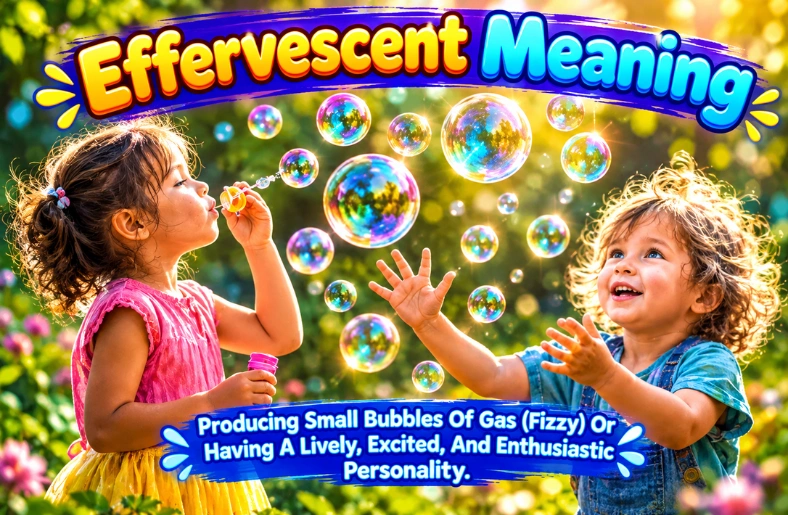
Effervescent Meaning in simple words is “full of bubbles” or “full of excitement and energy.”
Words can feel like magic. One small word can carry so many pictures inside it: bubbles rising in a soda, or a friend who is always cheerful. This page looks closely at one such lovely word, effervescent. Every part of it is explained here: its meaning, its sound, its word family, its history, and many easy examples, so the word feels fully clear by the end.
Quick Stats : Effervescent Meaning
| Point | Detail |
|---|---|
| Word / Term | Effervescent |
| Part of Speech | Adjective |
| Meaning | Bubbly, fizzy, or full of lively energy |
| Definition | Giving off small bubbles of gas, or showing bright and happy energy |
| Origin / Language | From Latin, through English |
| Pronunciation | eff-er-VES-ent |
| Syllables | 4 (ef-fer-ves-cent) |
| Word Family | effervesce, effervescence, effervescently |
| Synonyms | bubbly, fizzy, lively, sparkling, vivacious |
| Antonyms | flat, dull, lifeless, gloomy |
| Example Sentence | The effervescent drink made small bubbles pop on her tongue. |
| Category | Word Meaning |
Disclaimer: Word meanings can vary slightly by dictionary and context. Please treat this page as general information and confirm exact usage with a standard English dictionary if needed.
Effervescent Definition
Effervescent is a describing word (an adjective). It carries two close but different meanings, and both come from the same idea of “bubbling up.”
- It describes a liquid that makes small bubbles of gas, like soda, sparkling water, or a fizzy tablet dropped into water.
- It describes a person, a mood, or an event that is cheerful, bright, and full of happy energy, the kind that makes a room feel lighter.
Dictionaries usually list the first meaning as the original, scientific sense, and the second meaning as a figurative sense that grew out of it. (please verify wording against a standard dictionary)
Effervescent Meaning in Detail
The effervescent meaning always points to something rising or bubbling, either real bubbles in a drink or a bubbly, happy feeling in a person. When someone says a drink is effervescent, they mean it fizzes with tiny bubbles that keep forming and rising to the top. When someone says a person is effervescent, they mean that person is full of joy and energy, almost like happiness is bubbling out of them without effort.
This double meaning is what makes the word so rich and useful. A student can use effervescent to describe a can of soda on a hot afternoon, and also use the very same word to describe a favourite teacher who always walks into class with a smile and a bright voice. Both uses share the same root feeling: something lively rising up and spreading outward.
In science classes, effervescent is often used for chemical reactions that release gas bubbles, such as when a fizzy tablet meets water. In everyday talk, effervescent is often used for people, personalities, parties, or performances that feel full of life.
Pronunciation
The word effervescent is said like this: eff-er-VES-ent. The stress, or the loud part, falls on “VES.” Say it slowly first, one small piece at a time: eff, er, VES, ent. Then join the pieces and say it a little faster until it feels smooth and natural.
A simple way to practise: clap once for each part of the word while saying it out loud. Four claps, four parts, one stressed beat on “VES.”
Word Origin
Effervescent comes from an old Latin word that means “to boil up” or “to bubble out.” The Latin prefix meant “out” or “forth,” and it joined with a root meaning “to boil.” Over time, English borrowed this idea and used it first for liquids that bubble, and later for people or moods that seem to bubble over with energy. (please verify against a standard dictionary or etymology reference)
Words with a similar Latin root often carry a sense of movement, rising, or overflow, which is why effervescent so naturally fits both fizzy drinks and joyful people.
Part of Speech
Effervescent is an adjective. An adjective is a word that describes a noun. It tells us more about a person, place, thing, or idea. In “the effervescent girl,” the word effervescent describes the girl. In “an effervescent drink,” it describes the drink.
The word also has a full family of related forms, each with its own job in a sentence:
- Effervesce (verb): to bubble, fizz, or show lively excitement. Example: The mixture began to effervesce in the glass.
- Effervescence (noun): the state or quality of bubbling or lively energy. Example: The effervescence of the drink surprised her.
- Effervescently (adverb): in a bubbly or lively way, describing how an action is done. Example: She spoke effervescently about her holiday.
Types of Effervescent Meaning
Although effervescent is one word, its meaning can be grouped into two simple types, which helps students choose the right sense in reading and writing.
- Literal Effervescent Meaning: This is about real, physical bubbles. It is used for liquids, chemical reactions, and fizzy tablets. Example: The effervescent tablet dissolved with a hiss of bubbles.
- Figurative Effervescent Meaning: This is about feelings, energy, and mood. It is used for people, personalities, performances, and atmospheres. Example: Her effervescent laughter filled the hallway.
Knowing these two types helps a reader quickly understand whether a sentence is talking about a drink or about a person’s happy energy.
Structure and Usage
Effervescent is used the same way most adjectives are used in English. It can sit in two common positions in a sentence.
- Before the noun: “the effervescent lemonade,” “an effervescent singer.”
- After a linking verb: “The drink is effervescent,” “She seems effervescent today.”
It does not change its form for singular or plural nouns, because adjectives in English usually stay the same. For example: “an effervescent tablet” and “many effervescent tablets” both use the same word, effervescent, without any change.
Explanation
Think of a glass of soda. When it is poured, tiny bubbles rush upward from the bottom to the top, and this keeps happening for a while. That rush of bubbles is called effervescence, and the drink itself is called effervescent. Even after the first big fizz settles, small bubbles keep rising slowly, which shows the drink is still effervescent.
Now think of a friend who laughs easily, talks with bright energy, and makes everyone around them smile. That friend can also be called effervescent, because their happy energy feels like it is bubbling up from inside them, spreading outward the same way bubbles spread through a fizzy drink. An effervescent person often talks with excitement, moves with energy, and brings cheer wherever they go.
So the word always carries the same core picture: something rising, bubbling, or sparkling, whether it is gas in a liquid or joy in a person. This shared picture is why the word feels so warm and positive, no matter which sense is used.
Examples
- The effervescent lemonade fizzed in the glass.
- Her effervescent smile lit up the classroom.
- The scientist watched the effervescent reaction in the beaker.
- He has an effervescent personality that makes friends easily.
- The effervescent tablet dissolved quickly in water.
- The singer’s effervescent energy filled the stage.
- Effervescent waves of laughter spread through the room.
- The bath bomb turned the water effervescent.
- Grandma’s effervescent spirit never seems to fade.
- The effervescent mineral water tickled his nose.
- The coach praised her effervescent attitude during practice.
- Bubbles from the effervescent medicine floated to the top.
- The party felt effervescent with music and laughter.
- The chemistry teacher explained why the mixture was effervescent.
- His effervescent mood made the long trip feel short.
- The effervescent host welcomed every guest with a big smile.
- Small effervescent bubbles rose from the pool tablet.
- The crowd’s effervescent cheer echoed through the stadium.
- Her effervescent nature made the study group fun and light.
- The soda can hissed as its effervescent bubbles escaped.
Sentence Examples
- The soda felt cold and effervescent on a hot day.
- She greeted everyone with an effervescent hello.
- The effervescent crowd cheered for the winning team.
- His effervescent energy never seemed to fade, even late at night.
- The effervescent tablet turned the plain water into a fizzy drink.
Real-life Examples
- Soft drinks, sparkling water, and soda are common effervescent liquids used every day.
- A cheerful host on a morning show is often described as effervescent because of their bright energy and easy smile.
- Fizzy vitamin tablets that dissolve in a glass of water are called effervescent tablets, and they are sold in most pharmacies.
- Bath bombs are made to be effervescent, releasing gentle bubbles and fizz once they touch water.
- A lively school event, full of music, colour, and happy noise, can be described as an effervescent atmosphere.
Common Mistakes
| Wrong | Right |
|---|---|
| The drink is effervescence. | The drink is effervescent. |
| She has an effervescently personality. | She has an effervescent personality. |
| He effervescent talks a lot. | He talks in an effervescently cheerful way. |
| The tablet effervescents in water. | The tablet effervesces in water. |
| An effervescent of bubbles rose up. | An effervescence of bubbles rose up. |
Tip: Effervescent is the describing word (adjective), effervescence is the naming word (noun), effervesce is the doing word (verb), and effervescently is the word used to describe an action (adverb). Keeping these four forms separate stops most common mistakes.
Tips to Remember
- Picture bubbles rising in a soda glass when this word is used.
- Link the word to happy, high-energy people to remember its second meaning.
- Break the word into small parts: ef-fer-VES-ent, and say it slowly.
- Remember that effervescent is always a describing word (adjective).
- Use the word family chart (effervesce, effervescence, effervescently) to pick the correct form.
- Connect the Latin root, “to boil up,” with the picture of bubbles boiling to the surface.
Synonyms
- Bubbly: full of bubbles or cheerful energy
- Fizzy: making small bubbles, like soda
- Sparkling: bright and lively, or full of bubbles
- Vivacious: full of life and high spirits
- Lively: full of energy and movement
Antonyms
- Flat: without bubbles or energy
- Dull: without brightness or excitement
- Lifeless: without energy or spark
- Gloomy: sad or without cheer
Similar or Confusing Words
- Effusive: showing feelings in a very open, overflowing way, close in feeling but not about bubbles.
- Ebullient: full of excitement, very close to the second meaning of effervescent.
- Carbonated: describes a drink with added gas, a simple word close to the first meaning.
- Exuberant: full of energy and high spirits, often used for people the same way as the figurative effervescent meaning.
Comparison Table
| Word | Main Use | Closest Meaning |
|---|---|---|
| Effervescent | Drinks and people | Bubbly or full of lively energy |
| Carbonated | Drinks only | Containing added gas bubbles |
| Ebullient | People only | Full of excitement and enthusiasm |
| Effusive | People’s feelings | Showing emotion in an open, overflowing way |
Key Takeaways
- Effervescent Meaning bubbly, fizzy, or full of lively energy.
- It can describe a drink with bubbles or a cheerful, energetic person.
- It is an adjective, and its word family includes effervesce, effervescence, and effervescently.
- The word has two types of meaning: literal (real bubbles) and figurative (happy energy).
- Common synonyms are bubbly, fizzy, sparkling, vivacious, and lively.
- Common antonyms are flat, dull, lifeless, and gloomy.
- The word comes from a Latin root meaning “to boil up.”
Read Also: Limerence Meaning
Conclusion
Effervescent Meaning is a bright, cheerful word. It paints a picture of bubbles rising in a drink, or joy rising in a person. Once the meaning, sound, word family, and examples of this word feel familiar, it becomes easy to use it correctly and confidently in both writing and speaking.
Frequently Asked Questions
1. What is the simple effervescent meaning?
It means bubbly or fizzy, like a soda. It can also mean a person who is cheerful and full of energy.
2. Is effervescent a positive word?
Yes. It is almost always used in a warm, happy way, either for a fizzy drink or a joyful person.
3. What part of speech is effervescent?
It is an adjective, a word that describes a noun.
4. What is the difference between effervescent and effervescence?
Effervescent describes something, like a bubbly drink. Effervescence is the naming word for the bubbling itself.
5. Can effervescent describe a person?
Yes. It often describes someone who is bright, cheerful, and full of lively energy.
