
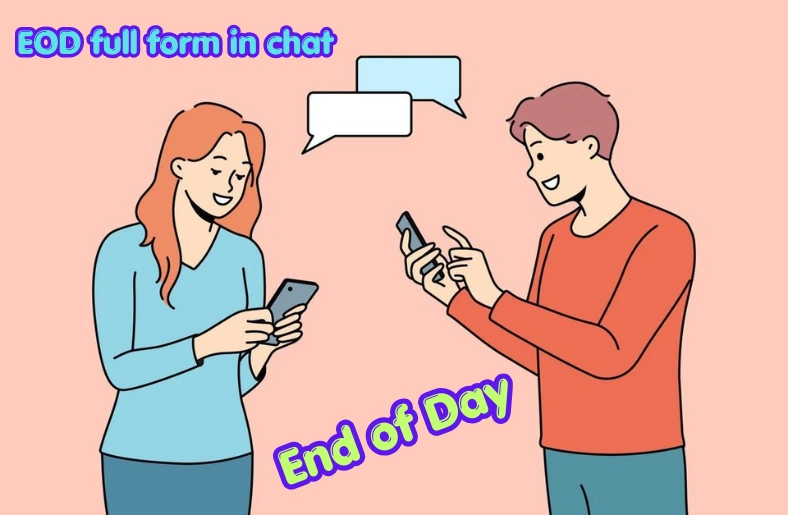
The EOD Full Form In Chat is End of Day, and it tells you that a task, reply, or file is needed before the day is over.
Have you seen the letters “EOD” in a work chat, a college group, or even a bank message and felt a little lost? Many people use this short form every single day, without ever saying the full words out loud.
This page gives you the full meaning in plain, simple words. You will see how it started, where it is used, and how it can shift a little from one place to another. By the end, you will know exactly when and how to use it, without any guessing.
Quick Stats : EOD
| Point | Detail |
|---|---|
| Word / Term | EOD |
| Part of Speech | Abbreviation (used like an adverb of time) |
| Meaning | End of Day |
| Definition | A short form used in chat to say a task must be done before the day ends |
| Full Form | End of Day |
| Also Called | Close of Business (in some offices) |
| Origin / Language | English, from office and business talk |
| Pronunciation | E-O-D (say each letter) |
| Synonyms | Close of Business, End of Business Day, COB, EOB |
| Example Sentence | “Please send the file EOD.” |
| Category | Full Form |
EOD Definition
This short form stands for three small words joined together into one quick tag. People add it to a message when they want a task finished before the working day closes.
It is quick to type, and it saves both the writer and the reader some time. Anyone in an office, a bank, or a chat group usually understands it the moment they see it, because it has become common across many kinds of writing.
EOD Full Form In Chat
The EOD Full Form In Chat is simple: End of Day. When a friend, a classmate, or a co-worker types this word, they mean “before today is over.”
It is one of the most common short forms used in chat apps, emails, and work messages, because it gets the point across in one small tag instead of three full words. You will see it in office group chats, college assignment groups, and even in casual texts between friends who are planning something for later that day.
Because chat apps favour short, fast typing, this term fits perfectly. A single sender can set a clear deadline without writing a long sentence, and the reader still understands the exact expectation.
EOD Meaning
The EOD Meaning is easy to remember once you break it down piece by piece. It shows that a job, a reply, or a file should be ready before the working day closes.
It does not always point to one fixed clock time, like 5 PM or 6 PM. It simply means “before this working day ends,” and the exact hour can shift depending on the office, the school, or the person who set the deadline.
Some readers treat it as a soft deadline, meaning “sometime today, when you get a chance.” Others treat it as a firm deadline, meaning “no later than closing time.” Because of this small gap, it always helps to check with the sender if the deadline feels unclear.
Pronunciation
Say each letter on its own: E-O-D (it sounds like “ee-oh-dee”). It is not read as one joined word, and it is not said like a normal English word with one smooth sound.
A common mistake is trying to blend the letters into a single sound. Keep a tiny pause between each letter, the same way you would say other short forms like ATM or PDF.
Word Origin And History
This short form grew out of office talk from many years ago. Long before chat apps existed, workers wrote “end of day” in full on paper notes, memos, and telegrams, because every word had to be written by hand or typed slowly.
As offices moved to typewriters, and later to fax machines and email, people looked for ways to save time and space. Writing three letters instead of three full words became a small but useful habit.
When mobile phones and chat apps became common, this habit moved with it. Texting on a small keypad made short forms even more valuable, and this three-letter tag became one of the most familiar ones in daily use, both at work and among friends.
Full Form Of EOD
| Letter | Stands For |
|---|---|
| E | End |
| O | Of |
| D | Day |
Part Of Speech
This short form works like an adverb of time inside a sentence. It answers the question “when,” in the same way words like “today” or “soon” do.
For example, in the sentence “Send it EOD,” the short form tells the reader when the task should be finished, not what the task is or who should do it.
EOD Full Form In Different Places
The short form does not always carry the exact same shade of meaning everywhere. Here is how it can shift a little across different fields.
EOD Full Form In Banking And EOD Full Form In Bank
In a bank, this term points to the closing of a working day’s records. Staff use it when all of that day’s transactions, deposits, and withdrawals are checked, added up, and locked before the next working day begins.
Bank systems often run a process at this point too. This process checks every entry from the day, matches numbers, and prepares clean records for the morning. Customers may notice that a transfer made late in the evening only shows up the next morning, because it gets counted in the next day’s batch instead of the same one.
EOD Full Form In Finance
In finance, people use it for prices, reports, or trades that are recorded at the close of the trading day. A finance team might say, “The EOD report will show today’s final numbers,” meaning the last price recorded before the market shuts for the day.
Investors and traders also watch this closing figure closely, because it often becomes the official number used for that day’s performance, rather than any price seen earlier in the day.
EOD Full Form In Company And EOD Full Form In Corporate
Inside a company, a manager may write, “Share the sheet EOD,” which means the sheet is due before office hours end that same day. This is one of the most common uses of the short form in daily corporate messages.
Teams often use it in project chats, task boards, and status updates, because it sets a clear, same-day expectation without needing a long explanation. It also helps managers track small tasks that do not need a formal deadline date.
EOD Full Form In College And EOD Full Form In Education
Teachers and students also use this short form, especially in online classes and assignment groups. A teacher might say an assignment is due “EOD Friday,” meaning before that Friday’s classes or school hours close.
Students use it among themselves too, for example when sharing notes or planning group work. “Send your part EOD” is a common line in a college project chat.
EOD Full Form Medical
In medical notes, letters can carry a different meaning, and this is one place where extra care is needed. On some prescriptions, these same three letters are short for “every other day,” a dosing pattern rather than a deadline word (please verify with a pharmacist or doctor, since medicine labels can differ by country and brand).
This means the very same three letters can point to a schedule (once every two days) in a medical setting, while pointing to a deadline (before today ends) in an office chat. Never guess a dose from a short form alone, and always ask a qualified professional to confirm.
EOD Full Form In Trading And IT
In stock trading software, this short form often appears next to a price or a batch job, meaning that number or process belongs to the close of that trading day. In IT and software teams, it can show up in ticket systems too, such as “fix this bug EOD,” setting a same-day target for developers.
EOD Full Form In Hindi
In Hindi, the same idea is written as “दिन के अंत तक” (din ke ant tak), which means “by the end of the day.” The English short form itself usually stays the same even when the rest of the sentence is written in Hindi, because it has become a familiar loan term in everyday chat.
EOD Full Form In English
In plain English writing, the correct way to write it out in full is “end of day,” written in small letters unless it starts a sentence. In the short form itself, capital letters are the common style in work messages.
How To Use It
You can add this short form at the end of a sentence, almost like a small tag, or you can place it right after the word “by” to make the deadline feel clearer.
- “Send it EOD.”
- “Please reply by EOD.”
- “The form is due EOD Monday.”
- “Can we close this EOD, if possible?”
Adding “by” before it, or a day name right after it, removes almost all confusion for the reader, because it turns a general idea into a clear, same-day target.
Why People Use Short Forms Like EOD
Chat messages move fast, and most readers skim rather than read every word slowly. A short form like this one lets the sender set a clear expectation without slowing the conversation down.
It also feels friendly and casual, which fits the tone of most chat apps better than a stiff, formal sentence. A short tag at the end of a message can carry a full instruction in just three letters, saving both typing time and reading time for everyone involved.
Examples
- “Can you finish the slides EOD?”
- “The manager wants the report EOD today.”
- “Please pay the bill by EOD Friday.”
- “The bank will close all entries EOD.”
- “Submit your homework EOD, please.”
- “I will send the invoice EOD, not later.”
- “Our team target is EOD tomorrow.”
- “The store closes stock counting EOD.”
- “Reply EOD so we can plan the next step.”
- “The teacher set the deadline as EOD Sunday.”
- “Finance will share the closing price EOD.”
- “Please confirm your seat EOD.”
- “The form must reach HR EOD.”
- “Upload the file EOD, thank you.”
- “The client asked for the quote EOD.”
- “Can you approve this EOD, before you log off?”
- “The support ticket needs a reply EOD.”
- “Please share your feedback EOD, if you can.”
- “The delivery team must confirm stock EOD.”
- “Let’s wrap this call EOD, at the latest.”
Real-Life Examples
Work chat: Priya sends a message to her colleague Aman: “Can you check my project file EOD?” Aman replies, “Sure, I will send my notes before the day ends.” Both understand the short form without any confusion, because it is common in daily office chat.
College chat: In a group project chat, Ritu types, “Guys, please send your slides EOD, so I can combine everything tonight.” One classmate replies, “Got it, sending mine in an hour.” Here, the short form quietly sets a shared, same-day goal for the whole group.
Common Mistakes
| Wrong | Right |
|---|---|
| “EOD tomorrow” with no date | “By EOD, Tuesday” (name the day clearly) |
| Writing it in small letters in a formal mail, like “eod” | Use capital letters, EOD, in work writing |
| Thinking it always means midnight | It usually means before office hours close, not midnight |
| Mixing it with the medical dosing sense without checking | Ask a doctor or pharmacist for the correct medical meaning |
| Using it in a very formal letter or report | Write “end of day” in full for formal writing |
| Assuming every office uses the exact same closing hour | Ask the sender if the deadline time feels unclear |
Tips To Remember
- Read it out loud as three letters, not one word.
- Picture a clock closing at the end of office hours.
- Pair it with a day name when the deadline could be unclear.
- Keep it for chat and work messages, not for formal essays.
- Ask a doctor before reading it as a medicine dosing term.
- Check your own office’s usual closing hour if you are new to a team.
Synonyms
- Close of Business (COB): the point when office work stops for the day.
- End of Business Day: a longer, formal way to say the same thing.
- EOB: a shorter cousin of COB, used the same way.
- End of Day: the plain, full meaning behind the short form itself.
- Day’s End: a simple, everyday phrase with the same idea.
- Before Closing Time: a plain sentence version of the same deadline.
Similar Or Confusing Words
- EOD vs COB: both point to the close of the working day, and many offices use them to mean the same thing.
- EOD vs EOW: EOW means “end of week,” a longer deadline than a single day.
- EOD vs ASAP: ASAP means “as soon as possible,” which can be sooner than the end of the day.
- EOD vs TBD: TBD means “to be decided,” which is not a deadline at all, but an open question.
- EOD vs SOD: SOD means “start of day,” the opposite point on the same working day.
Comparison Grid
| Short Form | Full Form | Time Frame |
|---|---|---|
| EOD | End of Day | Before today’s work hours close |
| COB | Close of Business | Same as EOD in most offices |
| EOW | End of Week | Before the work week closes |
| ASAP | As Soon As Possible | Right away, no fixed hour |
| SOD | Start of Day | The beginning of the working day |
| TBD | To Be Decided | No fixed time yet |
Key Takeaways
- The full form of EOD is End of Day.
- It tells a reader that a task is due before that day’s work hours close.
- The meaning can shift slightly in banking, finance, college, trading, and medical settings.
- Close of Business (COB) is its closest twin in office chat.
- SOD (Start of Day) marks the opposite point of the same working day.
- Always add a day name if the deadline could feel unclear.
- Keep it for chat and work messages, and write it in full for formal writing.
Read Also: Resilient Meaning In Hindi
Conclusion
Once you know the EOD Full Form In Chat every message that carries this short form becomes clear. It simply means “before the day ends,” and that idea stays the same whether it lands in a bank note, a college group, a trading report, or a friendly text. Finish the task before today closes, and check with the sender if the exact hour ever feels unsure.
Frequently Asked Questions
1. What is the EOD full form in chat?
It stands for End of Day. It means a task or reply is needed before the day closes.
2. Is EOD a formal word?
It fits casual and semi-formal chats well, like office messages and college groups. For very formal letters, write “end of day” in full.
3. Does EOD mean a fixed time like 5 PM?
Not always. It usually means before that day’s normal working hours end, which can change from office to office.
4. What does EOD mean in banking?
In banking, it points to the closing and locking of that day’s transaction records, after which new entries move to the next day’s batch.
5. Is the EOD full form the same in medical writing?
No, and this is worth noting carefully. In some prescriptions, the same letters can mean “every other day,” so always check with a doctor or pharmacist for medicine instructions.
