
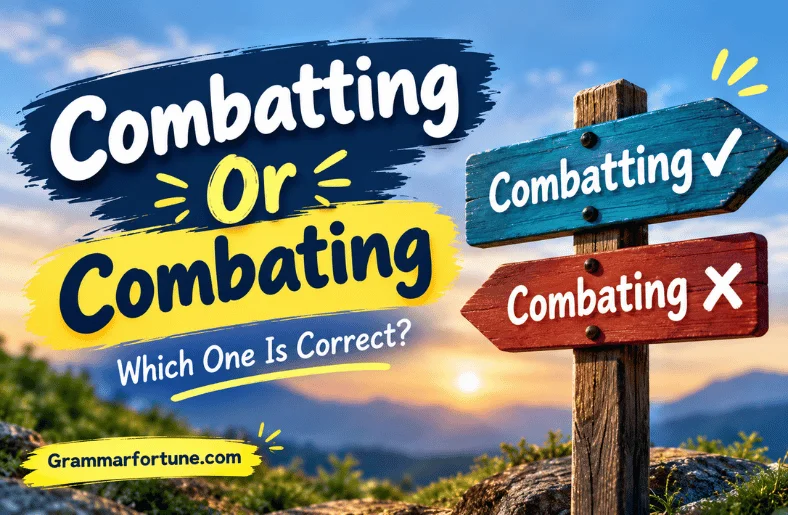
Combatting Or Combating Both spellings are accepted. Which one you pick depends on the dictionary or editorial standard you follow.
- Combating: The more common spelling and a safe default for American readers.
- Combatting: A recognized alternative that shows up in British and other varieties of English.
- Meaning: To oppose, resist, fight against or reduce a problem.
- Pronunciation: Both forms sound the same.
- Grammar: Either one can work as a present participle or a gerund.
Simple rule: Writing for Americans or for a general international audience? Use combating. If your publisher or school names a different form, follow that instead.
Quick Stats: Combatting Or Combating
| Detail | Answer |
|---|---|
| Topic | Spelling of the -ing form of combat |
| Spellings | Combating (one t) and combatting (two ts) |
| Meaning | To fight against, resist or reduce a problem |
| Same meaning? | Yes, both forms mean the same thing |
| Part of speech | Present participle or gerund of the verb combat |
| Pronunciation | Identical for both spellings |
| Common US choice | Combating |
| UK usage | Both forms appear, depending on the publisher |
| Past tense | Combated (combatted is a variant) |
| Safe default | Combating, unless a style guide says otherwise |
| Key rule | Pick one spelling and use it throughout |
Combatting or combating is a spelling question that trips up many writers. You may see both versions in news stories, school reports, business emails and online posts, and each one looks believable. So which one belongs in your sentence?
Here is the short answer. Both spellings carry the same meaning. Each one is an -ing form of the verb combat, which means to fight against something or to act to overcome a problem. Single-t combating is the more common choice in American English, while double-t combatting is a recognized variant.
The better choice depends on your readers and on the style rules you follow. This article covers the meaning, the grammar, regional habits, AP Style, Oxford Dictionary notes and seven tips that make the decision easy.
Meaning of Combating and Combatting
Both words describe an effort to oppose something, stop it from spreading or soften its harm.
Combat can mean physical fighting. Today it is just as common in talk about social, economic, medical, environmental and technology problems.
Here are a few everyday uses:
- Combating poverty: Taking action to reduce poverty.
- Combating misinformation: Working to stop false or misleading claims from spreading.
- Combating disease: Taking steps to control or prevent illness.
- Combating pollution: Reducing damage to air, water or soil.
- Combating discrimination: Acting against unfair treatment.
Swap in combatting and each line means the same thing. Neither spelling describes a different kind of action.
Why Combatting Or Combating Have Different Spellings
English adds -ing to verbs in different ways. Sometimes the last consonant doubles, and sometimes it stays single.
| Base verb | Form ending in -ing |
|---|---|
| Help | Helping |
| Visit | Visiting |
| Begin | Beginning |
| Admit | Admitting |
| Combat | Combating or combatting |
Words like begin and admit double the final letter because the stress falls on the last syllable. Combat is different. The verb is usually stressed on the first syllable, and some speakers stress the second, so dictionaries and writers have settled on two forms.
That is why a mechanical doubling rule does not always work. A dictionary shows which spellings exist, and a style guide shows which one a publication prefers.
7 Proven Tips To Choose Between Combatting Or Combating
You do not need to memorize a rule for every country. Use these seven tips instead.
1. Think about your readers.
Writing for a US audience? Pick combating. For readers in the UK, Canada, Australia or elsewhere, look at what the publication you are writing for usually does.
2. Check for a style guide.
Schools, universities, newsrooms and companies often require a specific dictionary or stylebook. If one applies to your work, it settles the question.
3. Look up the current dictionary entry.
Entries can change over time. A quick check of a trusted dictionary tells you which forms are listed and whether one is marked as preferred.
4. Stay consistent.
Choose one form and keep it from the first paragraph to the last. A mix of both spellings in one document looks careless.
5. Do not call the other form an error.
If you spot combatting in someone else’s writing, remember it is a valid variant. Fix it only when a style rule asks you to.
6. Keep quotes unchanged.
When you quote another writer, copy the spelling exactly as printed, even if it differs from your own.
7. When nothing applies, use combating.
With no audience clue and no style rule, combating is the simple and widely understood pick.
Combating Or Combatting in American English
In American English, combating is the usual form. It suits schoolwork, business writing, blog posts and many professional publications.
Some examples:
- Public health officials are combating the spread of infection.
- The group is combating financial fraud.
- Teachers are combating bullying through education.
- Engineers are combating security threats to company networks.
Writing for a specific American publisher? Check that publisher’s own reference before relying on general habits.
Combating Or Combatting AP Style
Many writers search for the combating or combatting AP Style answer. It helps to separate two ideas: what American writers commonly do, and what a stylebook officially says.
The Associated Press Stylebook guides journalists and anyone who follows AP rules. If your newsroom, class or client requires AP, read the current AP Stylebook entry for combat and its forms before you state that one spelling is required.
For general American writing, combating is a sensible default. Treat an AP ruling as something you confirm in the source, not something you guess from regional habits.
Combatting Or Combating in British English
British writers use both forms. Combatting is a well-known variant, and combating appears too.
- The charity is combating homelessness.
- The campaign is combatting food waste.
- Local groups are combating inequality.
All three sentences say the same thing. The spelling does not change the idea.
Combatting Or Combating in the UK
Writing for a UK outlet? Follow the dictionary or house style it uses. Publishers differ, so it would be wrong to claim every British writer must use the double-t form.
A British English spellchecker can help, but weigh its suggestion against your publication’s rules.
Combatting Or Combating Oxford Dictionary Check
People often ask about the combating or combatting Oxford Dictionary listing. The best move is to open the current entry for combat in an Oxford dictionary and read how it presents the verb forms.
Look at three things:
- Whether both spellings appear.
- How the entry orders them.
- Whether any form carries a preference label.
Also remember the difference between a dictionary and a style guide. A dictionary records forms in use. A style guide tells writers which form a publication wants. A dictionary listing a variant does not mean every editor will choose it.
Here is a simple way to handle what you find:
- If the entry lists both spellings, either one is safe, so pick the one that matches your audience.
- If the entry marks one spelling as the main form, use that one when your work follows that dictionary.
- If the entry shows only one spelling, use it for any writing tied to that reference.
Whatever you decide, write it down in a short note for your team or class. A one-line rule such as “we use combating” saves time later and keeps every document the same.
Combatting Or Combating in Canada and Australia
Combatting Or Combating in Canada
Canadian English blends several spelling traditions, and the words do not all follow one pattern. Being Canadian does not settle this choice by itself.
- Community groups are combating food insecurity.
- Awareness programs are combatting online fraud.
For a Canadian school, government office, university or publisher, follow its named dictionary. With no special rule, combating is a reasonable choice for general readers.
Combatting Or Combating in Australia
Australian English has its own spelling habits, yet the preferred form can still vary by dictionary and publisher.
- Researchers are combating environmental damage.
- Volunteers are combatting the effects of litter.
Check the reference your organization uses. Do not say one form is mandatory across Australia unless a reliable source backs that claim.
How To Spell Combating Or Combatting
Written out letter by letter, the two forms are easy to tell apart.
- Combating: C-O-M-B-A-T-I-N-G
- Combatting: C-O-M-B-A-T-T-I-N-G
The only difference is one t or two before -ing.
A handy memory aid: link single-t combating with everyday American writing. If you meet combatting in print, treat it as a valid variant before assuming the writer made a mistake.
Forms of Combat
Knowing every form of the verb makes it easier to use each one correctly.
| Word form | Use | Example |
|---|---|---|
| Combat | Base verb | We must combat fraud. |
| Combats | Present tense, singular subject | The group combats poverty. |
| Combated | Past tense and past participle | They combated the problem for years. |
| Combating | Common -ing form | She is combating misinformation. |
| Combatting | Alternative -ing form | She is combatting misinformation. |
The two -ing forms work the same way in a sentence.
When To Use Combated
Use combated for an action in the past, or in perfect and passive structures.
- The team combated the threat successfully.
- The town has combated several challenges.
- The problem was combated through shared effort.
A closely related spelling, combatted, also appears as a variant of the past form. As with the -ing forms, pick one and stay consistent.
Pronunciation and Word Stress
Both combating and combatting are pronounced the same way. Listeners cannot hear whether a speaker has one t or two, so the choice only matters in writing.
The verb combat is usually stressed on the first syllable in American speech: COM-bat. Many speakers also say com-BAT, especially for the verb. This flexible stress is one reason the spelling is not fixed by the usual doubling rule.
Combat as a Noun, Verb and Adjective
Combat does more than one job in a sentence, and that helps explain why its forms get so much attention.
- Noun: Fighting between opposing sides. Example: The soldiers trained for combat.
- Verb: To fight against something. Example: Doctors combat illness with medicine.
- Adjective: Related to fighting. Example: The soldier wore combat boots.
The -ing forms come only from the verb. The noun and adjective uses never take the extra letter, so no spelling question arises with them.
Words That Often Go With Combating and Combatting
Writers often pair the verb with the same kinds of targets. These pairings sound natural in both spellings.
- Combating fraud: Used in banking, insurance and online safety.
- Combating climate change: Used in science, policy and news writing.
- Combating fatigue: Used in health, work and sports contexts.
- Combating hunger: Used by charities and relief groups.
- Combating crime: Used in reports about law enforcement and community safety.
Notice how often the object is a problem, a risk or a harm. That pattern is a quick way to check that the verb fits your sentence.
Easy Ways To Remember Combating
Spelling tricks work best when they are short. Try one of these.
- Match the stress: Say combat out loud with the stress on the first syllable. When the stress is not on the last syllable, many writers keep the final letter single, which gives combating.
- Compare with similar verbs: Words such as target and limit take -ing without doubling the last letter (targeting, limiting). Combating follows the same pattern.
- Pick a house form: Decide once for your own writing and add it to your personal word list.
- Use find and replace: Before you submit, search for both spellings and make them match.
Combating Or Combatting in Everyday Writing
Most readers will not stop to judge which version you picked. They care that the sentence is clear and the spelling is steady. Here is how this plays out in common writing tasks.
School essays. Teachers usually look for consistency and correct meaning. Choose one form, use it every time and you are fine. If your teacher names a dictionary, follow it.
Work emails and reports. Short, clear sentences matter more than the spelling choice. Pick the form your company already uses in older documents so your writing matches.
Blog posts and websites. Think about where your readers live. A site aimed at Americans does well with combating. A site with a global audience can also use it, since readers will recognize it easily.
News and press releases. Editors often follow a house rulebook. Ask the editor or check the style sheet before you send your draft.
Social media. Space is tight and readers scroll fast. Either spelling is understood, so use the one you can type with confidence.
Combat Compared With Fight, Oppose and Tackle
Sometimes the best fix is a different verb. These alternatives can make a sentence feel lighter or more precise.
| Verb | Best used when | Example |
|---|---|---|
| Combat | The problem is serious or widespread | The city is combating air pollution. |
| Fight | You want a strong, direct tone | Nurses fight infection every day. |
| Tackle | The problem is one you plan to solve step by step | Schools tackle absenteeism early. |
| Oppose | You are speaking about a view or a plan | Residents oppose the new rule. |
| Counter | You are answering a specific claim or threat | The team countered the false rumor. |
| Reduce | You mean making something smaller | The program reduces waste. |
Picking the verb that fits your meaning is often more useful than debating one letter.
Combatting Or Combating Examples
These words show up most often when people write about tough problems. Here is how they sound across different topics.
Health and medicine
- Researchers are combating the spread of infectious disease.
- Health groups are combatting the misuse of antibiotics.
Environment
- Communities are combating plastic pollution.
- Conservation teams are combatting illegal wildlife trade.
Education
- Schools are combating absenteeism with extra support.
- Teachers are combatting misinformation through class discussion.
Technology
- Businesses are combating cybersecurity risks.
- Specialists are combatting online scams with better tools.
Social issues
- Volunteers are combating homelessness.
- Community leaders are combatting discrimination.
Each sentence means to oppose a problem or reduce its effects. Use the spelling your chosen standard accepts.
Common Errors To Avoid
Keep these points in mind when you decide between combatting or combating.
- Calling one form wrong: Combatting is a recognized variant.
- Treating regional habits as strict rules: Dictionaries and publishers inside one country can differ.
- Mixing both spellings: Choose one form and keep it.
- Mixing up spelling and meaning: The two forms describe the same action.
- Confusing a dictionary with a style guide: One records usage, the other sets editorial choices.
- Making claims you have not checked: Verify AP Style or Oxford Dictionary details before you attribute a preference to either one.
Conclusion
Combatting or combating is a question of spelling, not meaning. Both forms describe opposing a problem, and both work in the same grammar. Combating is the common, practical default, and combatting is a recognized alternative.
For school work, professional documents and web articles, pick the form that fits your audience and the reference your publication follows. When no rule applies, combating is a simple choice.
Explore more meaning and usage of other english words:-
- DSL Meaning Slang
- 52013 Meaning in Hindi
- What Does Wyll Mean In Text
- Wtms Meaning In Text
- Type B Personality
- Ethos Meaning
- PMO Meaning Slang
- Crush Meaning In Hindi
- Gorgeous Meaning In Hindi
- Unalive Meaning
- Effervescent Meaning
- Wassup Meaning In Hindi
- Euphemism Definition
- Sodomy Definition
- Marple Definition
- What Does ISS Mean on a Driver’s License
- Insolence Meaning
- Stalactite Meaning
- 5201314 Meaning
- Torta Meaning Slang
? FAQs About Combatting Or Combating
1. Is combatting or combating correct?
Both are recognized spellings of the -ing form of combat. Combating is the more common choice, and combatting is an established alternative.
2. What is the difference between combating and combatting?
Only the spelling differs. Both describe fighting against, resisting or reducing a problem.
3. Is combatting a misspelling?
Not necessarily. It is a recognized variant. Whether it is the preferred form depends on the dictionary or style guide in use.
4. Is combating American or British English?
Combating is common in American English and also appears in British and other varieties. It does not belong to one country alone.
5. Is combatting British English?
Combatting appears in British English but is not limited to Britain. Individual publishers may choose differently.
6. What does combating mean?
It means opposing, resisting, fighting against or acting to reduce something harmful, such as pollution, disease, fraud or discrimination.
7. Which spelling should I use in AP Style?
Check the current AP Stylebook entry if your writing must follow AP rules. For general American writing, combating is a practical default.
8. Does the Oxford Dictionary list combatting?
Open the current Oxford entry for combat and read the verb forms and any preference labels. A listed variant is not automatically the preferred form everywhere.
9. Which spelling should I use in Canada or Australia?
Follow the dictionary or style guide your school, workplace or publisher requires. Country alone does not always decide it.
10. How do you spell combating?
C-O-M-B-A-T-I-N-G, with one t before -ing.
11. What is the past tense of combat?
The usual past form is combated. Example: “The group combated the problem through education.”
12. Can I use combating and combatting in the same article?
Use one form consistently in your own writing. Keep the other only when you quote a source or when you are explaining the difference between the two.
