
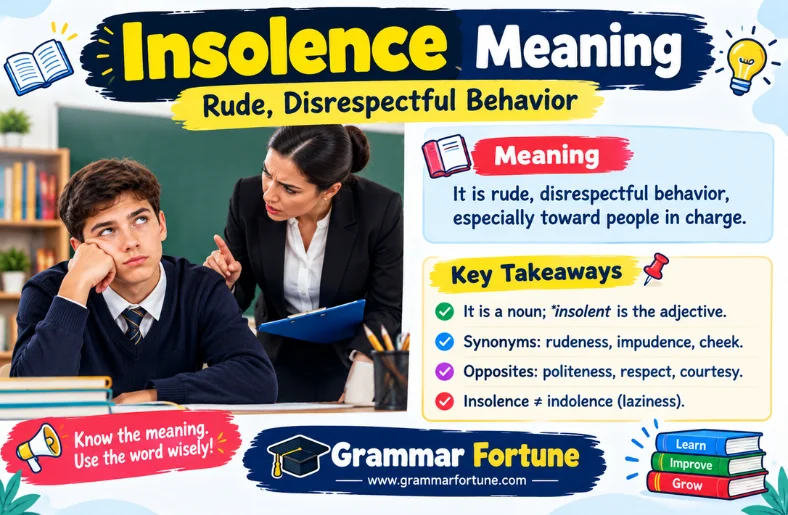
Insolence Meaning refers to rude, disrespectful, or boldly impolite behavior, especially toward someone who is expected to be treated with respect. It can describe the way a person talks, responds, or behaves when they show little regard for another person’s authority, feelings, or position.
For example, a student who mocks a teacher after being corrected, or an employee who responds disrespectfully to a manager, may be described as insolent. The word is a noun and is often used when ordinary rudeness becomes noticeably disrespectful or defiant.
The term can be confusing because it is sometimes mixed up with indolence, which means laziness. People may also search for its definition, sentence examples, pronunciation, synonyms, or even Guerlain Insolence, the name of a perfume. This guide explains these meanings and uses in simple English with clear examples.
Quick Stats: Insolence Meaning
| Point | Detail |
|---|---|
| Word | Insolence |
| Part of Speech | Noun (adjective: insolent, adverb: insolently) |
| Meaning | Rude, disrespectful, or arrogant behavior |
| Definition | Bold rudeness shown toward a person who deserves respect |
| Pronunciation | IN-suh-lunss |
| Origin | Latin, from insolentia |
| Synonyms | Rudeness, impudence, cheek, disrespect |
| Antonyms | Politeness, respect, courtesy, humility |
| Example Sentence | The teacher would not allow insolence in her class. |
| Category | Word Meaning |
Disclaimer: Grammar Fortune par di gayi jaankari general education ke liye hai. Word meanings standard English dictionaries aur grammar books se check kiye gaye hain, lekin meaning aur use region ya context ke hisaab se thoda badal sakta hai. Perfume ya brand se jude details (jaise Guerlain Insolence) badal sakte hain, isliye kharidne se pehle official brand website se confirm kar lein.
What Does Insolence Mean?
The simplest answer to What Does Insolence Mean is this: it means showing no respect, and showing it on purpose. The person does not just disagree. He or she speaks or acts in a way that is meant to sting, to mock, or to challenge a person of higher rank or age.
Think about the difference between two replies to a teacher:
- “I do not agree with this answer, Sir. May I explain why?”
- “That is a silly rule, and you are wrong, as usual.”
The first reply is a polite disagreement. The second reply is the behavior this page is about. The words are bold, the tone is sharp, and the aim is to put the other person down.
So the Insolence Meaning has two parts working together. The first part is disrespect. The second part is boldness, a feeling that “no one can tell me what to do.” When both parts meet, the behavior is called rude and contemptuous.
Insolence Definition
The Insolence Definition in a standard dictionary is close to this: “rude and disrespectful behavior, especially toward someone in a position of authority.”
In easy words, you can say:
- It is speaking or acting without respect.
- It is talking back in a bold or mocking way.
- It is showing contempt for a person who deserves polite treatment.
A few more points make the Insolence Definition complete:
- It is about behavior, not feelings. A person may feel angry inside, but the word applies only when the anger shows up as rude words or actions.
- It usually points upward. The word is most often used when a younger person, a student, or a worker is rude to an elder, a teacher, or a boss.
- It breaks a social rule. Every group has rules about how to speak to others. This behavior steps outside those rules on purpose.
How the Behavior Looks in Real Life
The word is easier to remember when you see where it appears. Here are the most common places.
In the classroom
A student answers a teacher in a mocking tone, makes faces behind the teacher’s back, or refuses to follow a fair instruction while smirking. Teachers often write the word in reports with the line “shows rude behavior toward staff.”
At home
A child shouts “You cannot tell me what to do!” at a parent. A teenager mimics an elder’s voice to make others laugh. Parents call this “back-chat” or “cheek.”
At work
An employee rolls his eyes in a meeting, replies to a manager’s email with a rude joke, or ignores clear orders in a bold way. In offices, this may be called insubordination, which is a close cousin of the word.
In public places
A customer mocks a shop worker, a driver argues rudely with a police officer, or a passenger sneers at a bus conductor. The person acts as if the other worker does not deserve basic respect.
Online
Rude comments, mocking replies, and bold insults toward teachers, coaches, or officials on social media also count. The screen does not change the meaning. Disrespect is still disrespect.
Forms of the Behavior: Words, Looks, and Actions
The behavior does not always come as loud speech. It can show up in three ways.
| Type | Examples |
|---|---|
| Words | Sharp replies, mocking names, sarcastic answers, rude jokes |
| Looks and Body Language | Eye-rolling, smirking, turning your back, crossing arms while being spoken to |
| Actions | Ignoring orders on purpose, slamming doors, throwing papers, walking away mid-sentence |
Many teachers say that a quiet, mocking look can feel more rude than a loud shout. This is why the tone and the aim of the act matter as much as the words.
Insolence Part Of Speech
The Insolence Part Of Speech is a noun. More exactly, it is an abstract noun, because it names a quality or a kind of behavior that you cannot touch or see as an object.
The word has a small family. Each member plays a different role in a sentence:
| Form | Part of Speech | Example |
|---|---|---|
| Insolence | Noun | His insolence shocked the class. |
| Insolent | Adjective | She gave an insolent reply. |
| Insolently | Adverb | He answered insolently. |
A good rule to keep in mind: use the noun to name the behavior, the adjective to describe a person or a reply, and the adverb to describe how someone acted.
Pronunciation
The easy sound spelling is IN-suh-lunss.
- The stress falls on the first syllable: IN.
- The middle part sounds like “suh.”
- The ending sounds like “lunss,” just like the end of the word “silence” as a quick comparison.
The adjective is said IN-suh-lunt, and the adverb is said IN-suh-lunt-lee.
Latin Roots Behind the Word
Like many English words, this one comes from Latin. It grew from the Latin word insolentia, which came from insolens. The parts are easy to read:
- in- means “not.”
- solens comes from solere, meaning “to be accustomed” or “to be used to.”
So the old Latin sense was “not accustomed,” then “unusual,” and then “going beyond what is normal.” Over time, a person who went beyond the normal limits of respect was called proud, haughty, and rude. That is how the word grew into its present meaning.
The word came into English many years ago and has kept the same core sense since then (please verify the exact period with a standard etymology dictionary).
Overbearing Insolence Meaning
Writers often use the phrase “overbearing insolence.” The Overbearing Insolence Meaning is rudeness mixed with a bossy, crushing attitude. The person is not only disrespectful, but also tries to dominate others and make them feel small.
The word “overbearing” describes someone who acts as if he or she is more important than everyone else. When it joins with rudeness, the result is a person who:
- speaks harshly to people with less power,
- expects everyone to obey at once,
- shows no care for the feelings of others.
Think of a rich customer who shouts at a waiter and treats him like dirt. That is not simple rudeness. It is rude and domineering at the same time, so people call it overbearing.
This phrase often appears in stories, history books, and news reports about people who misuse their position, such as cruel officers, harsh landlords, or proud rulers.
Simple way to remember it: plain rudeness says, “I do not respect you.” Overbearing rudeness says, “I do not respect you, and you must bow to me.”
Insolence vs Insubordination vs Impudence
Several close words can confuse a student. Here is how they differ.
| Word | Core Idea | Where It Is Used Most |
|---|---|---|
| Insolence | Rude, disrespectful behavior | School, home, work |
| Insubordination | Refusing to obey a person in charge | Offices, army, schools |
| Impudence | Shameless boldness, cheek | Daily talk, stories |
| Arrogance | Too much pride in oneself | Describing a person’s nature |
| Impertinence | Rudeness that goes beyond what is proper | Formal writing |
Key difference: A person can be rude without refusing an order. That is the first word. A person can refuse an order without being rude. That is insubordination. Often, both appear together.
Insolence Synonyms
Here are the most useful Insolence Synonyms, each with a short meaning and a quick example.
| Synonym | Short Meaning | Example |
|---|---|---|
| Rudeness | Bad manners toward others | His rudeness upset the guests. |
| Impudence | Bold, shameless disrespect | She had the impudence to laugh at the judge. |
| Cheek | Casual word for rude boldness | What cheek, talking to your uncle like that! |
| Disrespect | Lack of regard for someone | The boy showed open disrespect to his coach. |
| Arrogance | Too much pride in oneself | His arrogance made him unpopular. |
| Insubordination | Refusing to obey a superior | The soldier was punished for insubordination. |
| Audacity | Bold behavior that shocks others | He had the audacity to call the teacher a fool. |
| Impertinence | Rudeness beyond what is proper | The child’s impertinence amazed the guests. |
| Contempt | Deep lack of respect | She looked at him with contempt. |
| Sauciness | Playful, cheeky rudeness | The waiter’s sauciness made us smile. |
A small note on tone: Not all synonyms are equally strong. “Cheek” and “sauciness” are light and can even sound playful. “Contempt” and “arrogance” are heavy and serious. Pick the word that fits your sentence.
Insolence Antonyms
The Insolence Antonyms are words that show good manners and respect.
| Antonym | Short Meaning | Example |
|---|---|---|
| Politeness | Speaking and acting with good manners | Her politeness won everyone’s heart. |
| Respect | Treating others as important | He spoke to his elders with respect. |
| Courtesy | Kind and polite behavior | The clerk served us with courtesy. |
| Humility | Not thinking too highly of yourself | The champion showed great humility. |
| Deference | Polite yielding to another’s wishes | He bowed in deference to the teacher. |
| Civility | Basic good manners in speech | They argued with civility. |
| Obedience | Following the orders of someone in charge | The class showed perfect obedience. |
| Modesty | Not showing off | Her modesty impressed the judges. |
Insolence In A Sentence
Seeing Insolence In A Sentence is the best way to make the word stick. Here are short, correct examples in different settings.
At work:
- The manager warned him about his insolence during the team meeting.
- Her insolent reply to the customer cost her the job.
- The company does not accept insolence toward senior staff.
In school:
- The teacher did not accept insolence from any student.
- He was sent out of class for his insolent smile.
- The principal spoke to the boy about his insolent behavior in the hall.
At home and in daily talk:
- “Do not speak to your elders with such insolence,” said Grandfather.
- The child’s insolence surprised the whole family.
- She insolently turned her back while her aunt was speaking.
In stories and news:
- The king punished the servant for his insolence.
- The captain would not forgive the sailor’s insolent answer.
In every one of these lines, a person shows a lack of respect. Notice that the sentences describe a person’s behavior, not a person’s mood.
Insolence vs Indolence: Do Not Mix Them Up
These two words sound almost the same, because both start with “in-,” both end with “-ence,” and both stress the first syllable. But their meanings are completely different.
| Feature | Insolence | Indolence |
|---|---|---|
| Core Meaning | Rudeness, disrespect | Laziness, avoiding effort |
| Direction | Outward, affects others | Inward, affects the person |
| Tone | Aggressive or defiant | Passive and slow |
| Part of Speech | Noun (adjective: insolent) | Noun (adjective: indolent) |
| Common Context | Authority, workplace, classroom | Work, school, habits |
| Latin Root | insolentia (unusual, not customary) | indolentia (freedom from pain) |
| Example | Talking back to a manager | Missing deadlines from laziness |
The golden rule:
- If the problem is avoiding work, use indolence.
- If the problem is disrespecting someone, use insolence.
Can one person show both? Yes. A worker can avoid his tasks (indolent) and answer rudely when his manager asks about them (insolent). They are two separate habits that can sit side by side.
Memory Tricks
These small tricks help you keep the two look-alike words apart.
- The letter trick. Indolence has a d. Think “do nothing.” Insolence has an s. Think “sass.”
- The picture trick. Imagine a person slouched on a couch, not moving. That is indolence. Now imagine a person pointing a finger and arguing with a boss. That is insolence.
- The direction trick. Lazy habits hurt yourself. Rude habits hurt others.
Once your mind links a picture to each word, the confusion goes away.
Guerlain Insolence
Not every search for this word is about grammar. Guerlain Insolence is the name of a well-known perfume from the French fragrance house Guerlain. It was launched in the mid-2000s and became popular for its floral, violet-like scent and its bright purple packaging (please verify the launch year, the perfumer, and the scent notes with the official Guerlain website or a trusted perfume book).
Why did the brand choose this name? The word suggests a bold, daring, and cheeky spirit. In perfume marketing, the idea is to describe a confident woman who does not follow every rule. In this case, the name is used in a playful, fashionable way, not in the harsh sense of a rude child or worker.
Here is how the two uses differ:
| Use | Meaning | Where You See It |
|---|---|---|
| Dictionary word | Rude, disrespectful behavior | School, work, books |
| Guerlain Insolence | A perfume brand name that suggests boldness and style | Shops, ads, perfume websites |
If you want to buy the perfume, check prices, bottle sizes, and reviews on a trusted shop or on the brand’s own page. The dictionary meaning above will not help with that.
Why Does This Behavior Happen?
Teachers and parents often ask why a young person shows this kind of behavior. There is no single reason, but these are the most common ones:
- Seeking attention. Some children believe rude words will make others notice them.
- Copying others. A child may copy rude talk from friends, films, or videos.
- Anger or stress. A person who feels upset may let the feeling out as rude words.
- Testing limits. Young people sometimes check how far the rules can bend.
- Lack of good examples. If a child often hears rude talk at home, he or she may think it is normal.
This list is general information. Every child is different, and a kind talk with a teacher or counselor is often more helpful than any rule of thumb.
How to Respond Kindly but Firmly
When a person faces this behavior, a calm response works better than a loud one. Here are simple steps for parents and teachers.
- Stay calm. A loud reply often adds fuel to the fire.
- Name the behavior. Say, “That tone was rude,” not “You are a bad child.”
- Set a clear limit. Explain what is allowed and what is not.
- Give a way to fix it. Ask the person to say the same thing again in a polite way.
- Praise good manners. Notice and thank the child when he or she speaks politely.
These steps help the person see that the act is the problem, not the person.
Common Mistakes
| Wrong | Right |
|---|---|
| He showed his insolence by working slowly. | He showed his indolence by working slowly. |
| She was insolence to her teacher. | She was insolent to her teacher. |
| The insolent of the boy was shocking. | The insolence of the boy was shocking. |
| He answered insolence. | He answered insolently. |
| The indolent reply angered the principal. | The insolent reply angered the principal. |
Why these are wrong: The first and last lines mix up the two look-alike words. The other lines use the wrong form. Use insolent to describe a person or a reply, insolently to describe how someone acted, and insolence to name the behavior.
Tips to Remember
- Picture a child pointing a finger and arguing with a parent. That is bold, rude behavior.
- Link the word to “sass” so the s reminds you of the meaning.
- Keep the Latin root in mind: stepping outside the normal rules of respect.
- Use insolent for the person and insolence for the behavior.
- Read the word aloud a few times: IN-suh-lunss.
- Write three of your own sentences, one for school, one for home, and one for work.
Key Takeaways
- Insolence Meaning: Rude or disrespectful behavior.
- It is a noun; insolent is the adjective.
- Synonyms include rudeness, impudence, and cheek.
- Opposites include politeness, respect, and courtesy.
- Insolence ≠ indolence; indolence means laziness.
You can also explore the meaning and usage of other English words below.
- DSL Meaning Slang
- What Does Wyll Mean In Text
- Wtms Meaning In Text
- Type B Personality
- Ethos Meaning
- PMO Meaning Slang
- Crush Meaning In Hindi
- Gorgeous Meaning In Hindi
- Unalive Meaning
- Effervescent Meaning
- Wassup Meaning In Hindi
- Euphemism Definition
- Sodomy Definition
- Marple Definition
- What Does ISS Mean on a Driver’s License
Conclusion
The Insolence Meaning is simple once you link it to sass: bold, rude behavior aimed at someone who deserves respect. It is a noun with the adjective insolent, it comes from Latin, and it has many close words such as rudeness, impudence, and cheek. Its opposites are politeness, courtesy, and respect. Keep it apart from indolence, and you will use both words with confidence.
FAQs
What is the meaning of insolence?
It means rude, disrespectful behavior toward a person who deserves respect, especially a teacher, a parent, or a boss. The Insolence Meaning always involves a lack of respect shown in words, tone, or action.
What is the Insolence Part Of Speech?
It is a noun. The adjective is insolent, and the adverb is insolently. This is the full Insolence Part Of Speech family.
What is the difference between insolence and indolence?
One means rudeness and the other means laziness. A rude person talks back. A lazy person avoids work. They are two separate habits, though one person can show both.
Can a child show this behavior?
Yes. A child shows it by talking back, mocking an adult, or ignoring a fair request in a rude way. The word is common in school and family settings.
Is it the same as being confident?
No. A confident person speaks clearly and politely, even when he or she disagrees. Rude, mocking behavior that shows contempt is what this word describes.
