
The word “cheap” and the word “affordable” both point to low price. But call someone’s outfit “cheap” in front of others, and you have just insulted them. That single word swap shows you exactly what connotation vs denotation means in real life.
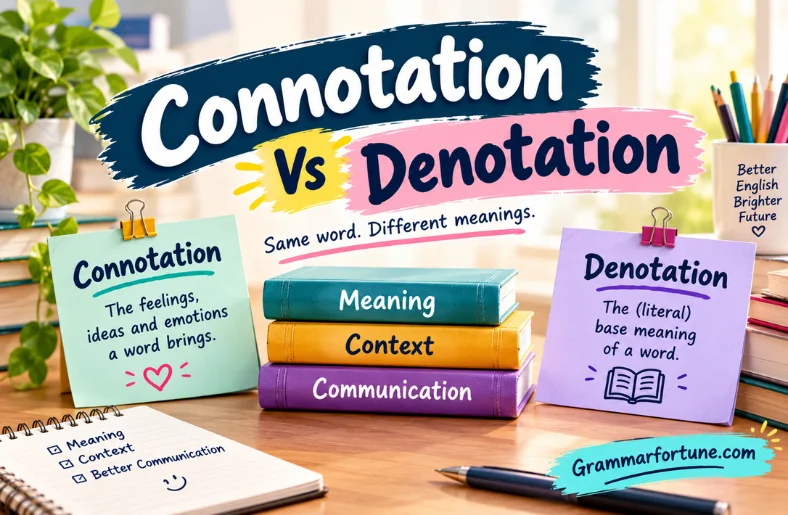
Denotation is a word’s literal, dictionary meaning. Connotation is the emotional or cultural feeling that word carries beyond its literal meaning.
Both layers live inside every word at the same time. Knowing the difference helps you read between the lines in books, speak more carefully in conversation, and write with far more control over how your words land.
What Is Connotation Vs Denotation? Clear Definitions
Denotation is the primary, literal meaning of a word. It is the definition you find in a dictionary. It carries no emotional weight and simply states what the word means at face value.
Connotation is the secondary meaning. It covers the feelings, images, and associations a word brings along with its literal definition. Connotation can be positive, negative, or neutral depending on context and culture.
Quick Definition: Denotation is the literal dictionary meaning of a word. Connotation is the emotional or cultural meaning a word carries beyond its dictionary definition. For example, “snake” denotes a legless reptile but connotes danger, betrayal, or deception in most contexts. Both meanings exist at the same time within the same word.
Think of denotation as what a word says and connotation as what a word suggests. A writer or speaker who knows both can choose words that hit exactly the right note every time.
A Root-Based Memory Trick Worth Knowing
The prefix “de-” in denotation means “down to” or “directly.” Denotation gets you straight down to the core meaning of a word.
The prefix “con-” in connotation comes from Latin and means “together with.” Connotation is the meaning that travels together with the word, the emotional baggage it brings along for the ride.
So: denotation = the direct meaning. Connotation = what comes with it. This root-based distinction sticks much better than rote memorisation, especially for older students and adults.
Connotation Vs Denotation: Quick Comparison
| Feature | Denotation | Connotation |
|---|---|---|
| What it is | Literal, dictionary meaning | Emotional or cultural meaning |
| Found in | Dictionary entries | Context, culture, personal experience |
| Emotional charge | Neutral | Positive, negative, or neutral |
| Changes over time? | Rarely | Yes, frequently |
| Example: “home” | A place where one lives | Warmth, safety, belonging, family |
| Example: “stench” | A strong smell | Disgust, rot, unpleasantness |
| Common use | Technical writing, definitions | Literature, advertising, everyday speech |
This table puts the connotation vs denotation definition side by side so you can see how one word always carries two layers of meaning at once.
10 Connotation Vs Denotation Examples
These connotation vs denotation examples cover everyday words that students and writers regularly encounter.
1. Home vs House
- Denotation of both: A building where people live.
- Connotation of “house”: Neutral, structural, a physical object.
- Connotation of “home”: Warmth, comfort, emotional belonging.
Real estate agents always say “your new home,” never “your new house.” The word choice is deliberate.
2. Cheap vs Affordable
- Denotation of both: Low in price.
- Connotation of “cheap”: Poor quality, inferior, embarrassing.
- Connotation of “affordable”: Accessible, reasonable, smart value.
Same literal meaning. Very different emotional response.
3. Slim vs Skinny
- Denotation of both: Having a lean body.
- Connotation of “slim”: Positive, healthy, attractive.
- Connotation of “skinny”: Often negative, sickly, or undesirable.
Choosing between these two words can shift the entire tone of a sentence.
4. Snake
- Denotation: A legless reptile.
- Connotation: Danger, betrayal, deceit, evil.
This is a classic connotation vs denotation example used in schools because the gap between the two meanings is so wide and easy to feel.
5. Politician vs Statesman
- Denotation of both: Someone who holds or pursues political office.
- Connotation of “politician”: Manipulative, self-serving, unreliable.
- Connotation of “statesman”: Wise, principled, a respected leader.
Writers use this pair to signal their opinion of a public figure without stating it outright.
6. Childlike vs Childish
- Denotation of both: Resembling or behaving like a child.
- Connotation of “childlike”: Innocent, curious, pure.
- Connotation of “childish”: Immature, silly, irresponsible.
One suffix difference, and the word flips from a compliment to a criticism.
7. Vintage vs Old
- Denotation of both: Having existed for many years.
- Connotation of “vintage”: Classic, valuable, timeless.
- Connotation of “old”: Worn out, outdated, no longer useful.
Marketers rely on this distinction constantly. “Vintage furniture” sells. “Old furniture” does not.
8. Assertive vs Aggressive
- Denotation of both: Strongly expressing opinions or demands.
- Connotation of “assertive”: Confident, healthy, effective.
- Connotation of “aggressive”: Hostile, threatening, problematic.
These two words appear often in workplace conversations, and the choice between them carries real weight.
9. Curious vs Nosy
- Denotation of both: Interested in other people’s affairs.
- Connotation of “curious”: Inquisitive, open-minded, interested.
- Connotation of “nosy”: Intrusive, rude, minding someone else’s business.
Context and tone decide which word fits, but the speaker’s choice always reveals an attitude.
10. Passionate vs Obsessed
- Denotation of both: Having very strong feelings about something.
- Connotation of “passionate”: Dedicated, driven, admirable.
- Connotation of “obsessed”: Unhealthy, excessive, worrying.
This pair shapes how readers feel about a character in fiction, often before the plot has even moved forward.
These 10 pairs are strong starting points for any connotation vs denotation worksheet or classroom activity.
Types of Connotation: Positive, Negative, and Neutral
Not all connotations carry the same emotional charge. They fall into three clear types.
Positive connotation means the word suggests something desirable or good. “Youthful,” “bold,” and “thrifty” carry warm feelings even though their denotations are plain and neutral.
Negative connotation means the word suggests something unpleasant or undesirable. “Reckless,” “blunt,” and “stingy” carry negative weight for those same literal meanings.
Neutral connotation means the word carries little to no emotional suggestion. Most technical and scientific words sit here. “Precipitation” means rain or snow with no positive or negative pull in either direction.
| Type | Example Word | Denotation | Connotation |
|---|---|---|---|
| Positive | Thrifty | Careful with money | Wise, financially smart |
| Negative | Stingy | Careful with money | Selfish, unwilling to share |
| Neutral | Precipitation | Water falling from the sky | No emotional charge |
The same denotation can sit under a positive or a negative connotation depending entirely on the word chosen to express it.
Connotation Vs Denotation Words List
Here is a quick connotation vs denotation words reference grouped by theme.
Appearance:
- Slim (positive) / Skinny (negative) / Thin (neutral)
Money:
- Thrifty (positive) / Stingy (negative) / Economical (neutral)
Place:
- Home (positive) / House (neutral) / Dwelling (neutral, formal)
Speech:
- Eloquent (positive) / Chatty (negative) / Talkative (neutral)
Ambition:
- Driven (positive) / Ruthless (negative) / Ambitious (neutral to positive)
Age:
- Youthful (positive) / Immature (negative) / Young (neutral)
These groupings work well on a connotation vs denotation anchor chart in any classroom or study space.
How Cultural Context Shapes Connotation
One fact most articles on this topic skip entirely: connotation is not fixed. It shifts depending on culture, religion, history, and geography.
The same word can carry opposite feelings in different communities.
Take the word “cow.” In most English-speaking Western countries, “cow” is a neutral word. It denotes a large dairy or beef animal. In India, however, “cow” carries deep positive, even sacred, connotation for many people because of its central role in Hindu culture and tradition.
Here are more examples of how culture changes connotation:
| Word | Denotation | Western Connotation | Indian / Asian Context |
|---|---|---|---|
| Cow | Large bovine animal | Neutral to negative (e.g., “don’t have a cow”) | Sacred, auspicious, highly positive |
| Dragon | A mythical creature | Dangerous, evil, destructive | Power, good luck, strength, imperial authority |
| White | The colour white | Purity, weddings, cleanliness | Mourning, funerals in several South Asian traditions |
| Lotus | An aquatic flower | Decorative, pretty | Spiritual purity, enlightenment, divinity |
This is why connotation can never be fully understood without context. A word that comforts one reader may offend another. Writers working across cultures must pay close attention to this layer.
Cultural connotation is especially important in translation, marketing, and cross-cultural communication.
Connotation and Denotation in Literature
Authors rely heavily on word connotations to shape how readers feel about characters, settings, and events, often without stating those feelings directly.
In George Orwell’s Animal Farm, the language used to describe the pigs gradually shifts toward words with connotations of greed and corruption as the story progresses. The word choices do the emotional work that outright statements never could.
In advertising, connotation is a deliberate tool. A car brand does not say their vehicle is “fast.” They say it is “powerful,” “responsive,” or “engineered for performance.” Each of those words denotes speed but connotes a very different feeling in the buyer’s mind.
Poetry is perhaps the richest space for connotation at work. The word “crimson” and the word “red” denote the same colour, but “crimson” carries a heavier, more dramatic connotation that a poet might choose for a scene of passion or intensity.
Knowing the denotation vs connotation of words lets readers move past what a text says and into what it actually means.
Connotation in Brand Names and Marketing
Brand names are among the most intentional uses of connotation in everyday life. Companies spend considerable time and money choosing names whose connotations align with the feelings they want customers to associate with their products.
Consider these well-known examples:
- Amazon denotes a river in South America. It connotes vastness, abundance, and a sense of endless supply, which maps perfectly onto a store that sells practically everything.
- Apple denotes a common fruit. It connotes simplicity, nature, and something approachable, which directly reflects the brand’s philosophy of making technology easy for everyone.
- Nike comes from the name of the Greek goddess of victory. The denotation is a mythological name. The connotation is winning, speed, and athletic achievement.
- Dove (the soap brand) denotes a bird. It connotes gentleness, softness, and peace, which is exactly what a skincare brand wants customers to feel.
The same logic applies to product descriptions. A perfume is never described as “strong.” It is “bold,” “intense,” or “captivating.” A chair is never “hard.” It is “structured” or “architectural.”
Every word choice in a product name or description is a connotation decision first. The denotation is almost always secondary.
Connotation Vs Denotation in Social Media and Emojis
Emojis are one of the clearest modern examples of connotation at work because most of them have almost no fixed denotation at all.
The 👍 thumbs-up emoji technically denotes approval or agreement. But in many workplace and generational contexts today, it connotes passive aggression, dismissiveness, or a cold response, especially when used in reply to an emotional message.
The 😂 (face with tears of joy) emoji denotes laughter. But in some younger communities, it has shifted to carry a connotation of being out of touch or uncool, because it is associated with older generations overusing it.
This is connotation shifting in real time, faster than any dictionary can track it.
Social media also shows how word connotation works in short text:
- Saying someone’s post is “interesting” connotes doubt or polite disagreement in comment sections.
- Saying something is “fine” in a message thread almost never connotes that something is actually fine.
- Ending a message with a period in informal chat can connote anger or seriousness, even though a period is grammatically neutral.
These shifts happen because connotation is driven by shared social experience, and social media creates shared experience at scale and speed.
Connotation Vs Denotation for Middle School
Connotation vs denotation middle school lessons typically begin in grades 6 through 8, when students start analysing texts more deeply.
Teachers often use an anchor chart with two columns: one for “Dictionary Meaning” (denotation) and one for “Feeling or Association” (connotation). Students fill in word pairs and begin to notice the pattern themselves.
A simple classroom activity:
- Write a neutral sentence: “The dog walked into the room.”
- Replace “walked” with “strutted,” “crept,” “bounded,” and “shuffled” one at a time.
- Ask students how each replacement changes the feeling, even though all four words denote movement.
This activity, commonly included in a connotation vs denotation worksheet, makes the concept concrete because students feel the shift rather than just reading about it.
Standardised tests and reading comprehension sections regularly ask students to identify how word choice affects meaning or tone. A solid grip on connotation vs denotation directly prepares them for those questions.
Connotation Vs Denotation Worksheet Template
Copy the table below directly into a document or print it out for classroom use. Students fill in the “Denotation” and “Connotation” columns for each word, then mark whether the connotation is positive (P), negative (N), or neutral (NT).
| Word | Denotation (Dictionary Meaning) | Connotation (Feeling or Association) | P / N / NT |
|---|---|---|---|
| Home | |||
| House | |||
| Slim | |||
| Skinny | |||
| Cheap | |||
| Affordable | |||
| Snake | |||
| Politician | |||
| Statesman | |||
| Vintage | |||
| Old | |||
| Childlike | |||
| Childish | |||
| Passionate | |||
| Obsessed |
Extension activity: Once the table is complete, ask students to write one sentence using the word with a negative connotation and then rewrite the same sentence swapping in the positive connotation version. Ask: what changed? What stayed the same?
This activity directly practises the skill of conscious word choice, which is at the heart of connotation vs denotation work.
Common Student Mistakes to Avoid
Students working with connotation vs denotation for the first time make a few predictable errors. Knowing them in advance helps avoid lost marks.
Mistake 1: Thinking denotation and connotation are separate meanings
They are not separate. Both live inside the same word at the same time. The word “home” always means a place where someone lives (denotation) and it always carries warmth and belonging (connotation). Neither switches off.
Mistake 2: Assuming connotation is the same for everyone
Connotation varies by culture, age, region, and personal experience. “Dragon” means good luck in Chinese culture and danger in Western fairy tales. Always ask: who is the audience, and what connotation does this word carry for them?
Mistake 3: Confusing connotation with tone
Tone is the writer’s overall attitude toward the subject. Connotation is the emotional charge of a specific word. A writer can use a word with positive connotation in a piece with an overall negative or sarcastic tone. They are related but not the same thing.
Mistake 4: Thinking neutral words have no connotation
Neutral connotation is still a type of connotation. Choosing a word with neutral connotation is itself a deliberate choice. Technical writing uses neutral words precisely to strip emotion from a statement.
Mistake 5: Looking only at individual words, not context
The word “sick” has traditionally negative connotations. But in many youth and informal contexts, “that move was sick” is a strong compliment. Context always shapes which connotation is active.
A quick self-check for students: after identifying a word’s connotation, ask yourself whether the context around the word changes or confirms that feeling. If it changes it, note that down.
Connotation Vs Denotation Practice Tips
Connotation vs denotation practice does not have to be limited to formal worksheets. Here are ways to build the skill naturally.
- Read advertisements carefully. Every product description is a lesson in positive connotation. Notice which words brands choose and ask why.
- Compare news headlines on the same story. Different outlets use different words with different connotations to frame the same facts.
- Keep a word journal. When a word surprises you emotionally, write it down with its denotation and your sense of its connotation.
- Do word substitution exercises. Take any sentence and swap one key word for a synonym. Notice how the feeling changes without the facts changing.
- Use free online quizzes. Many educational platforms offer quick connotation vs denotation practice sets that take only a few minutes to complete.
The fastest way to get good at this is to read widely and pause when a word creates a feeling. Ask yourself: is that feeling coming from the word’s literal meaning, or from something the word suggests?
Every Word You Choose Sends Two Messages
Denotation tells your reader what something is. Connotation tells them how to feel about it. Both travel together every time you speak or write, whether you are aware of them or not.
The gap between “slim” and “skinny,” “home” and “house,” or “curious” and “nosy” is not a grammar rule. It is a layer of meaning that lives in language and shapes real reactions in real people.
Start noticing word choices around you, in news articles, in songs, in advertisements, and in books. When a word creates a feeling that goes beyond its dictionary meaning, you are seeing connotation in action.
More English Word Definitions:-
- DSL Meaning Slang
- 52013 Meaning in Hindi
- What Does Wyll Mean In Text
- Wtms Meaning In Text
- Type B Personality
- Ethos Meaning
- PMO Meaning Slang
- Crush Meaning In Hindi
- Gorgeous Meaning In Hindi
- Unalive Meaning
- Effervescent Meaning
- Wassup Meaning In Hindi
- Euphemism Definition
- Sodomy Definition
- Marple Definition
- What Does ISS Mean on a Driver’s License
- Insolence Meaning
- Stalactite Meaning
- 5201314 Meaning
- Torta Meaning Slang
- Combatting Or Combating
- Audiodisplayed Meaning
FAQs: Connotation Vs Denotation
What is the simplest way to remember connotation vs denotation?
Denotation starts with D, and so does Dictionary. Denotation is the dictionary meaning. Connotation is the emotional or cultural layer beyond that. The D-trick helps students recall which is which under test conditions.
What are common examples of connotation vs denotation?
“Home” vs “house,” “cheap” vs “affordable,” “slim” vs “skinny,” and “politician” vs “statesman” are among the clearest everyday pairs. Each pair shares a denotation but carries different connotations.
What grade is connotation vs denotation typically taught?
Most school curricula introduce the concept in grades 4 through 6 and deepen it in middle school, particularly in grades 6, 7, and 8, where literary analysis becomes a larger part of English class.
Can the connotation of a word change over time?
Yes. Word connotations shift as culture changes. Words that once carried negative connotations have been reclaimed as positive by communities over decades. Denotations change far more slowly.
Is connotation always positive or negative?
No. Connotation can be positive, negative, or completely neutral. Technical and scientific words tend to carry neutral connotations because they aim for precision over emotion.
How does connotation vs denotation affect writing?
It shapes tone, character perception, and reader emotion. A writer who thinks only about denotation says what they mean but misses how it feels. A writer who thinks about connotation controls how the reader reacts at a deeper level.
What is a connotation vs denotation anchor chart?
It is a classroom visual showing two columns: “Denotation (Dictionary Meaning)” and “Connotation (Feeling or Association)” side by side, filled with example words. Teachers use it as a reference tool throughout a unit on word choice and tone.
How do I make a connotation vs denotation worksheet?
List 10 to 15 words and ask students to write the dictionary definition in one column and the emotional association in another. A second activity can ask students to rank synonyms from most positive to most negative connotation.
