
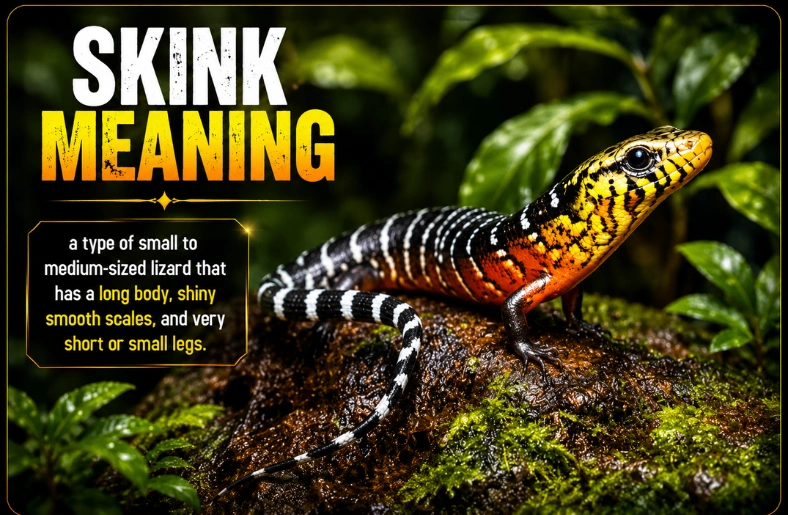
Skink Meaning in one line: a skink is a small, smooth, shiny lizard, and in old Scottish English, the same word also names a soup or a strong drink.
A skink looks like a small, glossy lizard that moves fast across warm ground. Many students first meet this word in a science class or a nature video. Skink also has a second, older sense from Scotland, tied to soup and drink. This page gives you the true Skink Meaning in easy words, with real examples, real animal facts, and clear word history, so you never mix it up again.
Quick Stats : Skink Meaning
| Point | Detail |
|---|---|
| Word / Term | Skink |
| Part of Speech | Noun (also an old verb) |
| Meaning | A small lizard with shiny scales; in Scots, an old word for soup or shin of beef |
| Definition | A smooth-bodied lizard of the family Scincidae; in Scots English, a thick soup or broth |
| Origin / Language | English, from Latin and Greek (lizard sense); Scots and Middle Dutch (soup and drink sense) |
| Pronunciation | SKINK, rhymes with “think” and “pink” |
| Habitat | Found on every continent except Antarctica and the Arctic |
| Lifespan | About 2 to 3 years for small wild skinks, up to 20 years for some kept as pets |
| Synonyms | Lizard, reptile, scincid (animal sense); broth, chowder, stew (soup sense) |
| Antonyms | No true opposite word, since it names one creature and one food |
| Example Sentence | The blue-tongued skink hid under a warm, flat rock. |
| Category | Word Meaning |
Disclaimer: This page is for general learning only. Meanings, word origins, and animal facts are checked against standard dictionaries and trusted references, but spelling, slang, and regional word use can change over time. Folklore and spiritual notes are beliefs, not proven facts. Please confirm important details with a current dictionary or expert source before you rely on them.
Skink Definition
The Skink Definition used by most dictionaries is simple: a skink is a lizard with a smooth, shiny body, short legs, and a long, tapering tail. Some skinks have very tiny legs, and some have no legs at all, so they look a little like a snake at first glance. They live in warm places all over the world, including gardens, sandy ground, leaf litter, and forest floors, in almost every habitat except the coldest polar regions.
A second, older Skink Definition comes from Scotland. There, “skink” names a thick soup, often made from meat or fish stock. This sense also gave an old verb, “to skink,” which meant to pour out a drink for guests at a table.
Skink Meaning In English
The plain Skink Meaning In English has two clear parts:
- Noun (animal): a small, agile lizard with shiny, overlapping scales, short or missing legs, and a long tail that it can drop to escape danger.
- Noun (Scots food) and verb: a thick soup or broth, or the old act of pouring and serving drink to guests.
Both senses are real English words, checked and listed in standard dictionaries. The animal sense is common around the world today, used by scientists, students, and pet owners alike. The soup and drink sense is now mostly seen in Scotland, in food writing, and in older books and poems.
Pronunciation
Say skink like this: SKINK. It rhymes with “think,” “pink,” and “link.” There is one short vowel sound, and the word has just one syllable, so it is quick and easy to say.
Word Origin
The skink that means “lizard” comes from a Latin word, scincus, which came from an older Greek word, skinkos, both used for this same kind of lizard. English writers began using this lizard sense from around the late 1500s, and it has stayed almost unchanged in spelling and meaning ever since.
The skink that means “soup” or “to pour drink” has a completely different root. It likely comes from an old Middle English word, “skynken,” taken from Middle Dutch “schenken” or “schinken,” meaning to pour out drink. This links back further to the Old English word “scencan,” which also meant to pour a drink, and to the German word “schenken.” In Scots English, this pouring sense slowly grew a food sense too, first meaning the shin or knuckle of beef used for a stock, and later meaning any thick, hearty soup made that way. This is why the famous Scottish fish soup, Cullen skink, still carries the word today, even though modern versions use no beef shin at all.
So one small word, skink, actually grew from two completely separate old roots, Latin and Greek on one side, Dutch and Old English on the other, that just happen to sound the same in modern English. Word experts call this kind of pair a “homonym,” two words with one shared spelling and sound but different histories and meanings.
Part of Speech
Skink is mainly a noun. It can name one lizard (“a skink”) or many (“skinks”). In its older Scottish sense, skink can also work as a verb, as in “to skink out the ale,” and it can sit inside a compound noun too, as in “Cullen skink.”
Skink Meaning Verb
The Skink Meaning Verb form is old and rare today. “To skink” meant to pour out a drink and serve it to guests. A host who “skinked” wine was simply pouring it out for others at the table, much like we now say “to pour” or “to serve.” You will mostly meet this Skink Meaning Verb sense in old poems, old plays, or history books about Scotland, not in daily talk.
Types of Skinks
Skinks form a very large lizard family, called Scincidae, with well over a thousand known kinds around the world. In fact, after geckos, skinks make up the second largest group of lizards on Earth. A few common and interesting types include:
- Blue-tongued skink: a heavy-bodied Australian skink known for its bright blue tongue, which it flashes wide open at a threat as a bluff, even though it has no real venom or bite strong enough to matter. It is a popular calm pet, often living 15 to 20 years in captivity.
- Five-lined skink: a small North American skink with pale stripes running down its back. Young five-lined skinks have a bright, electric-blue tail, which fades as they grow older; the blue color helps pull a predator’s attention away from the body and toward the tail instead.
- Fire skink: an African skink with bands of fiery red-orange and black along its sides, which help it blend into dry leaf litter on the forest floor.
- Sand skink and other legless skinks: these have lost their legs over time and “swim” through loose, dry sand using a snake-like, side-to-side motion of the body.
- Solomon Islands skink (monkey-tailed skink): the largest living skink, with a strong, grasping tail much like a monkey’s. Unlike most reptiles, it does not lay eggs; it gives birth to a single, large, live baby.
- Green-blooded skinks (genus Prasinohaema): found only in New Guinea, these skinks have startling lime-green blood, green muscles, and even a green tongue, caused by very high levels of a pigment called biliverdin. In most animals, this much biliverdin would be dangerous, but these skinks appear completely healthy, and scientists still study how they manage it.
Skink Meaning Scottish
The Skink Meaning Scottish sense is about food, not animals. In Scots English, skink is an old word for a thick soup or broth, and it once meant the shin or knuckle of beef used to make that soup. The most famous dish that still carries this word is Cullen skink, a creamy soup made from smoked fish, potato, and onion, named after the small Scottish fishing town of Cullen on the Moray coast. The dish is thought to have grown out of the older beef-shin skink, with local cooks swapping in smoked haddock once it became more plentiful than beef in the late 1800s. If you hear skink on a Scottish menu today, it almost always points to this warm, filling soup, not to a lizard.
Skink Meaning In Hindi
Many Hindi speakers search for the Skink Meaning In Hindi simply as a translation of the animal name. Hindi dictionaries usually give the loan word “स्किंक” (written the same as the English word, just in Hindi script), since there is no single old Hindi word for this exact lizard family. In plain terms, you can explain Skink Meaning In Hindi as “एक प्रकार की छिपकली,” which means “a type of lizard” (please verify the exact regional term with a standard Hindi dictionary, since local names for lizards can change by state).
Skink Meaning In Malayalam
The Skink Meaning In Malayalam has a true local word: “അരണ” (arana). This word is commonly used in Kerala for skinks and other smooth-bodied lizards of a similar shape. So if a Malayalam speaker asks about Skink Meaning In Malayalam, the short, correct answer is “അരണ” (please verify with a standard Malayalam dictionary, since a few related lizard types may share this same local name).
Skink Meaning Spiritual
Some folklore and totem-animal writing gives a Skink Meaning Spiritual angle, built around the lizard’s tail. A lizard, including many skinks, can drop and slowly regrow its tail after a scare. Because of this, some cultures link lizards to ideas like fresh starts, patience, and quick change. This Skink Meaning Spiritual idea is a belief, not a proven fact, and it changes from one culture to another. Please treat this as general folklore information only, and check a trusted cultural or folklore book for your own region’s beliefs.
Skink Meaning Slang
There is no widely used Skink Meaning Slang in standard slang dictionaries today. Unlike some animal names, “skink” has not picked up a common joking or informal sense in everyday talk. If you saw Skink Meaning Slang Urban used somewhere online, it was most likely a private joke, a game character name, or one small online group’s own made-up use, not a word with one fixed slang meaning (please verify any specific slang claim with a current slang dictionary before you trust it).
Skink Meaning Connections
The Skink Meaning Connections worth knowing tie back to word history. The lizard sense links to Latin and Greek. The soup sense links to Dutch, Old English, and Scots. These two paths crossed only by chance, in one small English word that now covers a garden reptile and a bowl of soup at the same time.
Some readers also search skink next to the old line, “the most pernicious race of little odious vermin.” This famous line has no true Skink Meaning Connections at all. It comes from Jonathan Swift’s 1726 book Gulliver’s Travels, spoken by the King of Brobdingnag, who is angry at human beings after hearing about wars and corruption in England, not at lizards or soup. In that line, “vermin” is used as a general word for small, harmful creatures, not as another name for a skink. It helps to know this, so you do not mix up an old book quote with the true Skink Meaning.
Explanation: How Skinks Really Live
To fully grasp the animal side of Skink Meaning, it helps to know a little about how these lizards actually behave in the wild.
Escaping danger. Most skinks can drop their own tail when a predator grabs it, a trick called autotomy. The dropped tail keeps wriggling on the ground, which pulls the predator’s attention away while the skink escapes. A new tail slowly grows back over about three to four months, though it is usually shorter and a little different in shape from the first one.
Staying safe in other ways. Besides dropping the tail, many skinks hiss and puff up their bodies to look bigger and scarier when they feel cornered. Blue-tongued skinks add a dramatic flash of their bright blue tongue as a warning bluff.
Daily habits. Skinks are mostly active in the daytime. They often bask on warm rocks, logs, or open ground to heat their bodies before hunting, then move quickly to catch insects, worms, snails, and other small bugs. Some larger, heavier skinks, like the blue-tongued skink, also eat plants, snails, and even small amounts of fruit.
Family life. Many skink mothers guard their eggs closely, staying near the nest and reacting to any nearby threat. Some skink species do not lay eggs at all; instead, they give birth to live young, already fully formed.
Examples
Here are 18 short, correct uses of skink:
- A skink slipped under the garden fence.
- Two skinks were sunning on the warm steps.
- The blue-tongued skink flicked its tongue.
- Her class studied the skink family for science.
- A legless skink can look like a small snake.
- The fire skink has bright orange sides.
- Skinks eat insects, worms, and small bugs.
- The zoo keeper fed the skink a cricket.
- A skink can drop its tail to escape danger.
- Cullen skink is a famous Scottish fish soup.
- The old host offered to skink out more ale.
- Grandmother’s family called any thick soup a skink.
- A five-lined skink hid in the wood pile.
- The desert skink swims through loose, dry sand.
- This lizard book has a full chapter on skinks.
- The green-blooded skink surprised every science student.
- A monkey-tailed skink gripped the branch with its tail.
- The skink’s new tail was shorter than the old one.
Sentence Examples
- “I found a skink under a flower pot in our garden.”
- “The recipe book had an old Scottish skink soup on page ten.”
- “Our teacher explained that a skink is not the same as a snake.”
- “In the story, the servant would skink wine for every guest.”
- “The pet shop sells blue-tongued skinks as calm, easy pets.”
- “The skink puffed up and hissed when the cat came near.”
Real-Life Examples
Skinks are common garden animals in many warm countries, including large parts of India, where children often spot them near walls, wood piles, or under fallen leaves. In Scotland, Cullen skink still appears on real restaurant menus today, served hot with crusty bread. Some families also keep a blue-tongued skink as a gentle pet, since it stays calm and is easy to handle compared to many other lizards. Wildlife researchers in New Guinea still study the strange, green-blooded skinks of the Prasinohaema group, hoping their unusual biology might one day help doctors understand human blood conditions better.
Common Mistakes
| Wrong | Right |
|---|---|
| “I saw a skunk on the wall” (meaning the lizard) | “I saw a skink on the wall.” |
| “Skink is a kind of snake.” | “A skink is a kind of lizard, not a snake, even when it has no legs.” |
| “Skinks have wet, slippery skin like a frog.” | “Skinks have dry, smooth, shiny scales.” |
| “Two skinkes were in the yard.” | “Two skinks were in the yard.” |
| “A skink and a salamander are the exact same animal.” | “A skink is a reptile; a salamander is a different group, called an amphibian.” |
| “All skinks lay eggs.” | “Most skinks lay eggs, but a few kinds, like the monkey-tailed skink, give birth to live young.” |
Tips To Remember
- Say the word out loud: SKINK rhymes with “think.”
- Picture a small, shiny lizard, not a furry animal, for the common sense of skink.
- Remember: skink the animal has scales; skink the soup has a spoon.
- If you see skink on a Scottish menu, expect soup, not a lizard.
- Keep the spelling steady: s-k-i-n-k, with a plain “s,” not a “sk” mix-up like “skunk.”
- If a “lizard” has no legs and no soup nearby, it may still be a skink, since some skinks are legless.
Synonyms
For the animal sense of skink:
- Lizard: any small reptile with (usually) four legs and a long tail; the general, everyday word.
- Reptile: the wider animal group that includes lizards, snakes, and turtles.
- Scincid: a scientific word for any animal that belongs to the skink family, Scincidae.
For the soup sense of skink:
- Broth: a thin, savory liquid made by cooking meat, fish, or bones.
- Chowder: a thick, creamy soup, often with fish or vegetables, close to how Cullen skink is made.
- Stew: a thick dish of meat or fish cooked slowly with liquid.
Antonyms
A true antonym is hard to give for skink, since it names one real creature and one real food, not a quality like “hot” or “big.” As a light, helpful contrast:
- For the animal sense, a rough opposite idea is mammal (a skink is a cold-blooded reptile, not a warm-furred mammal).
- For the soup sense, a rough opposite idea is dry dish (a skink is a wet, spooned soup, not a dry plate of food).
Similar Or Confusing Words
- Skunk: a furry, black-and-white mammal known for its strong smell. Easy to confuse with skink by spelling alone, though the two animals are not related at all.
- Sink: a bowl for washing, or the act of going down into water. Sounds close to skink but has a completely different meaning.
- Gecko: another type of small lizard, often with sticky toe pads for climbing walls, from a different lizard family than most skinks.
- Salamander: looks a little like a lizard but is actually an amphibian, with moist skin instead of dry scales, and it needs to stay near water far more than a skink does.
- Newt: a small amphibian, closely related to the salamander, and not the same animal group as a skink.
Skink The Lizard vs Skink The Soup
| Point | Skink (Lizard) | Skink (Soup) |
|---|---|---|
| Word Class | Noun | Noun, also an old verb |
| Root | Latin scincus, Greek skinkos | Middle Dutch/Old English pouring word, used in Scots |
| Where It Is Common | Worldwide, in gardens and wild land | Mostly Scotland, in food writing |
| What It Names | A small reptile with scales | A thick soup, once made from beef shin |
| Best Known Example | Blue-tongued skink | Cullen skink |
| Fun Fact | Some skinks have green blood | Cullen skink is named after a Scottish town |
Key Takeaways
- Skink Meaning has two true senses: a small lizard, and an old Scottish word for soup or shin of beef.
- The lizard sense comes from Latin and Greek roots.
- The soup and verb sense comes from Old English and Middle Dutch, through Scots.
- Skinks can drop and slowly regrow their tail, and a few kinds even have green blood.
- Cullen skink is the most famous real dish that still uses this word today.
- The old book line about “the most pernicious race of little odious vermin” is from Gulliver’s Travels and is not truly about skinks.
- There is no fixed Skink Meaning Slang in standard dictionaries today.
Read Also: Decider Meaning
Conclusion
Skink Meaning is simpler than it first looks, once you split it into its two real senses: a small, shiny lizard with some surprising biology, and an old Scottish soup word with its own separate word history. Keep the spelling clear, keep the two senses apart, and you will always use skink the right way, whether you are talking about a garden lizard, a green-blooded scientific wonder, or a warm bowl of Cullen skink.
? Frequently Asked Questions
1. What is the simple Skink Meaning for kids?
A skink is a small, shiny lizard with smooth scales and short legs, or sometimes no legs at all. It moves fast and often hides under rocks or leaves.
2. Is skink a real English word or just a Scottish word?
Both. Skink is a standard English word for a lizard, and it is also a separate, older Scots word for soup or shin of beef.
3. What is the difference between a skink and a gecko?
A skink has smooth, shiny scales and often small legs, while a gecko usually has sticky toe pads for climbing walls. Both are lizards, but from different families.
4. Can skink be used as a verb?
Yes, in old Scots English, “to skink” meant to pour out and serve a drink to guests. This use is rare in modern English.
5. What does Cullen skink mean?
Cullen skink is a thick, creamy Scottish soup made with smoked fish, potato, and onion. The name comes from the Scottish town of Cullen and the old word “skink” for soup.
