
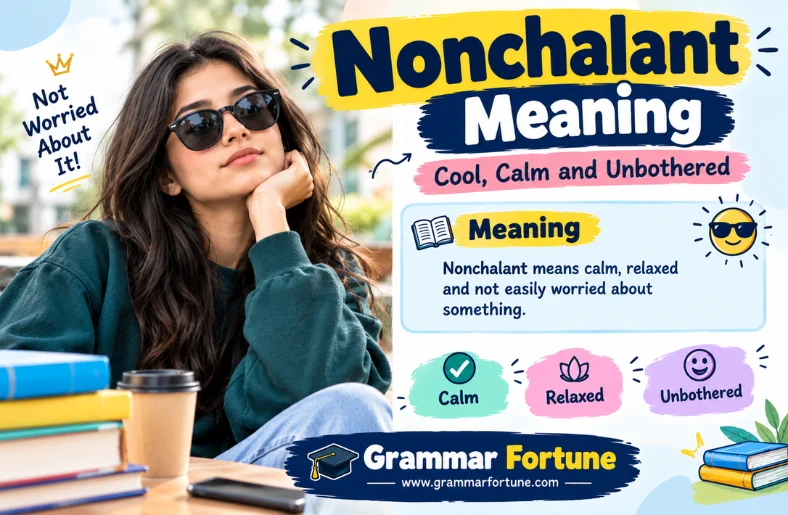
A boy walks into the exam hall with a big smile, while everyone else bites their nails. He is not rude, and he is not sleepy. He simply looks cool and unbothered. English has one special word for that look, and the Nonchalant Meaning is exactly that: calm, relaxed, and acting as if nothing bothers you.
You may have seen it in a cat sitting still on a wall, a goalkeeper before a big kick, or a girl who gets full marks and says, “It was fine.” Each one wears the same easy face. Let us see how this cool little word works, step by step.
Quick Stats: Nonchalant Meaning
| Point | Detail |
|---|---|
| Word / Term | Nonchalant |
| Part of Speech | Adjective |
| Meaning | Calm, relaxed, and not worried or excited |
| Definition | Showing no worry, fear, or strong feeling about something |
| Origin / Language | French |
| Pronunciation | non-shuh-LAHNT (US), NON-shuh-lunt (UK) |
| Synonyms | Calm, casual, carefree, unconcerned |
| Antonyms | Anxious, worried, eager, concerned |
| Example Sentence | She gave a nonchalant shrug and walked away. |
| Category | Word Meaning |
Nonchalant Meaning In Simple Words
A person who is like this stays calm and easy. They do not show worry, fear, or big excitement. They may be talking about a test, a race, or a problem at home, and their face still looks relaxed.
Think of a cat that sits on a wall while a dog barks below. The cat does not jump or run. It just sits and blinks. That is the feeling this word gives.
The calm can come from two places:
- Real calm. The person truly feels fine. They have practised, they are ready, and nothing scares them.
- Hidden worry. The person is nervous inside but keeps a cool face, so nobody can tell.
Because of this, the word is about how a person looks and acts, not always about how the person truly feels. Two children can both look relaxed before a race. One may be ready and happy. The other may be shaking inside. Both can be called by this word.
Nonchalant Meaning In English
In plain English, the word describes a person who acts casual and unbothered. It can describe a face, a voice, a walk, a shrug, a wave, or a whole attitude. People also use it for animals, such as a cat or a horse that stays calm in a noisy place.
Nonchalant Meaning In Chat
In chat and texting, people use it to say someone is acting cool and playing it down. If a friend says, “He was so nonchalant about it,” they mean he acted like it was no big deal. If someone replies to big news with a short “ok cool”, a friend may call that reply nonchalant too.
Most people use the word in a light and friendly way. Sometimes it carries a small hint of teasing, as in, “Why are you so nonchalant? Your team just won!”
Definition
Nonchalant Definition: Showing a calm and relaxed manner, and not seeming worried, excited, or interested in the matter at hand.
Easy version for kids: “Cool and not worried.”
Dictionary-style note: it is an adjective. It always describes a person, an animal, or something a person does, such as a smile, a reply, a tone, or a walk.
What Does Nonchalant Mean In Daily Life
The question What Does Nonchalant Mean has one short answer, but the feeling changes with the place. Here is how it looks in different parts of life.
At school. A student who walks into a class test with a calm face is acting this way. A student who hears a high mark and only gives a small nod is acting this way too. A teacher may like the calm, or may ask, “Do you care about your marks?” It depends on the child’s words and effort.
In sports. Players often look calm before a big kick, throw, or serve. This helps them stay steady. A nonchalant bowler walks back to his mark without showing any worry after a bad ball.
At home. A child who hears thunder and keeps drawing is calm. A brother who is told, “Dinner is ready,” and replies, “Okay,” without looking up is calm in a different way. He may seem lazy to his mother.
In stories. Writers use this word for brave heroes, clever thieves, and cool detectives. The hero walks into danger with a calm step. The writer wants us to feel that the hero is brave and sure.
With friends. A friend who says “No problem” about a big change may be truly fine, or may be hiding a hurt feeling. A kind friend looks at the face and the voice, not only the words.
Is It Good Or Bad?
The word is neither fully good nor fully bad. It depends on the moment.
| Situation | Feels Good Or Bad? | Why |
|---|---|---|
| Staying calm during a fire drill | Good | Calm helps everyone stay safe |
| Staying calm before a speech | Good | Calm helps you speak clearly |
| Shrugging when a friend is sad | Bad | The friend may feel you do not care |
| Acting cool when a teacher gives a warning | Bad | It can look rude |
| Smiling after a small mistake | Good | It shows you can take it in stride |
Meaning In Different Languages
Many readers in India search for this word in their own language. The English explanation stays the same. Only the matching word changes. Each row shows the closest everyday word, how to say it, and what it means.
| Language | Word | Sound | Short Meaning |
|---|---|---|---|
| Hindi | बेपरवाह / बेफिक्र | beparwah / befikr | Free from worry, not bothered |
| Tamil | அலட்சியமான / கவலையற்ற | alatchiyamana / kavalaiyatra | Not caring, free from worry |
| Malayalam | കൂസലില്ലാത്ത / നിസ്സംഗമായ | koosalillatha / nissangamaya | Not afraid, calm and detached |
| Marathi | बेफिकीर / निष्काळजी | befikir / nishkalji | Without worry, easygoing |
| Bengali | উদাসীন / নির্বিকার | udasin / nirbikar | Calm, not moved by anything |
| Telugu | పట్టించుకోని | pattinchukoni | Not paying attention or worrying |
| Gujarati | બેફિકર / બેપરવા | befikar / beparva | Without worry, carefree |
| Punjabi | ਬੇਪਰਵਾਹ / ਲਾਪਰਵਾਹ | beparvah / laparvah | Not caring, free from worry |
| Spanish | despreocupado / indiferente | des-pre-oh-koo-PAH-doh / een-dee-feh-REN-teh | Relaxed, not worried |
Nonchalant Meaning In Hindi
बेपरवाह / बेफिक्र: ऐसा व्यक्ति जो शांत और आराम से रहता है और किसी बात की चिंता नहीं करता। उसके चेहरे पर घबराहट या तनाव नहीं दिखता।
Nonchalant Meaning In Tamil
அலட்சியமான / கவலையற்ற: எதைப் பற்றியும் கவலைப்படாமல், அமைதியாகவும் இயல்பாகவும் இருக்கும் நபர். முகத்தில் பதற்றம் தெரியாது.
Nonchalant Meaning In Malayalam
കൂസലില്ലാത്ത / നിസ്സംഗമായ: ഒന്നിലും ഭയമോ ആശങ്കയോ കാണിക്കാതെ ശാന്തനായി ഇരിക്കുന്ന ആൾ. മുഖത്ത് പരിഭ്രമം കാണില്ല.
Nonchalant Meaning In Marathi
बेफिकीर: कोणत्याही गोष्टीची काळजी न करता शांत आणि निवांत राहणारी व्यक्ती. चेहऱ्यावर ताण दिसत नाही.
Nonchalant Meaning In Bengali
উদাসীন / নির্বিকার: যে মানুষ কোনো কিছু নিয়ে চিন্তা না করে শান্ত ও স্বাভাবিক থাকে। তার মুখে ভয় বা চাপ দেখা যায় না।
Nonchalant Meaning In Telugu
పట్టించుకోని: దేని గురించీ ఆందోళన పడకుండా ప్రశాంతంగా, తేలికగా ఉండే వ్యక్తి. ముఖంలో భయం లేదా ఒత్తిడి కనిపించదు.
Nonchalant Meaning In Gujarati
બેફિકર / બેપરવા: કોઈ વાતની ચિંતા કર્યા વગર શાંત અને આરામથી રહેતી વ્યક્તિ. ચહેરા પર તણાવ દેખાતો નથી.
Nonchalant Meaning In Punjabi
ਬੇਪਰਵਾਹ: ਜਿਹੜਾ ਬੰਦਾ ਕਿਸੇ ਗੱਲ ਦੀ ਚਿੰਤਾ ਕੀਤੇ ਬਿਨਾਂ ਸ਼ਾਂਤ ਤੇ ਆਰਾਮ ਨਾਲ ਰਹਿੰਦਾ ਹੈ। ਉਸ ਦੇ ਚਿਹਰੇ ‘ਤੇ ਕੋਈ ਤਣਾਅ ਨਹੀਂ ਦਿਖਦਾ।
Nonchalant In Spanish
Despreocupado: persona que se mantiene tranquila y relajada, sin mostrar preocupación ni nervios. Indiferente: persona a la que realmente no le importa algo.
Pronunciation
- US sound: non-shuh-LAHNT (the last part is loud)
- UK sound: NON-shuh-lunt (the first part is loud)
- Say “non” like the “non” in “nonstop”.
- The “ch” makes a “sh” sound, as in “shop”. It is not a “ch” as in “chair”.
- The middle “uh” sound is soft, like the “a” in “about”.
Practice by saying these in order: non, non-shuh, non-shuh-LAHNT. Then say the whole word three times slowly.
Word Origin
This word came from French. It comes from an old French word that meant “to be unconcerned”. That French word came from the Latin word calere, which means “to be warm”. So the first sense was “not warm”, or “not heated up about something”.
English speakers started using it around the 1700s (please verify with a standard etymology dictionary). At that time, it was mostly used for people who stayed calm and cool in polite company. Over time, it spread to daily talk, stories, and school books.
The Latin word calere is also a cousin of words like “caldron” and “calorie”, which both have something to do with heat. This is a small memory help: a person who is not heated up, and so stays cool.
Part of Speech and Word Family
It is an adjective. An adjective tells us more about a person or a thing.
| Form | Part of Speech | Example |
|---|---|---|
| nonchalant | Adjective | He gave a nonchalant wave. |
| nonchalantly | Adverb | She nonchalantly packed her bag. |
| nonchalance | Noun | His nonchalance surprised the teacher. |
How The Word Is Built And Used
Where it sits in a sentence. An adjective can sit before a noun or after a verb like “is”, “was”, “looked”, or “seemed”.
- Before a noun: “She gave a nonchalant shrug.”
- After a verb: “She looked nonchalant.”
Words that often go with it. These pairs sound natural and help children write well:
- a nonchalant shrug
- a nonchalant smile
- a nonchalant wave
- a nonchalant attitude
- a nonchalant voice
- a nonchalant air
- looked nonchalant
- stayed nonchalant
- seemed nonchalant
Small grammar tips.
- Use “a” before it, not “an”, because the first sound is “n”.
- For the action, use the adverb: “He walked in nonchalantly.”
- For the feeling as a thing, use the noun: “His nonchalance was clear.”
Nonchalant (Examples)
- Mina gave a nonchalant shrug when her friend asked about the test.
- The cat walked away with a nonchalant air.
- He stayed nonchalant while the crowd cheered.
- Her nonchalant smile hid her nervous heart.
- The goalkeeper looked nonchalant before the big kick.
- She nonchalantly tied her shoes and joined the race.
- His nonchalance made his parents laugh.
- Tom gave a nonchalant reply, but his hands were shaking.
- The pilot spoke in a nonchalant tone to calm the passengers.
- The horse stayed nonchalant, even with the band playing next to it.
Nonchalant In A Sentence
Here are longer lines that show the word in daily life.
- At school: “Even with the result in her hand, Priya kept a nonchalant face and waited for her friends.”
- On the playground: “He gave a nonchalant wave and kicked the ball into the net.”
- At home: “My brother stayed nonchalant when the lights went out, and he just lit a candle.”
- In a story: “The hero walked into the dark cave with a nonchalant step.”
- On a trip: “While the bus shook on the bumpy road, Grandpa read his paper with a nonchalant look.”
- At a party: “She gave a nonchalant laugh when her cake fell, and then she cut a new slice.”
Real-Life Examples
- A cricket player scores a six and simply walks back to his place without any big show.
- A student gets full marks and says, “It was fine,” with a small smile.
- A chef cooks for 100 guests and still hums a song, with no stress on his face.
- A child watches a thunderstorm through the window and keeps eating her snack.
- A bus driver stays calm in heavy traffic and drives with easy hands.
- A girl drops her ice cream, laughs, and says, “Oh well.”
Common Mistakes
| Wrong | Right | Why |
|---|---|---|
| He is a nonchalant. | He is nonchalant. | It is an adjective, so it needs a person or a noun to describe. |
| His nonchalant was surprising. | His nonchalance was surprising. | Use the noun form after “his”. |
| She walked nonchalant into class. | She walked nonchalantly into class. | Use the adverb to describe the action “walked”. |
| Nonchalent or nonshalant | Nonchalant | Spelling: n-o-n-c-h-a-l-a-n-t. |
| An nonchalant smile | A nonchalant smile | The first sound is “n”, so use “a”. |
| Nonchalant always means rude. | It can be calm and polite too. | The tone depends on the situation. |
| Nonchalant means lazy. | Nonchalant means calm and not bothered. | A nonchalant person can still work hard. |
Disclaimer: Word meanings and translations can change a little by region and by community. Please treat this page as general information and check a standard dictionary when you need a firm answer.
Tips To Remember
- Break it in two: non means “not” and chalant comes from “warm”. So it means “not heated up”.
- Picture a cat sitting calmly while a dog barks.
- Say the keyword line: “Cool face, no worry.”
- Link it to its noun: nonchalant, nonchalance, nonchalantly.
- Write three of your own sentences, one about school, one about sports, and one about home.
- Make a small card with the word on one side and a drawing of a calm cat on the other.
- Spell it out loud in four beats: non – cha – lant. Then write it five times.
Nonchalant (Synonyms)
Nonchalant Synonyms are words that point to the same calm feeling.
- Calm: quiet and peaceful
- Casual: easy and not formal
- Relaxed: free from stress
- Carefree: without worry
- Unconcerned: not troubled
- Laid-back: easygoing
- Cool: calm in a smart way
- Composed: steady and in control
- Easygoing: friendly and not strict
- Indifferent: not interested either way
- Unflappable: very hard to upset
- Unruffled: smooth and calm
Nonchalant (Antonyms)
Nonchalant Antonym words show the opposite feeling: worry, excitement, or strong interest. The Opposite Of Nonchalant is any word that shows a person is bothered or very keen.
- Anxious: full of worry
- Worried: afraid something bad may happen
- Concerned: caring and a little troubled
- Nervous: shaky or scared
- Eager: very keen
- Enthusiastic: full of joy and energy
- Excited: thrilled and happy
- Attentive: careful and watching closely
- Tense: tight with worry
- Uneasy: not calm inside
Similar or Confusing Words
- Indifferent: The person truly has no interest.
- Apathetic: The person has no feeling or energy at all.
- Careless: The person does not take care and may make mistakes.
- Calm: The person is peaceful, and it may or may not be on purpose.
- Blasé: The person acts bored, as if nothing is new or special. It is a French word too.
- Insouciant: A fancy word for carefree and light-hearted.
Difference Table
| Word | Main Idea | Example |
|---|---|---|
| Nonchalant | Looks cool and unbothered | He gave a nonchalant smile before the speech. |
| Indifferent | Does not care at all | She was indifferent to the result. |
| Careless | Does not take care | He made careless mistakes in his homework. |
| Calm | Peaceful and steady | The teacher stayed calm during the noise. |
| Apathetic | No feeling or energy | The crowd was apathetic and silent. |
| Blasé | Bored, seen it all | He gave a blasé yawn at the show. |
Quick Way To Choose
- If the person looks cool and may still care inside, use the word of this page.
- If the person truly does not care, use indifferent.
- If the person makes mistakes from not taking care, use careless.
- If the person is only peaceful, use calm.
Easy Phrases With The Same Feeling
These everyday phrases carry a similar mood. They are good for speaking and writing.
| Phrase | Meaning | Example |
|---|---|---|
| Cool as a cucumber | Very calm in a hard moment | She was cool as a cucumber on stage. |
| Take it in stride | Handle a problem without fuss | He took the loss in stride. |
| Shrug it off | Not let something bother you | She shrugged off the joke. |
| Not bat an eye | Show no surprise | He did not bat an eye at the news. |
| Keep a straight face | Show no feeling | I kept a straight face during the joke. |
| Go with the flow | Stay easy and flexible | We went with the flow on the trip. |
Quick Practice Questions
Try these short questions. Answers are given at the end.
A. Pick the closest word.
- A student smiles calmly before a test. Which word fits? (nonchalant / anxious)
- A boy is shaking and sweating before the race. Which word fits? (nonchalant / nervous)
B. Fill in the blank with nonchalant, nonchalantly, or nonchalance.
- He walked ______ into the room.
- Her ______ made the teacher smile.
- Ravi gave a ______ shrug.
C. Say if the sentence is right or wrong.
- “She is a nonchalant.” (right / wrong)
- “He gave a nonchalant wave.” (right / wrong)
Answers: 1. nonchalant. 2. nervous. 3. nonchalantly. 4. nonchalance. 5. nonchalant. 6. wrong (use “She is nonchalant.”). 7. right.
Key Takeaways
- The word describes a person who is calm, relaxed, and not bothered.
- It is an adjective. The noun is nonchalance, and the adverb is nonchalantly.
- It came from French, and the old root means “not warm”.
- Close words: calm, casual, carefree. Opposite words: anxious, worried, eager.
- It is different from careless and from indifferent.
You can also explore the meaning and usage of other English words below.
- DSL Meaning Slang
- What Does Wyll Mean In Text
- Wtms Meaning In Text
- Type B Personality
- Ethos Meaning
- PMO Meaning Slang
- Crush Meaning In Hindi
- Gorgeous Meaning In Hindi
- Unalive Meaning
- Effervescent Meaning
- Wassup Meaning In Hindi
- Euphemism Definition
- Sodomy Definition
- Marple Definition
- What Does ISS Mean on a Driver’s License
- Insolence Meaning
Conclusion: Nonchalant Meaning
The Nonchalant Meaning is easy to understand: it describes someone who stays calm and relaxed without showing much worry or excitement. Depending on the situation, this attitude can show confidence or seem uncaring. Practice using the word in simple sentences to remember its meaning and use it correctly.
Frequently Asked Questions
1. What does nonchalant mean?
It means calm, relaxed, and not showing worry or excitement. A person with this nature acts as if a problem is small, even when it may be big. The Nonchalant Meaning is about the cool look, not always about the real feeling.
2. Is this word good or bad?
It depends on the case. Staying calm in a hard moment is a good thing. Acting as if you do not care about other people can feel rude.
3. What is the opposite of nonchalant?
The Opposite Of Nonchalant includes anxious, worried, eager, concerned, and excited. These words show strong feeling.
4. What is the difference between nonchalant and indifferent?
A nonchalant person may look calm but still care inside. An indifferent person truly does not care.
5. What is the difference between nonchalant and careless?
A nonchalant person looks cool. A careless person does not take care and may make mistakes. A calm student can still check every answer, so calm does not mean careless.
