
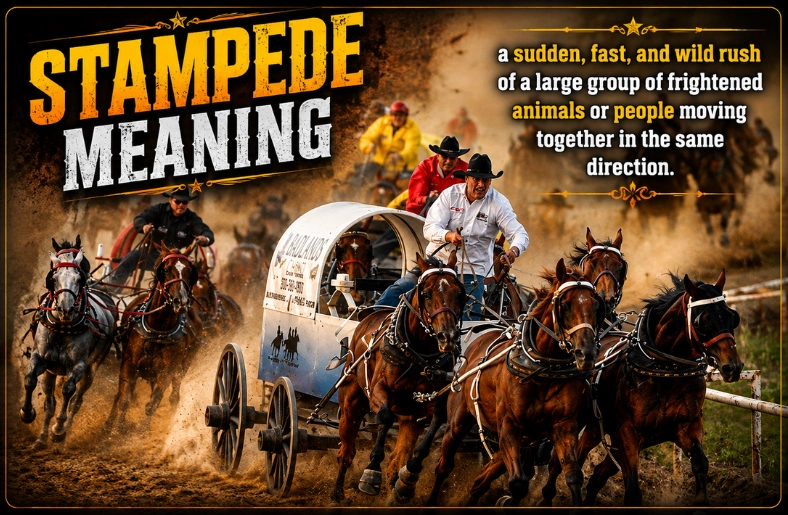
Stampede meaning in simple words is a sudden, wild rush of people or animals running in the same direction, often out of fear or panic, with little or no control.
Have you ever heard the word stampede on the news? It sounds scary, and it often is. This word shows up when we talk about wild animals running in fear. It also shows up when a big crowd of people rushes at once. Let’s look at the full stampede meaning in a clear, easy way. By the end of this page, you will know how to spell it, say it, and use it correctly in your own sentences.
Quick Stats :
| Point | Detail |
|---|---|
| Word / Term | Stampede |
| Part of Speech | Noun, Verb |
| Meaning | A sudden, wild rush of people or animals in one direction, caused by fear or panic |
| Definition | A fast, uncontrolled rush that happens without warning |
| Origin / Language | From American Spanish “estampida,” meaning a crash or loud noise |
| Pronunciation | stam-PEED |
| Syllables | 2 (stam-pede) |
| Synonyms | Rush, charge, flight, dash, bolt |
| Antonyms | Calm, stillness, order, quiet |
| Example Sentence | The loud noise caused a stampede of horses across the field. |
| Category | Word Meaning |
| First Known Use | Around the mid-1800s, in American English |
Disclaimer: This page is for general learning only. Stampede meaning and regional translations can vary by area, dictionary, and context. Please verify with a trusted dictionary or grammar source before official or academic use.
Definition
The simple definition of stampede is a sudden, fast rush of a large group. This group can be made of people or animals. The rush happens all at once, and it is not planned ahead of time. There is little or no order in a stampede. Everyone or everything just moves fast, often pushing forward without thinking.
A stampede is different from a normal rush. A normal rush might be a few people hurrying to catch a bus. A stampede is much bigger. It involves many bodies moving together, often in fear.
Meaning
The stampede meaning points to a moment when many people or animals move together, fast and without order. This can happen with cattle on a farm. It can also happen with people in a crowded place, like a train station or a stadium.
The key ideas inside the stampede meaning are:
- Speed: Everything happens fast.
- Fear: Something scary or shocking starts it.
- Lack of control: No one is guiding the group calmly.
- Group movement: It is never just one person or animal. It is always a group.
When you hear the word stampede, think of a fast group moving together because something has frightened them.
Pronunciation
We say stampede like this: stam-PEED. The stress falls on the second part, “peed.” Try saying it slowly first: stam… peed. Then say it a little faster: stam-peed. Then try it at normal speed: stampede.
Here is a simple sound guide for young readers:
- stam (rhymes with “ham”)
- peed (rhymes with “seed”)
Say both parts together, and put more force on “peed.”
Word Origin and History
The word stampede comes from American Spanish. The Spanish word “estampida” means a loud crash or a sudden noise. Cowboys in the American West used this word when a herd of cattle suddenly ran wild, often at night, because of a loud sound like thunder or a gunshot.
Over time, English speakers in the United States began to use stampede for cattle that ran in fear. Later, people started using the same word for any large group, human or animal, that suddenly rushed together. Today, the word is used all over the world, in news reports, in stories, and in daily talk. (please verify exact dates with a standard English dictionary)
Part of Speech
Stampede can be a noun or a verb.
- As a noun: “There was a stampede at the market.”
- As a verb: “The cows began to stampede across the field.”
- Past tense (verb): “The horses stampeded when they heard thunder.”
- Present participle: “The animals are stampeding toward the gate.”
This flexibility makes stampede a useful word. You can use it to name the event (noun) or to describe the action (verb).
How a Stampede Happens (Explanation)
Let’s break down the stampede meaning into small, simple parts, step by step.
Step 1: A Trigger Happens
A stampede almost always starts with one small event. This is called a trigger. A trigger could be:
- A loud sound, like thunder or a gunshot
- A sudden fire or smoke
- A scary sight, like a wild animal
- A rumor that spreads fast in a crowd
Step 2: One Person or Animal Reacts First
After the trigger, one person or animal reacts. They might jump, run, or scream. This first reaction is small, but it is very important.
Step 3: Others Copy the Reaction
Here is the tricky part. Other people or animals see the first reaction, and they copy it without stopping to think. This is sometimes called “herd behavior.” Nobody plans it. It just spreads, like a wave.
Step 4: The Whole Group Moves Together
Soon, the whole group is running in the same direction. This is the full stampede. At this point, it is very hard to stop, because everyone is moving fast and close together.
This is the heart of the stampede meaning: one small spark can cause a huge, fast reaction in a crowd or a herd.
Human Stampede Meaning
The human stampede meaning refers to a crowd of people rushing at once, often in a tight or crowded space. This can happen at festivals, train stations, religious events, or sports matches. People push forward without thinking about safety, often because they are scared or excited.
Sadly, a human stampede can cause real harm. People may fall, or they may get pressed together too tightly. This is why safety planning is so important at big public events. Event organizers often study crowd size, exits, and space to prevent a human stampede from starting.
Stampede Meaning in Medical
In a medical setting, doctors and rescue teams use the word stampede to describe crowd-crush injuries. The stampede meaning in medical reports usually points to problems like:
- Trouble breathing, because of tight pressure on the chest
- Bruises and cuts from falling or being pushed
- Broken bones, especially in the arms, legs, or ribs
- Fainting, from lack of air or heat
These injuries happen when too many bodies press against each other in a small space during a stampede. Medical teams often set up help stations near large events for this reason. (please verify current medical guidance with a trusted health source)
Tragic Stampede Meaning
A tragic stampede meaning points to an event where a stampede caused serious harm, injury, or loss of life. News reports often use the word “tragic” right before stampede when many people are hurt. This shows how serious and sad such events can be.
A tragic stampede is usually followed by safety reviews. Officials look at what went wrong, such as small exits, poor planning, or too many people in one place. The goal is to learn from the tragedy and stop it from happening again.
Crowd Stampede Meaning
A crowd stampede meaning is close to the human stampede meaning, but it focuses more on the size and shape of the crowd itself. It talks about a large group of people who suddenly rush together, often at a public event like:
- A concert gate opening
- A big holiday sale
- A religious gathering
- A sports stadium exit
A crowd stampede often happens because the space is too small for the number of people trying to move through it at once.
Rally Stampede Meaning
A rally stampede meaning points to a rush of people at a political rally or a large public gathering. When a big crowd gathers to hear a speaker, a small panic, like a loud noise or a sudden push, can turn into a rally stampede if there is not enough space, enough exits, or a good safety plan.
Stampede Meaning in Regional Languages
Many readers search for the stampede meaning in their own language. Here is a simple look at how the idea appears in other languages, written for you in English:
- Stampede meaning in Hindi: The idea matches the Hindi word “भगदड़” (bhagdad), which describes a chaotic, fearful rush of a crowd. (please verify with a standard Hindi dictionary)
- Stampede meaning in Tamil: The idea is close to “கூட்ட நெரிசல்” (koota nerisal), which points to a crowd pushing and rushing together. (please verify with a standard Tamil dictionary)
- Stampede meaning in Malayalam: The idea connects to crowd-crush situations, sometimes described using words for pushing and trampling in a crowd. (please verify with a standard Malayalam dictionary)
- Stampede meaning in Telugu: The idea matches “తొక్కిసలాట” (tokkisalata), a word used for a crowd rush or trample event. (please verify with a standard Telugu dictionary)
- Stampede meaning in Kannada: The idea is close to “ಕಾಲ್ತುಳಿತ” (kaltulita), used for crowd-crush or trampling events. (please verify with a standard Kannada dictionary)
- Stampede meaning in Marathi: The idea connects to “चेंगराचेंगरी” (chengrachengri), a word often used in Marathi news for a crowd stampede. (please verify with a standard Marathi dictionary)
- Stampede meaning in Bengali: The idea connects to “পদদলিত” (poddolito) events, describing people being trampled in a crowd rush. (please verify with a standard Bengali dictionary)
Note: These are common words used in regional news reports to describe stampede-like events. Spelling and word choice can change by region. Please check a trusted dictionary in each language for the most exact word.
Types of Stampedes
Not every stampede looks the same. Here are the main types you might read about:
- Animal Stampede: A herd of animals, like cattle, horses, or wild deer, runs together in fear.
- Human Stampede: A crowd of people rushes together, often in a tight public space.
- Panic-Driven Stampede: Starts from sudden fear, like a fire alarm or loud noise.
- Excitement-Driven Stampede: Starts from excitement, like a sale opening or a star arriving.
- Exit Stampede: Happens when many people try to leave through a small exit at once.
20 Examples of Stampede
- The stampede of elephants shook the ground as they ran.
- A fire alarm caused a stampede near the exit doors.
- The bulls began to stampede the moment the gate opened.
- Excited fans caused a small stampede to reach the stage.
- The herd’s stampede lasted only two or three minutes.
- Police controlled the stampede with quick, calm action.
- A loud thunderclap can stampede a herd of horses at night.
- The market sale led to a stampede at the front entrance.
- Wild deer often stampede when they sense a predator nearby.
- The stampede left the open field full of dust and noise.
- Guards tried to stop the stampede before anyone could fall.
- A sudden stampede broke out during the crowded festival.
- The zebras began to stampede across the wide, open plain.
- A small child was lifted away from the dangerous stampede.
- The stampede of shoppers surprised the small store staff.
- A gunshot sound started a wild stampede among the cattle.
- The train station saw a small stampede during rush hour.
- Rescue workers were ready in case of a stampede at the gate.
- The stampede of tourists rushed toward the famous viewpoint.
- A loud drum suddenly caused the goats to stampede downhill.
Sentence Examples
- “Stay calm, or this crowd could stampede,” warned the safety guard.
- The stampede started the moment the large doors opened.
- Nobody expected the cattle to stampede so early that morning.
- The stampede was over in less than a minute, but it felt much longer.
- Event planners built wide exits to prevent a stampede.
Real-Life Examples
Stampedes are often reported in news stories from around the world. Common real-life settings include:
- Religious gatherings, where huge crowds walk together in a small space.
- Sports stadiums, where fans rush toward exits or entry gates.
- Shopping sales, where large crowds push to be first inside a store.
- Wildlife reserves, where herds of animals run from sudden danger, like a predator or a loud vehicle.
(please verify any specific event details with a trusted news source before using them in a school project)
Common Mistakes
| Wrong | Right |
|---|---|
| The horses stampeded, they ran fast. | The horses stampeded and ran fast. |
| A stampede are dangerous. | A stampede is dangerous. |
| He stampede across the room. | He stampeded across the room. |
| The stampede was cause by loud noise. | The stampede was caused by a loud noise. |
| Many stampede happen every year. | Many stampedes happen every year. |
Tips to Remember
- Think of “stamp” plus “speed” to recall the fast, heavy footsteps of a stampede.
- A stampede is always sudden. It is never slow or planned ahead of time.
- Use it for both people and animals, not just one group.
- Remember that fear or panic almost always starts a stampede.
- Add “-d” for the past tense: stampede becomes stampeded.
Synonyms with Meanings
- Rush: A fast, sudden movement of a group toward one place.
- Charge: A quick, forward push, often used for animals or soldiers.
- Flight: A fast escape from danger or fear.
- Dash: A short, quick run, usually by a small number of people.
- Bolt: A sudden, fast run, often used for a scared animal or person.
Antonyms with Meanings
- Calm: A quiet, still, and controlled state.
- Order: A neat, planned, and controlled way of moving.
- Stillness: No movement at all.
- Quiet: Free from noise, panic, or sudden action.
Similar or Confusing Words
- Stampede vs Riot: A riot is often violent and can be planned in anger. A stampede is usually driven by panic and is not planned.
- Stampede vs Crowd: A crowd is simply many people gathered together. A stampede is that crowd moving fast and without control.
- Stampede vs Migration: A migration is a planned, slow movement of animals, often for food or weather. A stampede is sudden and driven by fear.
- Stampede vs Chaos: Chaos means general confusion. A stampede is one specific kind of chaos, tied to fast group movement.
Comparison Table: Stampede vs Related Words
| Word | Speed | Cause | Group Size | Planned? |
|---|---|---|---|---|
| Stampede | Very fast | Fear or panic | Large | No |
| Riot | Fast | Anger | Large | Sometimes |
| Migration | Slow | Food, weather | Large | Yes |
| Dash | Fast | Various | Small | Sometimes |
| Rush | Fast | Urgency | Small to large | Sometimes |
Safety Tips During a Stampede
If you are ever near a large crowd, these simple tips can help:
- Stay near a wall or edge, away from the center of the crowd.
- Keep your arms close to your chest to protect your breathing space.
- Move sideways, not against the flow of the crowd.
- Avoid bending down to pick up dropped items.
- Look for open exits before the crowd gets too large.
These are general safety ideas. Please follow instructions from event staff, police, or teachers during any real event.
Key Takeaways
- The stampede meaning is a sudden, fast rush caused by fear or panic.
- Stampede works as both a noun and a verb, with the past tense stampeded.
- A human stampede can be very dangerous in tight, crowded spaces.
- The word comes from the Spanish word “estampida,” first used for cattle.
- There are different types, including animal, human, panic-driven, and exit stampedes.
- Synonyms include rush, charge, dash, and bolt.
- Antonyms include calm, order, stillness, and quiet.
Read Also: Soulmate Meaning In Hindi
Conclusion
Now you know the full stampede meaning and how to use it correctly in a sentence. This word shows up often in news stories, animal documentaries, and everyday talk. Remember, a stampede is always fast, sudden, and usually caused by fear. Keep this word ready the next time you read about a crowd, a herd, or a sudden rush in a story or a report.
? Frequently Asked Questions
1. What is the simple stampede meaning?
The stampede meaning is a sudden, fast rush of people or animals, usually caused by fear or panic.
2. Is stampede a noun or a verb?
Stampede can be both. It works as a noun (“a stampede happened”) and as a verb (“the herd began to stampede”).
3. What causes a human stampede?
A human stampede often starts from a loud noise, a fire, smoke, or a scary rumor spreading fast in a crowded space.
4. What does tragic stampede meaning point to?
It points to a stampede event where people were badly hurt or lost their lives, often reported in serious news stories.
5. How is stampede different from a riot?
A stampede comes from panic and fear, while a riot often comes from anger and can be somewhat planned.
