
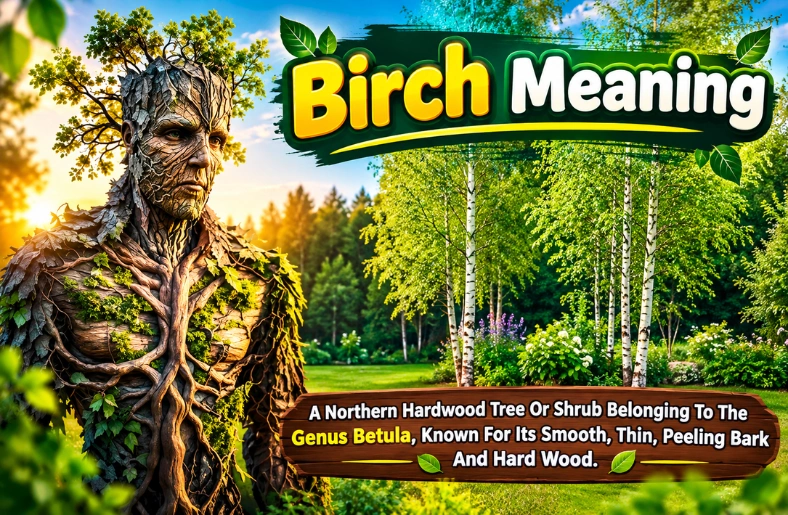
Birch Meaning refers to a type of tree known for its slender trunk, delicate branches, and smooth, often papery bark. Birch trees are commonly found in cooler regions and are easily recognized by their light-colored trunks. The word can also have an older English use related to a birch stick.
You may have seen a birch tree in a park, nature book, photograph, or story and wondered what birch actually means. Students often search for this word while studying English vocabulary or reading about trees and nature. This guide explains the Birch Meaning in simple words, along with its types, history, common uses, and meanings in Hindi, Marathi, and other Indian languages.
Quick Stats : Birch Meaning
| Point | Detail |
|---|---|
| Word / Term | Birch |
| Part of Speech | Noun (also used as a verb and an adjective) |
| Meaning | A tall tree with thin, peeling bark; older use: to hit with a birch stick |
| Definition | A birch is a tree from the Betula family, known for its smooth, papery bark |
| Genus | Betula |
| Family | Betulaceae |
| Origin / Language | Old English word “birce,” from old Germanic roots |
| Pronunciation | “burch” (rhymes with “church”) |
| Typical Height | 12 to 30 metres (about 40 to 100 feet), depending on the type |
| Typical Lifespan | 40 to 90 years for most kinds (please verify with a forestry book, as it can change by species) |
| Synonyms | birch tree, birchwood, silver birch |
| Antonyms | Not strong for the tree sense; for the old verb sense: to pet, to caress |
| Example Sentence | The silver birch stood tall beside the frozen lake. |
| Category | Word Meaning |
Disclaimer: Meanings and regional-language translations can vary by dictionary, area, and local use. Please treat this content as general information, not as a strict or official reference.
Definition
A birch is a tree. It has a thin trunk and light-colored bark. The bark often peels off in thin, paper-like layers, almost like the tree is shedding old paper. Birch trees belong to the plant genus Betula, which is part of the larger Betulaceae family. This family also includes trees like alder and hazel.
The word “birch” can also be a verb. “To birch” means to hit someone with a thin birch stick, usually as an old form of punishment. This old use is rare now, but it still appears in old books, court records, and word lists. This double meaning, tree and old punishment, is the full Birch Meaning that most dictionaries record.
Meaning
The core Birch Meaning has three parts:
- As a noun: A birch is a tree, often with white, grey, or silver bark, that grows in cold and cool places. This is the most common and modern use of the word.
- As a verb (old use): To birch someone means to punish them by hitting them with a bundle of thin birch branches. Schools and courts used this method long ago. In fact, “birching” was a real legal punishment in parts of Britain and the Isle of Man until the twentieth century. (please verify exact dates with a history reference book)
- As an adjective: The word can describe what something is made from or looks like, as in “birch bark,” “birch syrup,” or “birch furniture.”
Most students will use the noun meaning. The verb and adjective meanings are good to know for reading old stories, history lessons, or word puzzles.
Birch Meaning In English
Birch Meaning In English is simple and direct: it names a real tree from the Betula genus, known for its smooth, light bark and small, jagged leaves. In everyday English, “birch” almost always refers to the tree or things made from it, such as birch furniture or birch syrup.
English speakers rarely use the old verb sense today. If you read “birch” as a verb in a book, it is likely an old or historical text. In modern spoken English, “birch” is a plain, simple noun that any student can learn in one sitting.
Interestingly, the English word “birch” shares a very old root with the Sanskrit word “bhurja,” the source of the Hindi word “Bhojpatra.” Both words trace back to an ancient root that meant “to shine” or “white,” because the bark of the tree looks pale and bright. This is a nice link between Birch Meaning In English and Birch Meaning In Hindi, even though the two languages grew far apart over thousands of years.
Birch Meaning In Different Indian Languages
Birch trees do not grow in most parts of India. They grow mainly in the cold Himalayan hills, where winters are long and the ground is often covered in snow. Because of this, many Indian languages simply borrow the English word “birch” and write it in their own script. A few languages also have an old, special word for the Himalayan birch, since its bark had a real historical use.
Birch Meaning In Hindi
Birch Meaning In Hindi is often given as “भोजपत्र” (Bhojpatra), which is the special Himalayan birch tree. Its bark is thin, smooth, and easy to write on, so old scholars once used it like paper for holy texts and manuscripts. In simple daily talk, people also just say “बर्च वृक्ष” (Birch Vriksh), which means “birch tree.”
Birch Meaning In Marathi
Birch Meaning In Marathi is close to Hindi, since both languages share many Sanskrit-based words. People say “भूर्ज वृक्ष” (Bhurja Vruksha) or simply “बर्च झाड” (Birch Zhad), which means “birch tree.” (please verify with a Marathi dictionary for your exact region, as local use can differ)
Birch Meaning In Telugu
Birch Meaning In Telugu is usually written as “బిర్చ్ చెట్టు” (Birch Chettu), which means “birch tree” in a simple, direct way. Since birch is not a local tree in the Telugu-speaking regions, this is mostly a borrowed, transliterated term.
Birch Meaning In Tamil
Birch Meaning In Tamil is commonly “பிர்ச் மரம்” (Birch Maram), where “maram” means “tree.” Tamil speakers usually meet this word in science lessons or nature books, rather than in daily life.
Birch Meaning In Bengali
Birch Meaning In Bengali is often “বার্চ গাছ” (Birch Gachh). “Gachh” is the Bengali word for “tree,” so this term simply means “birch tree,” used mainly in geography or nature study.
Birch Meaning In Kannada
Birch Meaning In Kannada is usually “ಬರ್ಚ್ ಮರ” (Birch Mara), where “mara” means “tree.” As with other South Indian languages, this word is a simple, borrowed form.
Birch Meaning In Gujarati
Birch Meaning In Gujarati is commonly “બિર્ચ વૃક્ષ” (Birch Vruksh), which again means “birch tree.” Gujarati, like Hindi and Marathi, sometimes also uses the older Sanskrit-linked word for the Himalayan birch.
Birch Meaning In Malayalam
Birch Meaning In Malayalam is often “ബിർച്ച് മരം” (Birch Maram), where “maram” means “tree.” This word usually appears in school science books rather than in everyday conversation.
Note: Word forms in regional languages can change by area, script style, and local use. Please treat these as simple, general translations and check a trusted regional dictionary if you need the exact spelling for schoolwork.
Pronunciation
Say birch like this: “burch.” It rhymes with “church” and “lurch.” There is only one small sound part (one syllable), so it is quick and easy to say.
In simple sound spelling: b + ur + ch, said together fast, like “BURCH.”
Word Origin
The word “birch” comes from the Old English word “birce” or “beorc.” This came from an older Germanic root, often written as berkijon in old Proto-Germanic language studies. That root, in turn, comes from an even older root shared across many languages, one that meant “to shine, to be white or bright.” This is why the birch tree got its name: its bark is often pale, shining, and bright compared to darker tree bark.
This same ancient root is thought to connect to the old Sanskrit word “bhurja,” which is the source of the Hindi and Sanskrit word “Bhojpatra.” So the English “birch” and the Hindi “Bhojpatra” may share a very old family link, even though English and Hindi grew apart thousands of years ago.
There is also an old cultural link: in the runic alphabet once used by Germanic peoples, one letter was called “Berkano” or “Birca,” named after the birch tree. This rune was often linked with new growth, spring, and fresh beginnings, since birch trees are often some of the first to grow new leaves after a long winter.
Part of Speech
Birch is mostly used as a noun (a naming word for the tree). For example: “The birch grew tall by the fence.”
It can also work as a verb in old English, meaning “to hit with a birch stick.” For example: “The old schoolmaster would birch students who misbehaved.”
It can even be used as an adjective in phrases like “birch bark,” “birch syrup,” or “birch furniture,” where it describes what something is made from or comes from.
Types of Birch Trees
There are several kinds of birch trees around the world. Each type has its own bark color, shape, and home region.
- Silver Birch – has smooth, silvery-white bark; very common in parks and gardens across Europe. The Silver Birch Meaning is simply “the birch tree with shining, silver-white bark,” and it is one of the most well-known types.
- Paper Birch – its bark peels off like thin paper; found in cold North American forests. Native peoples once used this bark for canoes and baskets.
- Yellow Birch – has golden-yellow, curling bark, and grows slowly for a very long time compared to other birches.
- River Birch – grows near rivers and wet ground; has reddish-brown, flaky bark, and handles wet soil better than most birches.
- Himalayan Birch – grows in the cold Himalayan hills; its bark was once used for old writing (this is the tree behind the Hindi word “Bhojpatra”).
- Black Birch (Sweet Birch) – has dark bark and a faint, sweet smell, once used to flavor old-style birch beer.
- Downy Birch – common across northern Europe and parts of Russia, with soft, slightly hairy young twigs.
- Dwarf Birch – a very small, low, shrub-like birch that grows in cold, mountainous, or arctic areas.
Explanation
A birch tree is easy to spot once you know what to look for. Look for a thin trunk with pale bark that peels in thin sheets, almost like old paper. The leaves are small, with jagged, saw-like edges, and are shaped like a triangle or a small heart. In spring, birch trees grow small, hanging flower clusters called catkins.
Birch trees grow fast compared to many other trees. They like cold and cool weather, and they often grow well in poor, sandy soil where other trees struggle. Because of this, birch is often one of the first trees to grow back in a forest after a fire or after land has been cleared.
You will often see birch trees in forests, parks, and gardens in northern countries such as Russia, Finland, Canada, and the United Kingdom. In fact, the birch is closely linked with Russian culture and countryside, and the silver birch is sometimes called Finland’s national tree.
The word Birch Meaning can also point to an old form of punishment. Long ago, teachers and even courts used a bundle of birch twigs, tied together, to hit people who broke rules. This old use gave rise to the phrase “to give someone the birch.” Today, this method is no longer used, but the phrase still appears in older books and in history lessons.
There is also a small bit of Birch Meaning Slang. In old British slang, “the birch” meant a beating, and “to birch” someone meant to punish them physically. This slang use is now mostly found in history books and old dictionaries, not in daily talk.
Cultural and Real-Life Uses
Birch trees are useful in many real ways, not just as a pretty tree to look at:
- Furniture and Wood: Birchwood is light, strong, and pale, so people use it to make chairs, tables, toys, and even plywood for building.
- Canoes and Baskets: Long ago, Native American tribes such as the Ojibwe made canoes and baskets from strong, waterproof birch bark.
- Syrup: Birch sap can be boiled down into a sweet syrup, much like maple syrup, though it takes more sap to make the same amount.
- Birch Beer: In parts of North America, the sweet-smelling bark of the black birch was once used to flavor a fizzy drink called birch beer.
- Sports Equipment: Birch and birch plywood are used to make items like hockey sticks, snowshoes, and even ice-cream sticks.
- Sauna Traditions: In Finland and other Nordic countries, people use soft bundles of birch leaves and twigs, called a “vihta” or “vasta,” to gently tap their skin in a sauna for warmth and freshness.
- Paper and Old Writing: The bark of the Himalayan birch was once used like paper for old manuscripts and holy texts in the Himalayan region.
- Spring Festivals: In parts of Europe, fresh birch branches are used to decorate homes and maypoles during spring and early summer festivals, as a sign of new life.
- Health and Sweeteners: A natural sugar called xylitol, often used in sugar-free chewing gum, can be made from birch bark and wood. (please verify current sourcing with a science reference, as production methods can vary)
Examples
- The birch tree lost all its leaves in winter.
- We saw a row of silver birch trees near the park gate.
- The old book said the teacher would birch naughty students.
- Birch bark can be peeled off in thin white sheets.
- My grandfather built a small box from birchwood.
- The forest was full of tall, pale birch trees.
- Birch sap can be turned into a sweet syrup.
- The paper birch gets its name from its paper-thin bark.
- Birds often nest in the branches of a birch tree.
- The river birch grows well near wet, muddy banks.
- In old England, “the birch” was a tool for punishment.
- The yellow birch has bark that curls at the edges.
- Birch leaves turn golden yellow in the fall.
- The Himalayan birch bark was once used to write holy texts.
- Our school garden has two young birch trees.
- The dwarf birch barely grows taller than a small bush.
- Finnish families often keep a bundle of birch twigs for the sauna.
- Old canoes were sewn together using strips of birch bark.
- The black birch has a faint, sweet smell in its bark.
- Villagers once decorated the maypole with fresh birch branches.
Sentence Examples
- “That white tree with peeling bark is a birch,” said the teacher.
- The wind shook the thin branches of the birch tree.
- “Do you know the Birch Meaning?” asked Riya during the quiz.
- The silver birch outside our window looks lovely in the snow.
- The old text explained how a birch stick was once used for punishment.
- Our nature guide pointed out a tall paper birch by the trail.
Common Mistakes
| Wrong | Right |
|---|---|
| “Birch” and “Beech” mean the same tree | Birch and beech are two different trees |
| Birtch | Birch |
| Only spelled with a capital B | “Birch” is a common noun, so it does not need a capital letter unless it starts a sentence |
| “Berch” | Birch |
| Thinking birch only means a tree | Birch can also be a verb meaning “to whip with a birch stick” |
| Mixing up birch bark with normal tree bark | Birch bark is thin and peels in sheets, unlike most rough tree bark |
| Thinking all birch types look the same | Different types, like silver, paper, and river birch, have different bark colors |
Tips to Remember
- Think of “birch” and “bright,” since birch bark looks bright and pale.
- Picture peeling white bark to remember the tree.
- Remember: birch rhymes with “church.”
- Keep “birch” (tree) and “beech” (a different tree) apart by their spelling: “i” for birch, “ee” for beech.
- The Birch Meaning as a verb is old and rare, so use it only when reading old texts.
- Link the tree’s name to its use: think “b” for both “birch” and “bright bark.”
Synonyms
| Word | Short Meaning |
|---|---|
| Birch tree | Another simple way to say “birch” |
| Birchwood | Wood that comes from a birch tree |
| Silver birch | A common type of birch with silvery bark |
Antonyms
Birch, as a tree name, does not have a true opposite word, since it names one specific kind of tree. For the old verb sense (to hit), a loose antonym would be:
| Word | Short Meaning |
|---|---|
| Pet | To touch gently and kindly |
| Caress | To touch softly, with care |
Birch vs Beech
Students often mix up “birch” and “beech” because the words look and sound similar. Here is a simple table to keep them apart.
| Point | Birch | Beech |
|---|---|---|
| Bark | Thin, peels like paper | Smooth, does not peel |
| Color | Silver, white, or grey | Grey-brown |
| Leaves | Small, jagged edges | Oval, smooth edges |
| Growth Speed | Fast | Slower |
| Common Use | Furniture, canoes, syrup | Furniture, flooring |
| Common Confusion | Spelled with “i” | Spelled with “ee” |
Key Takeaways
- The main Birch Meaning is “a tall tree with thin, peeling, pale bark,” from the genus Betula.
- Birch can also be an old verb meaning “to hit with a birch stick,” and an adjective describing birch-made items.
- The Silver Birch Meaning points to a common, silvery-barked type of birch, popular in parks.
- Birch Meaning In English centers on the tree itself, while old slang and verb uses are now mostly historical.
- In Hindi, Birch Meaning In Hindi often links to “Bhojpatra,” the Himalayan birch, once used for writing.
- In most other Indian languages, the word is a simple transliteration of “birch tree,” since the tree is not local.
- Birch has many real-life uses: furniture, canoes, syrup, sauna traditions, and even sugar-free sweeteners.
Read Also: Serendipity Meaning
Conclusion
Now you know the full Birch Meaning, from its simple tree sense to its old verb use, its many types, and its real-life uses around the world. You also learned how the word appears in Hindi, Marathi, Telugu, Tamil, Bengali, Kannada, Gujarati, and Malayalam. Keep this page close by the next time you spot a tall, pale tree with peeling bark. That may just be a birch!
Frequently Asked Questions
1. What is the simple Birch Meaning for kids?
A birch is a tall tree with thin, pale bark that peels like paper. It is easy to spot in cold, forested places.
2. What is Birch Meaning In English?
In plain English, birch names a real tree from the Betula genus, known for its pale, peeling bark and small, jagged leaves.
3. What is Birch Meaning In Hindi?
In Hindi, birch is often called “भोजपत्र” (Bhojpatra), the special Himalayan birch tree once used for old writing.
4. Is birch a noun or a verb?
Birch is mostly a noun for the tree. In old English, it was also used as a verb meaning “to hit with a birch stick,” and it can act as an adjective too.
5. What is Silver Birch Meaning?
Silver Birch Meaning points to a common type of birch tree with smooth, shining, silver-white bark, often planted in parks and gardens.
