
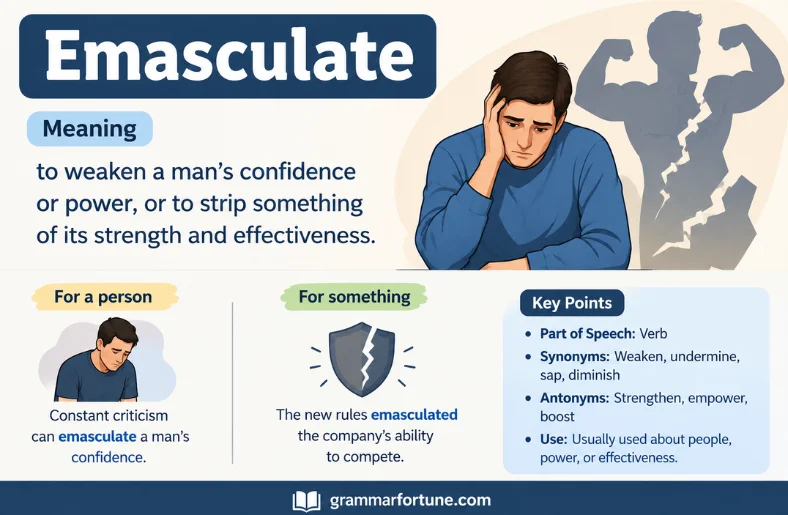
Emasculate Meaning: to weaken someone or something by taking away power, strength, or confidence.
Some words look big, but the idea behind them is small and clear. What Does Emasculate Mean is a question many students ask when they see this word in a story, a news line, or a quiz. In plain talk, it is about making a person, a group, or a plan feel weak and powerless. A friendly look at Emasculate Meaning, with short examples and easy word lists, makes the idea simple for any young reader.
Quick Stats : Emasculate
| Point | Detail |
|---|---|
| Word / Term | Emasculate |
| Part of Speech | Verb (also a rare adjective) |
| Meaning | To weaken or take away power, strength, or confidence |
| Definition | To make a person, group, or plan weak and powerless |
| Noun Form | Emasculation |
| Origin / Language | Latin |
| Pronunciation | ih-MAS-kyuh-layt |
| Tone | Strong and formal |
| Synonyms | weaken, undermine, sap, cripple |
| Antonyms | empower, strengthen, fortify, embolden |
| Example Sentence | Too many cuts emasculated the team’s plan. |
| Category | Word Meaning |
Emasculate Meaning and Simple Definition
Emasculate Meaning in one line: to take away the strength, power, or courage of a person or a thing. If you need to Define Emasculate for a school note, write this: to make someone or something weak and powerless.
Picture a strong tree that loses all its branches. The tree still stands, but its power is gone. That picture shows the same idea. When a rule, a boss, or a hard event removes someone’s power, this is the word that fits.
The word often points to a loss that happens step by step. A little is cut here, a little is taken there, and in the end very little force is left. That is why writers like it for plans, laws, speeches, and teams. It paints a clear picture of something that began strong and ended weak.
Dictionaries list two senses. The first is old and medical. The second is the one people use today.
Meaning in Everyday English
Sense 1: The Old Medical Sense
This sense is about removing the male body parts of a man or an animal. It appears in old medical and farm books. Students rarely need it, and most readers never see it in daily talk.
Sense 2: The Figure Sense
This is the common sense. It tells us that something is weakened, that confidence is drained, or that power is taken away. Here the word has nothing to do with the body. It is about the strength of a mind, a group, a rule, or a plan.
A Note on Gender
The word grows from a root linked to males. Even so, people use it for any person, any group, and even for rules and plans. Some writers avoid it because it ties strength to being male. These writers pick neutral words such as weaken or undermine. Both choices are fine.
Please never use this word as a teasing insult. Kind speech is always better.
How Strong Is the Word?
This is a strong, formal word. It sounds serious. In a talk with friends, a simpler phrase such as “took away all the power” sounds more natural. In a school essay, a news report, or a book review, the word fits well. Pick it when the loss of power is big, and pick a milder word when the loss is small.
Pronunciation
Say it like this: ih-MAS-kyuh-layt. Saying Emasculate Meaning aloud a few times helps the sound stick.
- “ih” sounds like the “i” in it.
- “MAS” sounds like mass. This part gets the strong beat.
- “kyuh” sounds like cue, said softly.
- “layt” sounds like late.
When the word works as a rare adjective, the last part is short: ih-MAS-kyuh-lit.
Word Origin
The word comes from the Latin emasculatus. It joins “e”, which means out or away, with masculus, which means male. English speakers began using it in the early 1600s (please verify in a standard etymology dictionary).
The Latin root also gives us the word masculine. Spotting that shared piece is a smart way to recall the spelling.
How the Word Has Changed Over Time
At first, the word belonged to medicine and farm life. Over many years, writers began using it as a picture. A strong thing that lost its force could be described with the same word, even when no body was involved.
Today the picture sense is the main one. News reports use it for laws that lose their punch. Book reviewers use it for stories that lose their edge after heavy edits. Sports writers use it for rules that cut a team’s advantage.
In recent times, many readers also talk about the gender links inside the word. This is why some writers now pick milder, neutral words. Knowing both the old root and the modern habit helps you use the word wisely (please verify current usage notes in a standard dictionary).
Part of Speech and Word Forms
The word is mainly a verb. A verb is an action word. Here the action is weakening. If a teacher asks you to Define Emasculate, name the part of speech first, then give the short sense. Any note on Emasculate Meaning should say the same.
| Form | Example |
|---|---|
| emasculate | Harsh rules can emasculate a good plan. |
| emasculates | The long delay emasculates the new law. |
| emasculated | The edits emasculated the story. |
| emasculating | Endless bossing is emasculating for workers. |
| emasculation (noun) | The emasculation of the plan made everyone sad. |
In rare cases the word acts as an adjective, as in “an emasculate version of the film”. Most writers choose “weakened” here, because it is easier to read.
How the Word Works in a Sentence
A simple pattern keeps every sentence clean:
Cause + emasculate + the thing that loses power
Example: The new rule (cause) emasculated (action) the club’s best idea (result).
Active Voice
In active voice, the cause comes first. The rule emasculated the plan. This is short and strong, and it is the best choice for young writers.
Passive Voice
In passive voice, the weakened thing comes first. The plan was emasculated by the rule. Use this form when the plan is the main topic of the sentence.
Needs a Target
The verb needs something to act on. A sentence such as “The rule emasculated” feels unfinished. Always say what lost its power.
Words That Often Go Together
Words travel in groups. These groups sound natural to a reader:
| Group | Sample Phrases |
|---|---|
| Things that lose power | a bill, a law, a plan, a speech, a team, a rule |
| Things inside a person | confidence, courage, authority, spirit |
| Words that add strength to the verb | completely, almost, slowly, badly |
| Feeling forms | felt emasculated, left emasculated |
Pick one phrase from each row, and a clear sentence is ready.
15 Easy Examples
These fifteen lines show Emasculate Meaning in action, and they answer What Does Emasculate Mean with real sentences.
- Harsh rules can emasculate a club’s best ideas.
- The long delay emasculated the new law.
- The editor cut so much text that the story felt emasculated.
- Endless bossing can emasculate a worker’s confidence.
- The coach feared the new rule would emasculate his strong team.
- Constant fear may emasculate a brave plan.
- Budget cuts emasculated the school’s art program.
- Loud critics tried to emasculate her speech, but she stayed calm.
- The captain felt emasculated when the match officials ignored his advice.
- A clever answer emasculated the bully’s mean joke.
- Too many changes can emasculate a strong poster design.
- The council’s new limits emasculated the old safety plan.
- Nobody wanted the long list of fees to emasculate the fair.
- The film’s last cut was so soft that critics called it emasculated.
- Careful teachers never let marks emasculate a child’s love of reading.
Sentence Examples by Tense
| Tense | Sentence |
|---|---|
| Past | The cuts emasculated the plan last week. |
| Present | The new rule emasculates the old one every day. |
| Future | Too many limits will emasculate the project. |
| Present continuous | Heavy fees are emasculating the small fair. |
| Past perfect | The delay had emasculated the law before it began. |
Real-Life Examples
At school: A group makes a bold poster plan. The teacher removes half the ideas, and the plan loses its spark. Writers say the teacher’s edits left the plan weak, and this word fits that scene.
In sports: A league adds a rule that stops the strongest team from using its best skill. Reporters say the rule emasculated the team’s advantage.
In news: A lawmaker adds so many changes to a bill that the bill no longer does its job. Reporters often say the changes emasculated the bill.
In books and films: A strong villain is softened so much that the story loses its thrill. Reviewers say the soft ending emasculated the whole tale.
At work: A manager takes every choice away from a team. The team still has a title, but it has no real say. Workers may feel emasculated, even though nobody was rude.
At home: A child with a lively idea hears “no” to every step. Slowly the idea loses its shine. Kind parents try to guard such ideas with praise and small tweaks.
A Short Story Example
Mira’s Science Fair Idea
Mira planned a model volcano with a small pump, red water, and a glowing light. She was proud of it. Then the judges added rules: no water, no pump, no light. Mira removed each part, one by one.
By the end of the week, her project was only a plain brown cone. The new rules had emasculated her bold plan. Mira felt small and quiet.
Her teacher saw the change. She helped Mira add a bright poster, a clear chart, and a short talk. Little by little, the project grew strong again. Mira stood tall on fair day. The teacher’s help did not emasculate her work. It helped to empower it.
Common Mistakes
| Wrong | Right | Why |
|---|---|---|
| The scandal demasculated him. | The scandal emasculated him. | “Demasculate” is not a standard English word. |
| The room looked emasculate. | The room looked immaculate. | Immaculate means spotless. The two words sound alike but differ. |
| Our team emasculated them 5-0. | Our team crushed them 5-0. | The word is about taking power away, not about winning a game. |
| He emasculet the plan. | He emasculated the plan. | The verb ends in -ate, and the past form ends in -ated. |
| The rule emasculated. | The rule emasculated the plan. | The verb needs a target. |
| The flower was emasculated by rain. | The flower was weakened by rain. | Plain nature scenes sound odd with this strong word. |
| He emancipated the plan. | He emasculated the plan. | Emancipate means to set free, which is a different idea. |
Tips to Remember
These tips keep Emasculate Meaning fresh in memory. They also help any student who has to Define Emasculate in a test, and they answer What Does Emasculate Mean quickly.
- Link the word to masculine. The shared piece “mascul” is easy to spot.
- Think “E for Empty.” The word empties out someone’s strength.
- Picture a plant that loses its leaves. The plant is alive but weak.
- Say the word aloud with the beat on “MAS”. Sound helps memory.
- Pair it with its opposite, empower, and draw a small see-saw in your notebook.
Synonyms
Every Emasculate Synonym below shares the core Emasculate Meaning: taking away strength. Each one has its own flavor, so pick with care.
| Synonym | Short Meaning | Example |
|---|---|---|
| weaken | to make less strong | The storm weakened the old bridge. |
| undermine | to slowly reduce power or trust | Rumors can undermine a team. |
| sap | to drain energy or strength | The heat sapped our energy. |
| cripple | to cause serious damage to ability | The strike crippled the town’s bus service. |
| enfeeble | to make very weak | Long illness enfeebled the old king. |
| debilitate | to take away strength, often from illness | The fever debilitated him for days. |
| unman | an old word for taking away courage | Fear nearly unmanned the young guard. |
A good Emasculate Synonym for school writing is weaken or undermine. Both are neutral and easy to read. Use any Emasculate Synonym that matches the size of the loss.
Antonyms and Opposite Of Emasculate
The Opposite Of Emasculate is any word that gives strength, power, or courage. Putting it next to Emasculate Meaning shows a clear contrast. Every Emasculate Antonym works like a boost.
| Antonym | Short Meaning | Example |
|---|---|---|
| empower | to give power or control | The club empowers every member. |
| strengthen | to make stronger | Daily practice strengthens skill. |
| fortify | to make strong against danger | Workers fortified the wall. |
| embolden | to give courage | Her praise emboldened the shy boy. |
| invigorate | to give fresh energy | A cool morning walk invigorates me. |
| reinforce | to add support | Steel bars reinforce the roof. |
Example: The coach’s kind words did not emasculate the team. They helped to embolden every player.
A useful Emasculate Antonym to remember is empower, which means to give someone strength, confidence, or authority. Other opposites include strengthen, reinforce, and bolster. These words express the idea of building up power rather than taking it away.
Emasculate Crossword Clue
Puzzle makers use short clues. A box in a grid with the hint “Emasculate” often takes one of these answers:
- UNMAN (5 letters)
- GELD (4 letters)
- NEUTER (6 letters)
- WEAKEN (6 letters)
The correct answer depends on the number of letters and the crossing letters in your puzzle. If you encounter this clue, count the empty boxes first, then compare possible answers with the letters already filled in. This simple method can help you find a word that fits the grid accurately.
Here is a quick table:
| Letters | Possible Answer |
|---|---|
| 4 | GELD |
| 5 | UNMAN |
| 6 | NEUTER, WEAKEN |
If none of these fit, think of other weakening words, such as SAP or CRIPPLE, and check the letter count again.
Emasculate vs. Demasculate
Many students search for Emasculate Vs Demasculate because the two words look similar. However, emasculate is the established English word, while demasculate is not commonly recognized as a standard English word in mainstream dictionaries.
Emasculate is a verb that means to deprive someone or something of strength, power, or effectiveness. Its correct past-tense form is emasculated. For example: “The budget cuts emasculated the project.”
By contrast, demasculated is generally treated as a nonstandard form or a mistaken alternative to emasculated. Although the prefix “de-” can indicate removal in words such as defrost, it does not make every newly formed word standard English. The related term demasculinize may appear in specialized writing, but it has a distinct usage and should not be treated as interchangeable with emasculate.
| Point | Emasculate | Demasculate |
|---|---|---|
| Standard usage | Established English word | Not commonly recognized as standard |
| Part of speech | Verb | Nonstandard form |
| Past tense | Emasculated | Avoid in formal writing |
| Recommended use | “The changes emasculated the plan.” | Use “emasculated” instead |
In short, use emasculate and its past form emasculated in school assignments, professional writing, and everyday communication. If you encounter demasculate or demasculated, choose the established word that best expresses the intended meaning.
Similar and Confusing Words
| Word | Short Meaning | Sample Sentence |
|---|---|---|
| immaculate | spotless and clean | The kitchen was immaculate. |
| emaciated | very thin from lack of food | The stray dog looked emaciated. |
| emancipate | to set free | The law helped emancipate the workers. |
| eliminate | to remove fully | The team wanted to eliminate errors. |
Disclaimer: This word has a sensitive medical sense and some strong uses. Word senses can change by region and by reader. Please treat this page as general information for school use.
All of these words start with similar sounds, so read each one slowly before you write it. A neat memory line: immaculate is clean, emaciated is thin, emancipate is free, and emasculate is weak.
Quick Practice
Part A: Choose the correct word.
- The long list of rules (emasculated / demasculated) the old plan.
- The hotel room was (emasculate / immaculate) after cleaning.
- A kind teacher can (embolden / emasculate) a shy student.
- The opposite of weaken is (strengthen / sap).
- Which part of speech is the word? (noun / verb)
Answers: 1. emasculated. 2. immaculate. 3. embolden. 4. strengthen. 5. verb.
Part B: Write one sentence. Use the verb for a plan, a law, or a speech. Show it to a teacher or a parent.
Key Takeaways
- Emasculate Meaning: to take away power, strength, or confidence.
- What Does Emasculate Mean in daily life? A plan, a person, or a rule loses its power.
- It is a verb. The forms are emasculates, emasculated, and emasculating.
- “Demasculate” is not a standard word. The Emasculate Vs Demasculate answer is always emasculate.
- Weaken is a good Emasculate Synonym, and empower is a good Emasculate Antonym.
You can also explore the meaning and usage of other English words below.
- DSL Meaning Slang
- What Does Wyll Mean In Text
- Wtms Meaning In Text
- Type B Personality
- Ethos Meaning
- PMO Meaning Slang
- Crush Meaning In Hindi
- Gorgeous Meaning In Hindi
- Unalive Meaning
- Effervescent Meaning
- Wassup Meaning In Hindi
- Euphemism Definition
- Sodomy Definition
- Marple Definition
- What Does ISS Mean on a Driver’s License
- Insolence Meaning
Conclusion
Emasculate Meaning becomes easier to understand when you remember that it means taking away someone’s power, confidence, or strength. It is a verb with Latin roots and should be used carefully because it can carry a sensitive tone. Remember the correct form, emasculated, and consider simpler alternatives like “weaken” when they fit the context better.
Frequently Asked Questions
What does emasculate mean in simple words?
What Does Emasculate Mean in a sentence? It means to weaken someone or something by taking away power or confidence. To Define Emasculate, picture a plant that loses its strength.
Is demasculate a real word?
No. Standard dictionaries do not list it, so Demasculated Meaning has no official answer. The right word is emasculate, and the Emasculate Vs Demasculate choice is simple.
What is the opposite of emasculate?
Words such as empower, strengthen, and embolden work as the Opposite Of Emasculate. Each one gives power or courage.
Does the word apply only to men?
No. People use it for any person, group, rule, or plan. Some writers still pick neutral words such as weaken, because the root of this word is linked to males.
Is it a rude word?
It is not a bad word, but it can sound strong or hurtful. Use it in careful writing, and never as a tease.
