
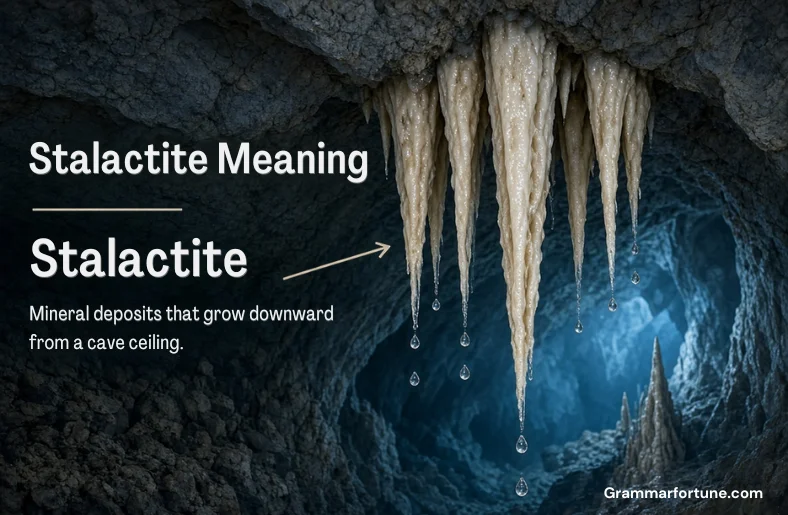
Stalactite meaning: A stalactite is a mineral formation that hangs from the ceiling of a cave. It often looks like a stone icicle and forms when water leaves mineral deposits behind over time. A stalagmite is different because it grows upward from the cave floor.
Quick facts about stalactites meaning
| Feature | Details |
|---|---|
| Word | Stalactite |
| Part of speech | Noun |
| Simple meaning | A mineral formation hanging from a cave ceiling |
| Pronunciation | stuh-LAK-tite |
| Syllables | Usually pronounced in two syllables: stal-ac-tite |
| Plural | Stalactites |
| Word origin | Greek, through Latin |
| Common material | Calcite, though other minerals can occur |
| Related term | Stalagmite |
| Main subject | Geology and cave formations |
What Does Stalactite Mean?
A stalactite is a natural mineral formation that hangs from the roof or ceiling of a cave. Many stalactites are pointed and resemble icicles. They usually form as mineral-rich water drips from the ceiling and leaves small deposits behind.
The word is mainly used in geology, science classes, and descriptions of caves. It helps people identify a particular type of natural rock formation.
Stalactites are common in limestone caves, although they can form from other minerals in suitable conditions. Many contain calcite, a mineral made of calcium carbonate.
Stalactite Meaning and Definition in Simple English
A stalactite is a mineral deposit that hangs downward from a cave ceiling or another suitable overhead surface.
In simple terms, it is a natural stone shape that grows from above. It may be thin and narrow, thick and rounded, or long and pointed.
For example:
Small drops of water fell from the stalactite onto the cave floor.
In this sentence, stalactite names the hanging formation from which the water drips.
What does a stalactite look like?
A stalactite often looks like an icicle made of stone. It may have a narrow tip and a wider upper section, although shapes vary.
Some stalactites are so thin that they resemble drinking straws. Others grow into large formations that extend several feet from the cave ceiling.
Their size, shape, and color depend on the water supply, mineral content, and conditions inside the cave.
Is a stalactite a rock or a mineral?
A stalactite is best described as a mineral formation, not a single mineral type. It is a shape created by minerals collecting over time.
Many stalactites contain calcite, but others may contain gypsum, halite, or different minerals. The term describes the formation’s shape and position rather than its exact chemical makeup.
How Do Stalactites Form?
Stalactites form through a natural process called mineral deposition. This means minerals carried by water collect and become solid material.
In many limestone caves, rainwater passes through soil and absorbs carbon dioxide. This creates a weak acid that can dissolve small amounts of limestone as the water moves through cracks in the rock.
When the water reaches an air-filled cave, it can release carbon dioxide. This change allows calcite to separate from the water and remain on the cave ceiling. Repeated deposits gradually build a stalactite.
The formation process, step by step
-
Rainwater enters the ground. Water moves through soil and cracks in the rock above a cave.
-
The water dissolves minerals. In limestone areas, it can carry dissolved calcium carbonate.
-
Water reaches the cave ceiling. Drops collect along cracks or other openings.
-
Minerals remain behind. Changes in the water allow solid mineral material to form.
-
The formation grows. More drops add more deposits, gradually extending the stalactite.
The process is not the same in every cave. Water chemistry, evaporation, airflow, and the structure of the rock can affect how a formation develops.
How long does a stalactite take to form?
There is no single growth rate for all stalactites. Some grow faster than others, depending on the supply of water and the conditions inside the cave.
A thin formation called a soda straw can take a long time to grow. The National Park Service notes that some soda straws grow only about an inch in a century. That figure is an example, not a universal rate for every stalactite.
This slow growth is one reason cave formations need protection. Breaking one can destroy a structure that took a very long time to develop.
Types of Stalactites and Related Cave Formations
Not every hanging cave formation has the same shape. Geologists use different names to describe formations based on their appearance and how they form.
1. Soda straw stalactites

Water flows through the tiny central tube and leaves mineral deposits around its rim. If the tube becomes blocked, water may flow along the outside and make the formation thicker.
2. Thick or cone-shaped stalactites

Their shapes vary. Some have sharp points, while others have rounded ends.
3. Draperies

Draperies are related cave formations, but they are not simply another name for a typical stalactite.
4. Helictites
Helictites are unusual cave formations that twist or curve in different directions. They can grow from ceilings, walls, or other mineral formations.
Their shape differs from the usual downward-pointing stalactite. Tiny channels and the movement of small amounts of water help support their growth.
Stalactite Meaning Examples in Sentences
These sentences show how to use stalactite naturally in everyday English.
-
A stalactite hung from the ceiling of the cave.
-
The students took photographs of the cave formations.
-
Water dripped from the tip of a long stalactite.
-
The limestone cave contained several large stalactites.
-
The scientist examined the mineral deposits under a light.
-
The formation looked like an icicle made of stone.
-
Visitors walked carefully beneath the cave ceiling.
-
The stalactite grew slowly as minerals collected.
-
Our science class discussed stalactites and stalagmites.
-
A thin soda straw hung above the underground pool.
-
The cave walls displayed many shapes and colors.
-
The researcher recorded changes in the mineral formation.
-
The stalactites were protected by barriers along the path.
-
A stalactite can contain calcite or other minerals.
-
The photograph showed a pointed formation above the walkway.
Using Stalactite Meaning in different contexts
| Context | Example sentence |
|---|---|
| School | A stalactite hangs from a cave ceiling. |
| Science | Calcite deposits can contribute to stalactite growth. |
| Travel | We saw impressive stalactites during our cave tour. |
| Writing | The narrow passage had a stalactite overhead. |
| Conversation | That rock formation looks like a stone icicle. |
In formal writing, use stalactite when referring to the actual geological formation. In casual conversation, you can compare it to a stone icicle to help someone picture its shape.
Stalactite Synonyms and Antonyms
Synonyms for stalactite
There is no exact synonym that works in every situation. These phrases can describe a stalactite, but they are not always interchangeable with the scientific term.
| Related word or phrase | Meaning |
|---|---|
| Hanging mineral formation | A mineral structure that extends downward from a surface |
| Cave formation | A natural structure that develops inside a cave |
| Mineral deposit | Material that collects from water or another process |
| Stone icicle | An informal description based on a stalactite’s appearance |
For scientific work, stalactite is the most precise word for a formation that hangs from a cave ceiling.
Antonyms for stalactite
Stalactite has no direct antonym. However, stalagmite is the closest contrasting term in cave geology because it grows upward from the floor rather than downward from the ceiling.
The two words describe related formations with different positions. They are not exact opposites in every scientific sense.
Stalagmite vs. Stalactite Meaning: What’s the Difference?
A stalactite hangs from the ceiling of a cave, while a stalagmite grows upward from the floor. Both often form when mineral-rich water deposits calcite inside a cave.
| Feature | Stalactite | Stalagmite |
|---|---|---|
| Location | Ceiling or overhead surface | Cave floor |
| Direction | Grows downward | Grows upward |
| Common shape | Pointed or icicle-like | Rounded, cone-shaped, or mound-like |
| Formation | Minerals collect on the ceiling | Minerals collect where water hits the floor |
| Memory trick | T for top | G for ground |
Stalagmite and stalactite meaning
These terms describe two common types of cave formations. They can develop in the same area because water that drips from a stalactite may leave mineral deposits on the floor below.
If a stalactite and a stalagmite grow until they meet, they may form a pillar called a column. Not every pair reaches this stage.
An easy way to remember the difference
Use the first letter in the middle of each word:
-
Stalactite: think of top.
-
Stalagmite: think of ground.
Another memory trick is that stalactites hang tight to the ceiling. Both tricks can help students remember which formation grows where.
Stalactite Calcite: What Is It?
Calcite is a common mineral in limestone caves. It consists of calcium carbonate and often forms the main material in familiar white or pale stalactites.
The term stalactite calcite refers to calcite within a stalactite, rather than to a separate type of formation.
Calcite can look white or nearly colorless when it is relatively pure. Other minerals and materials can give cave formations shades of yellow, orange, red, brown, or gray. Not all stalactites have the same composition or color.
Amethyst Stalactite Meaning
An amethyst stalactite is a stalactite-shaped mineral formation associated with amethyst, a purple variety of quartz.
The phrase may appear in mineral collections and crystal shops. In those settings, it can describe a natural specimen with a hanging or stalactite-like shape.
However, a decorative specimen’s name does not confirm its exact composition or origin. If you are buying a mineral specimen, check the seller’s description and any available identification details.
Stalactite Cave Meaning and Real-World Examples
A stalactite cave is an informal phrase for a cave known for its stalactites. In schoolwork and formal writing, a cave with stalactites is often a clearer expression.
Stalactites occur in caves around the world. Examples include cave systems in U.S. national parks.
Carlsbad Caverns National Park in New Mexico contains many cave formations. Great Basin National Park in Nevada also features stalactites, stalagmites, and other mineral structures.
Why should stalactites be protected?
Many cave formations grow slowly and can be fragile. Touching them may leave oils or other material on their surfaces, and breaking a formation can cause damage that is difficult or impossible to repair within a person’s lifetime.
When visiting a cave:
-
Stay on marked paths.
-
Do not break or remove mineral formations.
-
Avoid touching cave formations.
-
Follow instructions from park staff.
These simple actions help protect natural cave features for future visitors.
Common Mistakes About Stalactite Meaning
| Common mistake | Correct information |
|---|---|
| A stalactite grows from the cave floor. | A stalactite hangs from above. |
| A stalagmite hangs from the ceiling. | A stalagmite grows upward from the floor. |
| Every stalactite is made of ice. | Most familiar cave stalactites are mineral formations. |
| All stalactites contain only calcite. | Stalactites can contain other minerals. |
| Stalactite and stalagmite mean the same thing. | They describe different formations. |
| All stalactites grow at the same rate. | Growth rates vary with cave conditions. |
Is a stalactite the same as an icicle?
No. An icicle forms when water freezes, while a stalactite forms through the accumulation of mineral deposits.
The two can look alike, but their materials and formation processes are different.
What does “stalactite carrot” mean?
A stalactite can resemble a carrot because both may have a tapered shape. The National Park Service uses carrots as one comparison for the appearance of stalactites. However, carrot is not a scientific synonym for stalactite.
What do “stalactite shift” and “stalactite organ” mean?
These phrases do not name the standard cave formation itself.
-
Stalactite shift: Its meaning depends on the context. It is not a standard term for the ordinary process of stalactite growth.
-
Stalactite organ: This may refer to an instrument or object associated with cave formations. At Luray Caverns in Virginia, the Great Stalacpipe Organ uses cave formations to produce musical sounds.
What does “stalactite origin crossword clue” mean?
This is a search phrase about the word’s origin. Stalactite entered English in the late 17th century through Latin, from the Greek stalaktos, meaning dripping or trickling.
Key Takeaways: Stalactite Meaning
-
A stalactite is a mineral formation that hangs from a cave ceiling.
-
Many stalactites form when mineral-rich water deposits calcite.
-
Their shape can resemble an icicle or carrot.
-
A stalagmite grows upward from the cave floor.
-
A stalactite and stalagmite can join to form a column.
-
The plural of stalactite is stalactites.
-
Cave formations are often fragile and should be protected.
Conclusion: Stalactite Meaning
The stalactite meaning is simple: it is a mineral formation that hangs from the ceiling of a cave. Water carries dissolved minerals into the cave, and repeated deposits can slowly build the formation.
Remember T for top to distinguish a stalactite from a stalagmite. This simple rule makes the terms easier to remember and use correctly in science classes and everyday writing.
Explore The Meaning And Usage Of Other English Words Below:-
- DSL Meaning Slang
- What Does Wyll Mean In Text
- Wtms Meaning In Text
- Type B Personality
- Ethos Meaning
- PMO Meaning Slang
- Crush Meaning In Hindi
- Gorgeous Meaning In Hindi
- Unalive Meaning
- Effervescent Meaning
- Wassup Meaning In Hindi
- Euphemism Definition
- Sodomy Definition
- Marple Definition
- What Does ISS Mean on a Driver’s License
- Insolence Meaning
FAQs About Stalactite Meaning
1. What is the simple stalactite meaning?
A stalactite is a mineral formation that hangs from a cave ceiling. It often looks like a stone icicle.
2. What is the difference between a stalactite and a stalagmite?
A stalactite hangs downward from the ceiling. A stalagmite grows upward from the floor, often where mineral-rich water drips from above.
3. How are stalactites formed?
Mineral-rich water reaches the cave ceiling and leaves deposits behind. Over time, these deposits build into a hanging formation.
4. Is a stalactite made of calcite?
Many stalactites contain calcite, but others may contain minerals such as gypsum or halite. The composition depends on the cave’s conditions.
5. What is the plural of stalactite meaning?
The plural is stalactites. For example: Several stalactites hang above the cave path.
6. What is the origin of the word stalactite?
The word comes from Greek stalaktos, meaning dripping or trickling. It entered English through Latin.
7. Can stalactites and stalagmites join together?
Yes. When they grow until they meet, they can form a column or pillar connecting the cave floor and ceiling.
8. Are stalactites still growing today?
Yes, some are. Their growth depends on water supply, mineral content, and cave conditions. Others may stop growing if those conditions change.
