
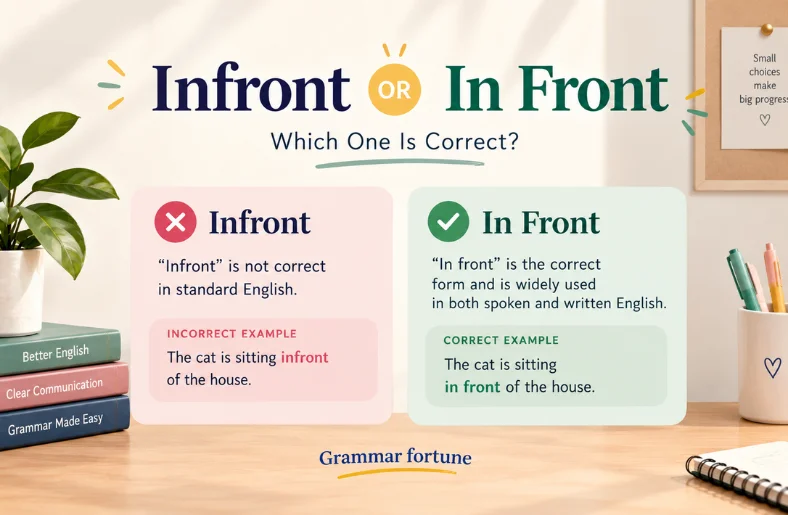
“In front” (two words) is always correct. “Infront” (one word) does not exist in any major English dictionary and is treated as a spelling mistake in formal, academic, and professional writing — in both British English and American English.
Infront or In Front Which is Correct?
“In front” is correct. “Infront” is a spelling error.
No major English dictionary — Oxford, Cambridge, Merriam-Webster, or Collins — lists “infront” as a valid word. Grammar tools like Grammarly and Microsoft Word flag it as a mistake instantly.
| Form | Correct? | Recognised by Dictionaries? |
|---|---|---|
| In front | Yes | Yes |
| Infront | No | No |
The two words work together as a prepositional phrase, not as a single compound word. That is why the space stays.
What Does “In Front” Mean?
“In front” describes a position that is ahead of or before someone or something.
It is most often used as part of the phrase “in front of”, followed by a noun or pronoun.
In Front Meaning at a glance:
- Physical location: The car is parked in front of the house.
- Order or sequence: Her name appeared in front of mine on the list.
- Movement: He walked in front of the group.
- Audience context: She spoke in front of 200 students.
It can also appear without “of” when the reference point is already clear from context.
“I’ll wait in front.” (Everyone already knows: in front of the building.)
The phrase covers both literal physical space and figurative uses. You can say someone is performing well in front of a crowd, meaning they are visible and present before that audience.
Is Infront a Word?
No. “Infront” is not a word in standard English.
This is one of the most searched questions around this topic, so the answer deserves a clear section of its own.
Here is the status of “infront” across the four most trusted English dictionaries:
| Dictionary | Lists “infront”? |
|---|---|
| Oxford English Dictionary | No |
| Cambridge Dictionary | No |
| Merriam-Webster | No |
| Collins English Dictionary | No |
It is also not in:
- Macmillan Dictionary
- Longman Dictionary of Contemporary English
- The American Heritage Dictionary
Spell-check tools — Grammarly, Microsoft Word, Google Docs — all flag “infront” as an error and suggest “in front” as the correction.
So if you ever wondered is infront a word, the answer is a firm no. The word you need is always “in front” — two separate words with a space between them.
One narrow exception: “Infront” appears as a company name (a financial data and market intelligence firm). Brand names can have their own spelling rules. But that has no effect on the grammar rule for the everyday location phrase.
Infront Meaning — What People Actually Mean
When people write or search for “infront meaning,” they are almost always looking for the meaning of the phrase “in front.”
There is no independent infront meaning because “infront” as a single word has no entry, no definition, and no recognised usage in any variety of standard English.
The meaning people are reaching for is:
In front (phrase): at or toward a position that is ahead of, before, or facing another person or thing.
It answers the question: Where is something?
- The gate is in front of the garden wall. — location
- She walked in front of him. — movement, relative position
- He spoke in front of the whole company. — audience or public context
So whenever you see someone asking for the infront meaning, the correct answer to give them is the meaning of “in front” — because that is the real phrase.
Infront or In Front Grammar: Why Two Words?
This is the part most websites skip, so let us explain it properly.
“In front” is a prepositional phrase. In grammar terms:
- “In” is a preposition.
- “Front” is a noun meaning the forward-facing part of something.
When a preposition and a noun combine to describe location, English usually keeps them as separate words — especially when the noun still carries its own clear meaning.
Compare these pairs:
| Two-Word Phrase (Correct) | Incorrect One-Word Version |
|---|---|
| In front | Infront |
| In fact | Infact |
| In charge | Incharge |
| In case | Incase |
| At least | Atleast |
| A lot | Alot |
Notice the pattern. In each case, the second word (“fact,” “charge,” “case,” “least,” “lot,” “front”) is still a recognisable noun or adjective with its own meaning. Because it has not lost that independence, the phrase stays separated.
English does merge some prepositional combinations into single words — “inside,” “into,” “onto,” “upon” — but in those cases the original nouns (“side,” “to”) have mostly lost their standalone meaning in that context. “Front” has not. It still means the forward part of something, so it stands apart.
This is the grammar rule behind infront or in front — and once you see it, the answer becomes permanent.
Infront or In Front Difference: Side-by-Side Table
| Feature | In Front | Infront |
|---|---|---|
| Spelling | Correct | Incorrect |
| Dictionary entry | Yes (all major dictionaries) | No |
| Grammar role | Prepositional phrase | Not a grammatical unit |
| Accepted in formal writing | Yes | No |
| Accepted in UK English | Yes | No |
| Accepted in US English | Yes | No |
| Flagged by spellcheck | No | Yes |
| Common context | Speech, writing, formal documents | Typing errors, casual texts |
In Front Or Infront Of — How to Use It Correctly
The full phrase “in front of” is the most common structure. It always needs the word “of” before the noun that follows.
Structure: In front of + noun / pronoun
Correct uses:
- The school is in front of the park.
- She sat in front of me in class.
- Please stand in front of the camera.
- A crowd gathered in front of the courthouse.
Incorrect uses:
- She sat infront of me. — wrong spelling
- The car stopped in front the gate. — missing “of”
- Please stand in-front-of the camera. — hyphens are not used here
A very common secondary mistake is dropping “of” entirely. “In front” without “of” only works when the reference point is already established in the conversation. In most sentences, “of” is required.
Infront or In Front Examples
Here are 10 correct example sentences using “in front of” and “in front”:
- The bus stop is directly in front of the hospital.
- He stood in front of the mirror for five minutes.
- Please keep your bags in front of you at all times.
- In front of the temple, a large crowd had gathered.
- She answered every question in front of the whole class.
- A dog was sitting in front of the door when we arrived.
- The new billboard stands in front of the old library building.
- Park your vehicle in front, not on the side lane.
- Three people were standing in front of us in the queue.
- The actor performed brilliantly in front of a live audience.
Incorrect versions — so you can see the mistake clearly:
- The bus stop is directly infront of the hospital. — wrong
- She answered every question infront of the whole class. — wrong
- A dog was sitting infront of the door. — wrong
The error is always the same: removing the space between “in” and “front.”
The “In Front Of My Salad” Meme — Grammar Lesson Inside
You may have come across the popular “in front of my salad” meme — sometimes written online as “infront of my salad” — and wondered what it means.
The original phrase is “right in front of my salad”, which became a well-known internet meme. The joke format uses the line to express shock or disbelief at something happening in a highly inconvenient or absurd setting. Variations like “really right in front of my salad” are used for extra comic emphasis.
The meme is relevant here for a simple reason: it is one of the most viral uses of the phrase “in front of” in online culture, and many people who write it casually type it as “infront of my salad” — which is the wrong spelling.
Whether it is a meme caption or a school essay, the correct form is always:
“right in front of my salad” — not “right infront of my salad”
The meme does not change the grammar rule. It just proves that “in front of” appears in every context — even the most absurd ones.
Infront or In Front UK vs US — Any Difference?
No difference at all.
Both British English and American English use “in front” as two words. The same is true for Australian English and Canadian English.
| Variety of English | Correct Form |
|---|---|
| British English (UK) | In front |
| American English (US) | In front |
| Australian English | In front |
| Canadian English | In front |
| Indian English | In front |
“Infront” is not accepted as a regional variation in any of these. It is simply an error across all standard varieties of English.
So whether you are writing for a UK audience or a US audience, the rule stays the same: keep the space.
Infront or In Front Spelling Tricks to Remember
Here are three quick methods to get this right every time.
Trick 1 — Swap “front” with another noun:
Try replacing “front” with a different noun and see if the one-word version still sounds right.
- in bed — not inbed
- in school — not inschool
- in town — not intown
- in front — not infront
The same logic applies across all of them.
Trick 2 — The “of” test:
If you can say “in ___ of” with the word, it is almost certainly a two-word phrase.
- in charge of — two words
- in place of — two words
- in front of — two words
Phrases that follow this “in ___ of” pattern are always written separately.
Trick 3 — Ask: does “front” have its own meaning here?
If “front” still means the forward side of something in your sentence, it is still a noun doing its own job. Nouns that keep their meaning do not get absorbed into a single compound word.
Infront or In Front Synonyms
If you want to avoid repeating “in front of” too many times in a piece of writing, here are natural alternatives:
| Synonym | Best Used For |
|---|---|
| Ahead of | Direction or movement |
| Before | Formal writing, sequence |
| Facing | Describing orientation |
| At the front of | Physical location |
| Preceding | Order, sequence |
| Opposite (careful — see below) | When directly across, not ahead |
Note on “opposite”: Many writers use “opposite” and “in front of” interchangeably, but they are not the same.
- In front of means directly ahead of something — in the same forward direction.
- Opposite means across from something — facing it from the other side.
Example:
- The post office is in front of the bus stop. — the post office is ahead as you face the bus stop.
- The post office is opposite the bus stop. — they face each other across a road or gap.
Using the wrong one can genuinely confuse readers about location.
How to Say “In Front Of” in Other Languages
If you are a multilingual writer or learning English alongside another language, it helps to see how “in front of” translates.
| Language | Translation of “in front of” |
|---|---|
| Hindi | ke aage / ke saamne |
| Spanish | en frente de / delante de |
| French | devant |
| German | vor |
| Arabic | amam |
| Portuguese | na frente de / em frente a |
This matters because in several languages — Hindi, Arabic, German — the equivalent is a single word or a very tight compound. That cross-language habit sometimes carries over when people write in English, making them want to treat “in front” as one unit. It is not. In English, the space is non-negotiable.
“In Front” as an Adverb vs a Prepositional Phrase
Most people know “in front of” as a prepositional phrase. But “in front” can also work as an adverb phrase — and the two uses look slightly different.
As a prepositional phrase (most common): Followed by “of” + a noun. It tells you the position of one thing relative to another specific thing.
The dog sat in front of the door.
Here, “in front of” links the dog’s position directly to the door.
As an adverb phrase (less common but correct): Used without “of” when the reference point is already understood. It modifies the verb directly.
Please move in front. (No noun needed — everyone knows what is in front.) She always sits in front. (In front of the class — understood from context.) He ran in front to warn them. (Ahead of the group — clear from context.)
| Use | Structure | Example |
|---|---|---|
| Prepositional phrase | In front of + noun | The car stopped in front of the gate. |
| Adverb phrase | In front (alone) | She moved in front. |
Both are grammatically correct. The key is whether the reference point needs to be stated or is already obvious from context.
In formal writing, always name the reference point clearly. In conversation or informal writing, “in front” alone is fine when the meaning is clear.
The Word “Front” on Its Own
Understanding why “in front” stays two words becomes clearer once you see how “front” works on its own.
“Front” is a noun in English. It has a full, independent meaning:
Front (noun): the side or part of something that faces forward, or the most important side.
Examples of “front” used alone as a noun:
- The front of the building is painted white. (the facade)
- She sat at the front of the class. (the leading position)
- There is a garden at the front. (the forward-facing area)
- He was sent to the war front. (military context)
Because “front” keeps all of this meaning intact, English does not absorb it into “infront.” The word is too independent to be swallowed by the preposition before it.
This is why the spelling rule is permanent. Once you understand that “front” is a full noun with its own dictionary life, the idea of writing “infront” stops making sense.
Figurative Uses of “In Front Of”
“In front of” does not only describe physical position. It also works in figurative and idiomatic contexts that writers often overlook.
1. In front of an audience — performing or speaking publicly
She gave a speech in front of hundreds of people. He had never performed in front of a live crowd before.
Here “in front of” means visible to, or in the presence of.
2. In front of a problem — facing a challenge
We placed the real issue in front of the committee. The evidence was right in front of them.
This means making something visible or present for others to consider.
3. Money or payment in front — paid in advance
They paid three months’ rent in front. (informal; means upfront)
This is mainly used in spoken Indian and South Asian English. The standard written phrase for this context is “upfront” or “in advance.”
4. In front — ahead in a race, competition, or ranking
Our team is in front by two goals. She is in front going into the final lap.
Here “in front” means leading or ahead. No “of” is needed because the comparison is built into the context.
Knowing these figurative uses helps you read “in front of” accurately in any sentence — not just the ones about physical position.
How “In Front Of” Moves in a Sentence
One practical question writers have is: where exactly does “in front of” go in a sentence?
The short answer is: it is flexible. But the position changes the emphasis.
At the end of a sentence (most natural in everyday writing):
The children were playing in front of the school.
This is the most common word order. It answers “where?” at the end.
At the beginning of a sentence (emphasises location):
In front of the school, the children were playing.
Starting with “in front of” puts the location in focus. A comma usually follows it here.
In the middle of a sentence (after the subject):
The children in front of the school were playing noisily.
Here “in front of the school” works as a noun modifier — it describes which children.
| Position | Example | Effect |
|---|---|---|
| End | She stood in front of the mirror. | Natural, most common |
| Start | In front of the mirror, she stood quietly. | Emphasises location |
| Middle | The girl in front of the mirror smiled. | Identifies which girl |
Moving the phrase does not change the grammar rule. “In front of” stays as three separate words no matter where it sits.
Brief Word Origin of “Front”
The word “front” came into English from the Old French word front, which itself came from the Latin frons (genitive: frontis). In Latin, frons meant the forehead or brow of a person.
Over time, the meaning widened from “forehead” to “the forward-facing part of anything” — a building’s front, a military front line, the front page of a newspaper.
The preposition “in” combined with this noun naturally to form a location phrase in Middle English — and it has stayed two words ever since.
“Front” has centuries of history as an independent noun. It was never a suffix or a particle. It was always its own word — and it still is.
Common Mistakes People Make
Beyond the main “infront vs in front” error, here are a few related mistakes worth watching:
1. Writing “infront of” instead of “in front of” This is the most common form of the error. Two fixes needed: add the space, keep “of.”
2. Writing “in front the” instead of “in front of the” Dropping “of” before the noun makes the sentence grammatically incomplete.
Wrong: The car stopped in front the building.
Right: The car stopped in front of the building.
3. Writing “in-front-of” with hyphens Hyphens are not used in this phrase. “In front of” needs no hyphens in any standard usage.
4. Confusing “in front of” with “opposite” These describe different spatial relationships — covered in the synonyms section above.
5. Using “infront” in professional documents Even if a spellchecker misses it, editors and teachers will not. It weakens the credibility of otherwise good writing.
6. Capitalising “infront” as if it were a brand The company name “Infront” (the financial data firm) uses a capital I. But in ordinary sentences, write “in front” in lowercase with a space.
Conclusion
The answer to infront or in front is simple and permanent.
In front — two separate words — is correct in British English, American English, academic writing, business emails, school assignments, and casual texts. “Infront” does not exist as a standard English word and will be flagged as an error by every major grammar tool and dictionary.
The grammar reason is straightforward: “in” is a preposition and “front” is a noun. Both words still carry their own meaning, so they stay apart — the same way “in charge,” “in fact,” and “in case” all stay as two words.
Whether you are writing a professional email, a school assignment, a meme caption, or a blog post, write “in front.” Put the space in, and the sentence is correct. Remove the space, and it becomes an error that editors, teachers, and spellcheckers will catch.
Learn More English Words Definitions:-
- Insolence Meaning
- Stalactite Meaning
- 5201314 Meaning
- Torta Meaning Slang
- Combatting Or Combating
- Audiodisplayed Meaning
- Connotation vs Denotation
- Lygophile Meaning
- Fozzie Meaning
FAQs
Is “infront” one word or two?
Always two words: “in front.” “Infront” as a single word is a spelling mistake not recognised by any major English dictionary.
Is infront a word in English?
No. “Infront” has no dictionary entry, no grammatical role, and no accepted usage in formal or informal standard writing. The correct phrase is “in front.”
Is it “in front or infront”?
It is “in front.” This answer is the same in British English, American English, Indian English, and every other major variety.
What does “in front of my salad” mean?
“Right in front of my salad” is a popular internet meme used to express comic disbelief. The grammar is correct — it is always “in front of,” never “infront of.”
Is “in front of” grammatically correct?
Yes. “In front of” is a standard prepositional phrase used in all varieties of English. Example: The dog sat in front of the door.
Can “in front” be used without “of”?
Yes, when the reference point is already clear from context. Example: “I’m parked in front.” In most written sentences though, “in front of” followed by a noun is the complete and correct form.
Why do people write “infront” as one word?
English speech naturally runs short phrases together. When people type quickly, they reproduce that merged sound on paper — the same reason people write “alot” instead of “a lot” or “infact” instead of “in fact.”
How do you say “in front of” in Spanish?
“En frente de” or “delante de.” “En frente de” implies something directly facing another object. “Delante de” is used for physical position ahead of something.
For more word meanings and language tips, check out Grammar Cache.
