
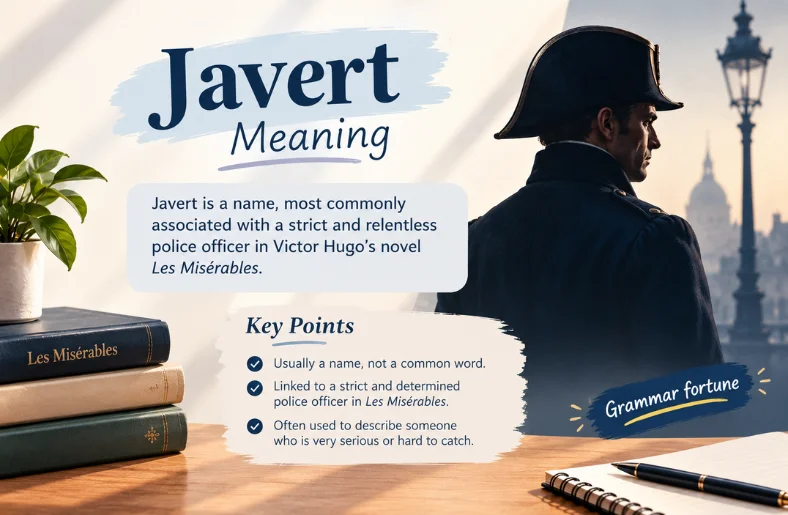
Javert meaning refers to the fictional police inspector in Victor Hugo’s Les Miserables (1862). The name has no French dictionary definition. Its meaning is symbolic: a person who follows rules absolutely, sees the world in pure black and white, and cannot extend mercy or recognise that people can change. Scholars call Javert “one of the most tragic legalists in Western literature.”
Quick Facts About Javert Meaning
| Category | Detail |
|---|---|
| Full Name | Inspector Javert (no first name given) |
| Created By | Victor Hugo |
| First Appeared | Les Miserables, 1862 |
| Estimated Birth Year | Around 1780 |
| Death Date | June 7, 1832 |
| Occupation | Prison guard, then police inspector |
| Based On | Eugène François Vidocq (real-life criminal turned police official) |
| Key Trait | Total devotion to the law; zero capacity for mercy |
| Hugo’s Description | “A marble informer, Brutus in Vidocq” |
| Fate | Suicide by drowning in the River Seine |
| Musical Songs | “Stars,” “Javert’s Suicide” |
| Modern Slang Use | Person who enforces rules with no flexibility or compassion |
| Modern Fiction Echo | Inspector Franklin Jalbert in Stephen King’s Danny Coughlin’s Bad Dream (2024) |
| Pronunciation | French: [ʒavɛʁ] / English: “zhah-VAIR” |
What Does Javert Mean?

Javert has no confirmed dictionary definition in French. Victor Hugo invented or adapted the name for his 1862 novel Les Miserables, and its meaning comes entirely from the character attached to it.
Today, through that character, “Javert” carries a widely understood cultural meaning:
A person who enforces rules with total rigidity, no mercy, and absolute moral certainty, unable to accept that circumstances or people can change.
Victor Hugo himself described Javert as composed of two “simple” sentiments: respect for authority and hatred of rebellion. In Javert’s worldview, “murder, robbery, all crimes, are only forms of rebellion.” That single line from the novel tells you almost everything about the name’s meaning.
Javert Name: Origin, Pronunciation, and Real-Life Inspiration
How to Pronounce Javert
Javert is a French name. The IPA pronunciation is [ʒavɛʁ].
For English speakers, the closest approximation is “zhah-VAIR” — the “zh” sounds like the s in “measure,” and the final r is soft, not fully pronounced.
Stage productions and the 2012 film vary slightly. The French version is softer on the final syllable than what most English-speaking actors deliver.
The Real Person Behind Javert
Hugo did not invent Javert from nothing. The character is loosely based on Eugène François Vidocq, a criminal-turned-police-official who founded the French Surete in the early 19th century. Vidocq was one of the most colourful figures of his era: a convicted criminal who later became France’s most effective detective.
Hugo used Vidocq as the model for both Javert and Jean Valjean, since Vidocq had lived on both sides of the law. In the novel, Hugo calls Javert “a marble informer, Brutus in Vidocq” — meaning the cold, unyielding version of a man who knew crime from the inside.
Vidocq himself reportedly wrote that he never arrested anyone who stole purely out of need, which is the opposite of Javert’s position. That gap between the real Vidocq and the character Hugo built from him is the entire point.
Who Is Inspector Javert?
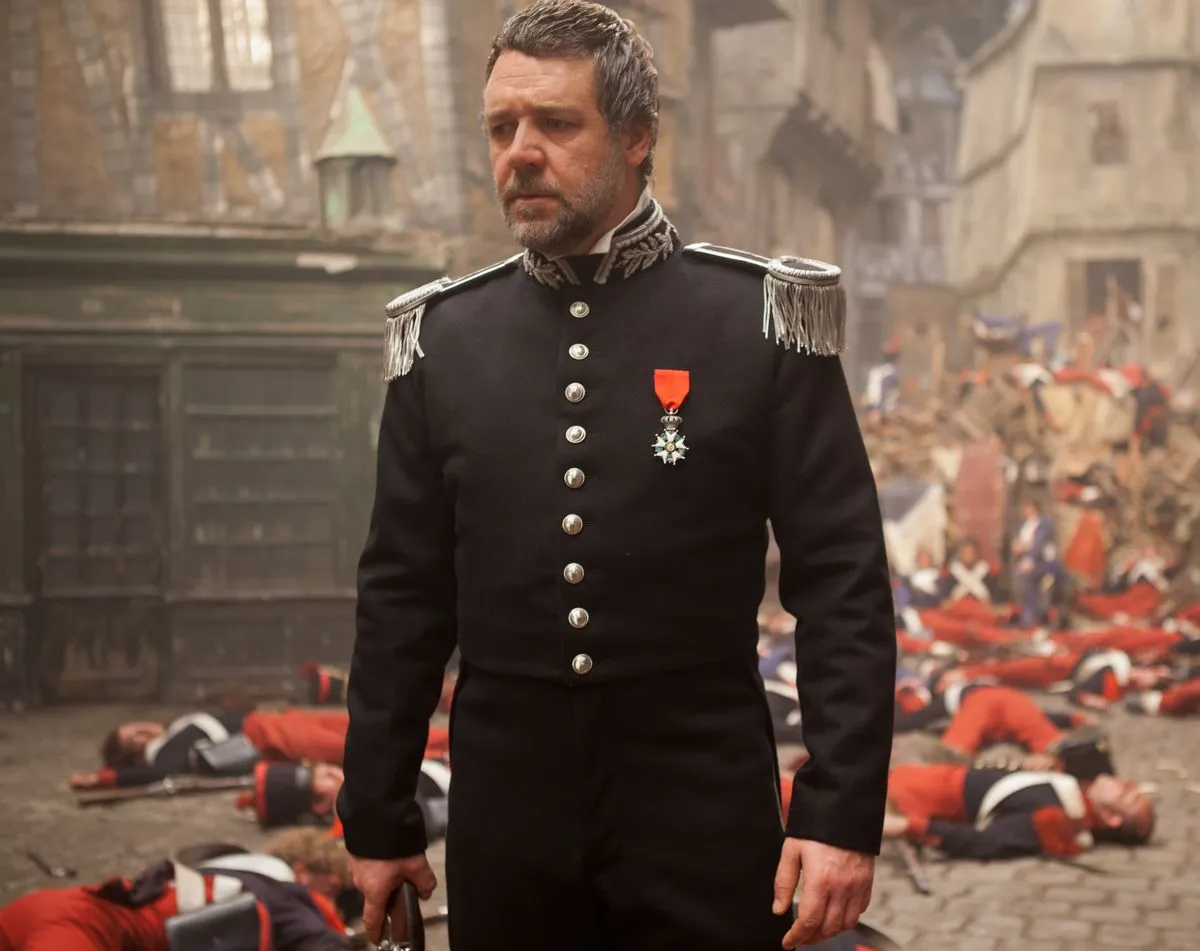
Basic Facts
Javert is presumed born around 1780, based on internal evidence in the novel. He died on June 7, 1832, the final day of the June Rebellion in Paris.
He worked first as a prison guard at the Bagne of Toulon, where he first encountered Jean Valjean as a convict. He later became a police inspector in Paris.
Hugo describes him physically as imposing, cold-eyed, and defined by a single expression of permanent suspicion.
His Role in the Story
Javert’s job in Les Miserables is simple on the surface: hunt down Jean Valjean, who violated parole after serving nineteen years for stealing bread and subsequent escape attempts.
But his role in the novel is much larger. He is the force that never allows Valjean’s past to disappear. Every time Valjean builds a new life, Javert is the reason it cannot last.
His most revealing moment comes mid-novel when he realises he has wrongly suspected Valjean of being someone else. Rather than quietly moving on, Javert visits the mayor (Valjean in disguise) and demands to be fired for insubordination against a magistrate. He condemns himself at length: “if I were not severe towards myself, all the justice that I have done would become injustice.”
This is the most important scene for understanding him. The same system of zero tolerance he applies to criminals, he applies to himself. There is no room for error anywhere in his world.
What Hugo Says About Him
Hugo writes that for Javert, reflective thought was “an uncommon thing for him, and singularly painful” because thought “inevitably contains a certain amount of internal rebellion.” Thinking too deeply was, for Javert, a kind of crime against order.
Before his death, Javert writes a brief letter to the prefect of police noting administrative lapses at the Conciergerie prison. Even in his final hour, he is filing a report.
The Psychology of Javert: Why He Became This Way

The psychology is the most valuable part of the character, and Hugo gives readers the information directly.
Born Inside a Prison
Javert was born inside a French prison. His mother was a fortune teller, his father was serving in the prison galleys. He grew up in an environment where the entire world was divided into two groups: guards and prisoners, protectors and attackers.
He had a choice between these two identities and chose the side of order. Not out of compassion, but as a way to separate himself from the world he came from.
A Romani Man Ashamed of His Origins
The novel specifies that Javert is of Romani background. Hugo states that Javert chose law enforcement partly out of “an irrepressible hatred for that bohemian race to which he belonged” — an internalised shame about his own ethnic identity that he channelled into becoming the most loyal possible servant of the state.
This detail is almost never discussed in popular summaries of the character. It explains why his devotion to the law is not simply professional. It is personal. The law is how he distances himself from everything he despises about his own origins.
His Self-Rigidity Goes to Extremes
Hugo includes a small but striking detail: if Javert’s collar buckle was slightly below his ear instead of behind his nape, it was a sign of “one of those emotional upheavals inside him that might be called an inner earthquake.” A misaligned button meant he was in distress.
That level of physical self-regulation gives you the full picture. The external order of his uniform and the internal order of his moral system were the same thing.
He Would Have Arrested His Own Family
Hugo writes it plainly: Javert “would have arrested his own father if he escaped from prison and turned in his own mother for breaking parole. And he would have done it with that sort of interior satisfaction that springs from virtue.”
This is not a metaphor. It is Hugo’s way of showing that for Javert, the law had fully replaced human relationship.
Why Did Javert Die?
What Happened
During the June Rebellion of 1832, Javert is captured by revolutionaries while working undercover. Jean Valjean, also at the barricade, requests the honour of executing him. Instead, he cuts Javert’s bonds and lets him go.
Later, Valjean carries the badly wounded Marius through the Paris sewers. At the exit, he meets Javert again. Valjean asks only for time to deliver the boy to safety. Javert agrees, waits outside the house, and when Valjean looks out the window, Javert is gone.
He wanders the streets in crisis, then drowns himself in the River Seine.
Why He Could Not Go On
The problem was not simply that Valjean was kind. The problem was what that kindness proved.
Javert had built his entire identity on one belief: a person who has broken the law is a fundamentally bad person, and the law is always right. Valjean disproved both halves of that belief simultaneously.
Hugo writes that Javert now faced “two straight lines, both equally straight, and contradictory.” He had, for the first time, seen a world where law and morality pointed in opposite directions. The law commanded him to arrest Valjean. His conscience told him that would be wrong.
He could not arrest Valjean without acting immorally. He could not release Valjean without betraying the law. In his own system, both options were impossible.
The letter to the prefect he writes before his death is his final act of duty: he was still filing corrections to administrative problems at the Conciergerie. Even on the way to his own death, the job came first.
What It Means
Javert’s death is not evidence that law is worthless. Hugo’s argument is sharper than that: a system of justice that has no mechanism for mercy or redemption will eventually destroy itself.
Javert is not destroyed by Jean Valjean. He is destroyed by his own inability to process reality when it becomes more complicated than his categories allow.
Javert in the Musical and on Screen
The Stage Musical
Les Miserables was adapted into a stage musical, originally produced in France in 1980 and opening in London’s West End in 1985, where it ran for over 16 years before its first production ended.
Javert is a bass-baritone or baritone role with two major solo songs:
- “Stars” — sung before the June Rebellion, where Javert compares himself to the stars: fixed, faithful, incorruptible, and part of an order that never changes.
- “Javert’s Suicide” — the musical climax where his worldview collapses. The song moves from confusion to acceptance of death within four minutes.
Notable performers in the role:
| Production | Actor |
|---|---|
| Original London (1985) | Roger Allam |
| Original Broadway | Terrence Mann |
| 10th Anniversary Concert (1995) | Philip Quast |
| 25th Anniversary Concert (2010) | Norm Lewis |
| 2012 Film | Russell Crowe |
Philip Quast’s 1995 concert performance is widely cited by theatre critics as the definitive portrayal of the role’s emotional complexity.
On Screen
Actors who have played Javert on screen include Charles Laughton, Anthony Perkins, Geoffrey Rush, John Malkovich, and Russell Crowe. Each brought a different emphasis: Rush played Javert as quietly menacing, Malkovich as coldly calculating, Crowe as physically powerful but emotionally contained.
In Modern Fiction
In Stephen King’s 2024 novella Danny Coughlin’s Bad Dream, a character named Inspector Franklin Jalbert is explicitly named for and inspired by Javert. King confirmed the reference in interviews. This is the most recent major cultural use of the Javert archetype in literary fiction.
Javert Meaning in Slang and Pop Culture
When Someone Calls You a Javert
In informal English, “Javert” is used as a noun or adjective for someone who:
- Enforces rules to the letter, regardless of human cost
- Cannot make exceptions, even when circumstances clearly call for one
- Confuses following procedure with doing what is right
- Punishes without considering context
Example sentences:
- “Our compliance officer is a total Javert — she wrote up someone for using the wrong font in an internal email.”
- “Stop being so Javert about the leave policy. The guy’s mother just died.”
- “Every workplace has a Javert. Ours is the guy who times your lunch breaks.”
The term appears frequently on Reddit (especially in r/antiwork and r/AmITheAsshole), in literary commentary, and in political writing about bureaucracy and policing.
The Modern Relevance
The Javert type is recognisable because it exists everywhere: the manager who enforces a rule even when it clearly causes harm, the official who cannot apply judgment to an unusual situation, the person who hides cruelty behind procedure.
Hugo’s character endures because the pattern he represents did not die in 1832.
Javert vs. Clouseau vs. Gadget
Many people search for these three names together. They share the title “Inspector” and nothing else.
| Character | Source | Tone | Known For |
|---|---|---|---|
| Inspector Javert | Les Miserables, 1862 (novel) | Tragic, serious | Rigid law enforcement, moral absolutism, suicide |
| Inspector Clouseau | The Pink Panther, 1963 (film) | Comic | Constant incompetence, accidental success |
| Inspector Gadget | Inspector Gadget, 1983 (cartoon) | Children’s comedy | Bionic tools, obliviousness; his niece Penny actually solves cases |
If someone references Javert, they mean Les Miserables. If they mean comedy, they mean Clouseau. If they mean a cartoon, they mean Gadget. Context always clarifies which one.
Javert Meaning in NYT Connections
NYT Connections is the daily word-grouping puzzle from The New York Times. Players sort 16 words into four groups of four based on a hidden category.
When “Javert” appears, look for these likely categories:
- Fictional inspectors (alongside Clouseau, Morse, Lestrade, or Gadget)
- Les Miserables characters (Jean Valjean, Fantine, Cosette, Javert)
- Characters from musicals
- Literary antagonists
The most common trap: grouping Javert with Clouseau or Lestrade because all three are “inspectors.” The category that separates them is almost always source material (musical vs comedy film vs crime fiction).
If you see Javert in Connections, check whether other Les Miserables characters or musical theatre names are in the grid first.
Conclusion
The Javert meaning comes down to what happens when certainty has no exit.
Inspector Javert is not evil. He is thorough, consistent, and sincerely devoted to what he believes is right. That is precisely what makes him dangerous, and precisely what makes him tragic. When Jean Valjean showed him mercy, Javert did not become cruel. He became lost. His system had no category for a criminal who was also a good man, and no procedure for what to do when the law is wrong.
Victor Hugo’s warning is still useful. Rules need judgment. Justice needs compassion. And a moral system that cannot update itself when reality contradicts it will, like Javert, eventually break.
Learn More English Words Definitions:-
- Insolence Meaning
- Stalactite Meaning
- 5201314 Meaning
- Torta Meaning Slang
- Combatting Or Combating
- Audiodisplayed Meaning
- Connotation vs Denotation
- Lygophile Meaning
- Fozzie Meaning
- Infront or In Front
FAQs About Javert Meaning
What does Javert mean?
A fictional name with no French dictionary definition. It means a person who enforces rules with zero mercy and total moral certainty.
Who is Inspector Javert?
A police inspector in Victor Hugo’s Les Miserables (1862) who spends decades hunting the ex-convict Jean Valjean.
Why did Javert die?
He drowned himself in the Seine because Valjean’s act of mercy shattered his worldview. He could not arrest a good man, and could not break the law by freeing him. There was no exit inside his own moral system.
Is Javert a villain?
No. He is a tragic antagonist who acts from genuine belief, not malice.
How do you pronounce Javert?
“zhah-VAIR.” The zh sounds like the s in “measure.”
What does Javert mean in slang?
Someone who follows rules so rigidly they lose sight of basic human judgment or compassion.
Is Javert based on a real person?
Loosely. Hugo drew on Eugène François Vidocq, a French criminal who became a police official, as the model for both Javert and Valjean.
What is Javert Meaning in Connections?
He typically appears under fictional inspectors or Les Miserables characters. Do not group him with Clouseau just because both are called “Inspector.”
Is Javert the same as Inspector Clouseau?
No. Javert is serious literary fiction (1862). Clouseau is a bumbling comedy character from The Pink Panther (1963). They share only the title.
