
“Cocoon” is the only correct English spelling. “Cacoon” is a widespread misspelling that does not appear in any standard dictionary as a spelling of this word. A cocoon is a protective silk casing that an insect larva builds around itself before becoming an adult. The word also carries figurative meaning for any safe, warm, private environment in everyday speech.
Cacoon or Cocoon: Which Is Correct?
Cocoon is the correct spelling. Cacoon is a misspelling when used for the insect structure.
No major English dictionary — including Merriam-Webster, Oxford, or Collins — lists “cacoon” as a valid spelling for the silk casing that insects produce. Every time you see “cacoon” used in a biology article, school essay, or social media post about butterflies, it is a spelling error.
Quick Facts: Cacoon or Cocoon
| Feature | Details |
|---|---|
| Correct spelling | Cocoon |
| Wrong spelling | Cacoon (misspelling in standard English) |
| Pronunciation | kuh-KOON |
| Part of speech | Noun and verb |
| First known use | Around 1699 in English |
| Origin | French cocon → Occitan coucoun → Latin coccum (shell) |
| Literal meaning | Silk casing spun by insect larvae during pupation |
| Figurative meaning | Any safe, warm, enclosed private space |
| Made by | Mostly moth larvae; NOT most butterflies |
| Butterfly equivalent | Chrysalis (not a cocoon) |
| Correct use in a sentence | “The caterpillar formed a cocoon before becoming a moth.” |
| Common mistake | Writing “cacoon” instead of “cocoon” |
| Is cacoon ever real? | Only as a rare botanical term for a tropical seed — never for insects |
| Verb forms | cocoon / cocoons / cocooned / cocooning |
| Famous uses | Cocoon (1985 film), COCOON (2023 game), cocoon coat (fashion) |
The confusion happens because the first syllable of “cocoon” is unstressed when spoken aloud. The “co-” part floats somewhere between “co” and “ca” in fast or accented speech. That small vowel shift is all it takes to plant the wrong letter in a writer’s memory.
Wait — Is “Cacoon” Ever a Real Word?
Here is something most competitor articles either get wrong or ignore completely.
“Cacoon” is not simply meaningless noise. In certain specialized botanical contexts, particularly in older horticultural writing and references to tropical plants from the West Indies, “cacoon” appears as a common name for specific plants and large seed pods. It describes a kind of tropical bean or seed found in that region.
This botanical “cacoon” is a completely different word from the insect “cocoon.” One involves seeds and plants; the other involves silk and metamorphosis. They share nothing biologically, and one cannot be substituted for the other.
Practical rule: If you are writing about insects, larvae, moths, butterflies, or transformation, the word you need is cocoon, never cacoon. If you somehow come across “cacoon” in an old plant reference or botanical index, that is a separate, narrow term in its own specialist context.
The table below shows the split clearly:
| Context | Correct Word |
|---|---|
| Moth spinning a silk casing | Cocoon |
| Butterfly’s pupal stage | Chrysalis |
| Insect metamorphosis, general | Cocoon (for the structure) |
| Tropical bean or seed from West Indies | Cacoon (specialized botanical term only) |
| Standard English writing about nature | Cocoon — always |
What Does Cocoon Mean?
According to Merriam-Webster, a cocoon is “an envelope often largely of silk which an insect larva forms about itself and in which it passes the pupa stage.”
Plainly: it is the silky protective casing that a caterpillar or other insect larva builds around itself before transforming into an adult.
The word entered English around 1699. It arrived through French cocon, which came from Occitan coucoun, tracing back to coco, meaning “shell.” Further back, the roots are Latin coccum and Greek kokkos — both connected to berry or shell-like forms. The journey from shell to silk casing makes natural sense: a cocoon looks like a small shell, smooth and enclosed.
Cocoon Synonyms
- Casing
- Sheath
- Shell
- Housing
- Protective covering
- Pupal case (in scientific writing)
None of these are perfect substitutes in every context, but each works for general descriptions of an enclosed protective structure.
Cocoon as a Verb: All the Forms You Need
“Cocoon” works as both a noun and a verb in English. The verb form means to wrap, enclose, or surround something completely, either literally or in a figurative sense. It has been used this way since the late 1800s.
| Verb Form | Example Sentence |
|---|---|
| Cocoon | She likes to cocoon herself at home every Sunday. |
| Cocoons | The larva cocoons itself in silk before pupating. |
| Cocooned | He cocooned himself in blankets and fell asleep. |
| Cocooning | Cocooning at home on a rainy day is her favourite thing. |
The verb is where the word really expands its usefulness in everyday writing. You can cocoon a fragile object before shipping it. A family can cocoon together inside the house during a cold spell. A startup team can enter a “cocoon phase” of intense, heads-down work.
All of these carry the same core idea: wrapping, enclosing, protecting.
How to Spell Cocoon: Why People Get It Wrong
Spelling “cacoon” instead of “cocoon” is one of the most common errors in this word group. Here is exactly why it happens.
The raccoon trap
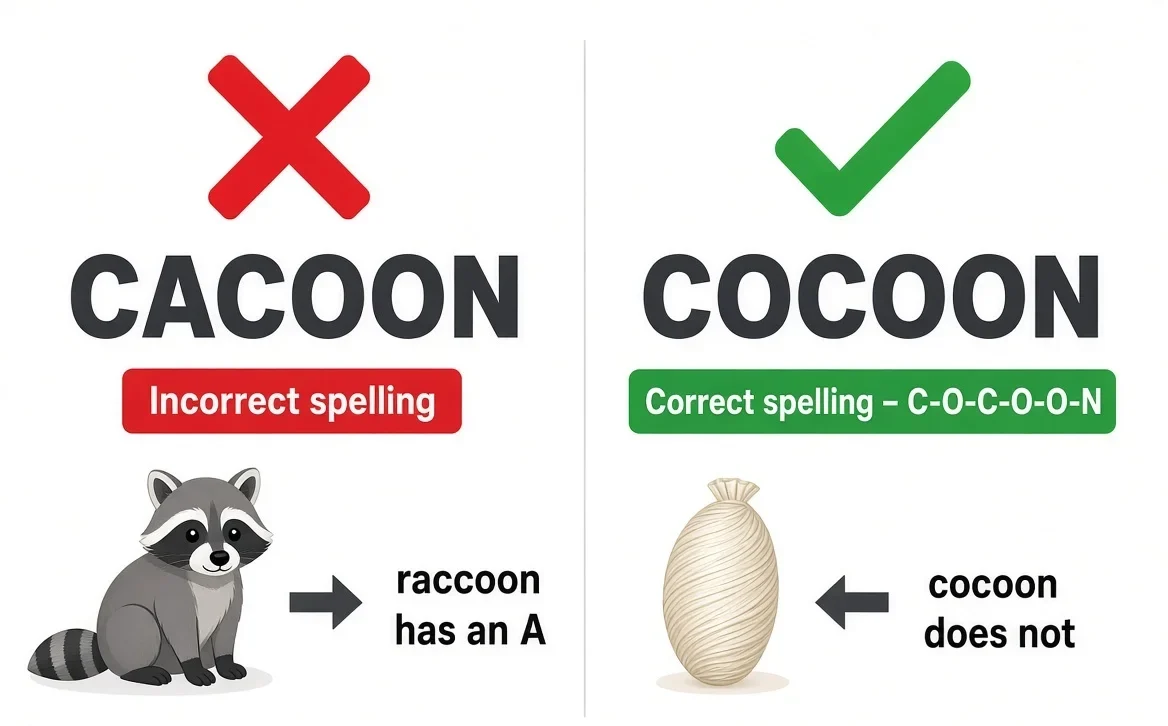
One of the biggest reasons people write “cacoon” is a word they already know well: raccoon. Raccoon has the same ending sound, a very similar rhythm, and carries an “a” early in the word. Someone who has typed “raccoon” hundreds of times may automatically insert that same “a” when reaching for “cocoon.” The brain uses the familiar pattern from one word and applies it to the next. The fix is to consciously separate these two: raccoon has an “a,” cocoon never does.
Unstressed syllables
The “co-” at the start of “cocoon” carries very little stress in speech. When a syllable is lightly pronounced, the vowel inside it becomes harder to identify clearly. Listeners may hear something closer to “ca-” and spell accordingly.
Fast typing
Fingers often move ahead of attention. “Ca” requires slightly less of a reach on most keyboards than “co” in certain typing patterns, and the mistake passes unnoticed until proofreading.
Spell-check gaps
Because “cacoon” is technically a real word in narrow botanical usage, some spell-checkers may not flag it as an error, especially in a text about nature.
Is It Spelled Cacoon or Cocoon? The Quickest Test
Type either word into Merriam-Webster’s search box. “Cocoon” has a full entry. “Cacoon” either redirects you to cocoon or comes up empty in the insect context. That is your answer.
Similar Misspellings in English
| Correct Word | Commonly Misspelled As |
|---|---|
| Cocoon | Cacoon |
| Raccoon | Racoon |
| Balloon | Baloon |
| Occasion | Ocassion |
| Necessary | Neccessary |
| Committee | Comitee |
The pattern across this list: unstressed vowels, doubled letters, and familiar sound patterns from other words all create the same kind of drag toward the wrong spelling.
The Insect Life Cycle: Where a Cocoon Actually Fits
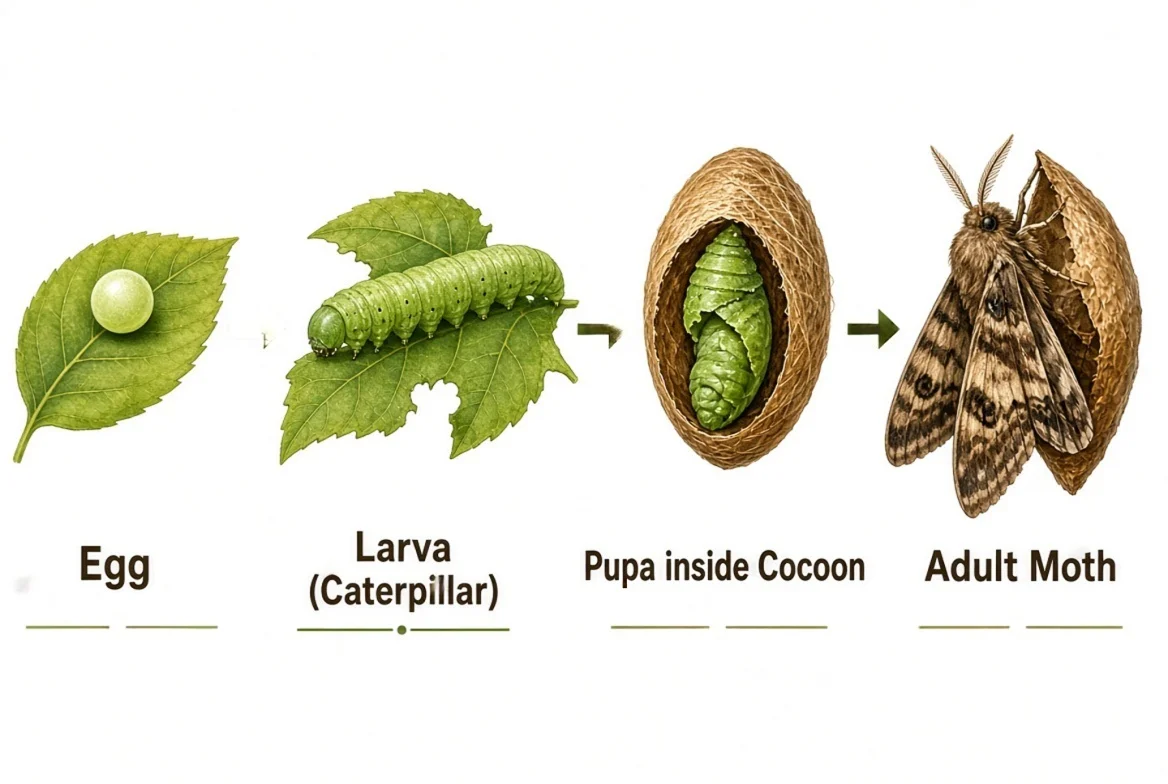
To understand what a cocoon does, you need to know the stage it belongs to. Insects such as moths, butterflies, beetles, and flies go through complete metamorphosis — a four-stage process where each stage looks and behaves completely differently from the others.
Stage 1: Egg. The insect begins life as an egg. The female lays it on a suitable surface — a leaf, bark, soil, or water — depending on the species.
Stage 2: Larva. The egg hatches into a larva. For moths and butterflies, the larva is a caterpillar. This stage is almost entirely about eating and growing. The caterpillar consumes large quantities of plant material and stores energy for the transformation ahead.
Stage 3: Pupa. After enough growth, the larva enters the pupal stage. This is where the major body rebuild happens. In many moth species, the larva first spins a cocoon around itself, then becomes a pupa inside that cocoon. In butterflies, the larva forms a chrysalis directly, without a separate silk casing.
Stage 4: Adult. The adult insect emerges with wings, new mouthparts, reproductive structures, and often an entirely different diet. A caterpillar that ate leaves becomes a moth that sips nectar.
Where the cocoon fits: It appears at the transition from larva to pupa — stage 2 into stage 3. It is the structure the larva builds, not the developmental stage itself. That distinction matters and is where a lot of confusion starts.
| Stage | What Is Happening | Cocoon Relevant? |
|---|---|---|
| Egg | Development of embryo | No |
| Larva (caterpillar) | Feeding and growing | No (but the larva builds the cocoon at the end of this stage) |
| Pupa | Body transformation | Yes — cocoon surrounds the pupa in many moth species |
| Adult | Reproduction and dispersal | No — the cocoon has already been left behind |
What Happens Inside a Cocoon?
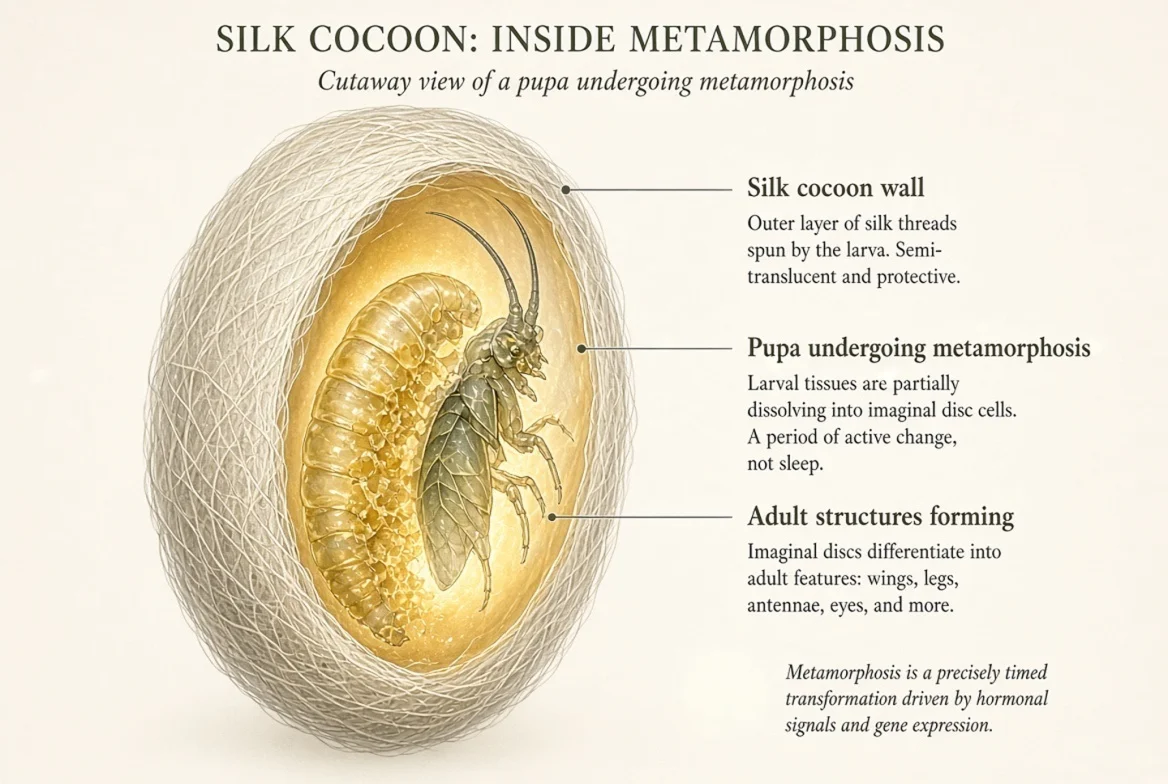
A common idea, especially among children, is that the caterpillar “sleeps” inside the cocoon until it wakes up as a butterfly or moth. That picture is almost entirely wrong.
What actually happens inside is one of the most remarkable processes in nature. The insect’s body undergoes a large-scale structural reorganization. Larval tissues are broken down and rebuilt into adult structures — wings, legs suited to an adult lifestyle, new sensory organs, and reproductive parts.
Hormonal signals manage the timing of these changes. The process is active, not passive. The pupa is not resting; it is rebuilding.
The cocoon itself plays a supporting role during all of this. It holds the pupa stable, shields it from physical knocks, and reduces exposure to the outside environment while this internal work happens. Without that protection, the vulnerable pupa would face far higher risks.
One interesting detail: some moth species spin their cocoon from a single unbroken thread of silk. The silkworm (Bombyx mori) is the most famous example. A single silkworm cocoon can contain anywhere from several hundred to over a thousand metres of silk thread, depending on the species and conditions. The silk industry has built itself around carefully unwinding these threads from cocoons before the moth inside can break them.
What Does a Cocoon Protect Against?
A cocoon is not just decoration around a pupa. It serves specific protective functions, and the materials and structure of each cocoon reflect the threats a particular species faces.
- Physical disturbance — A firm silk wall absorbs bumps, knocks from rain, and the movement of leaves or branches.
- Predator access — Many cocoons are designed to conceal the pupa or make it harder to reach. Some incorporate leaves, bark fragments, soil, or plant hairs that help it blend into surrounding material.
- Moisture and temperature — The silk structure can buffer the pupa from extreme moisture loss or sudden temperature shifts, giving the developing insect a more stable internal environment.
- Parasites — Some parasitic wasps and flies target pupae. A well-constructed, hidden cocoon reduces the chance of detection.
Not every cocoon succeeds on all these fronts. Predators and parasitoids have co-evolved countermeasures. Some wasps can locate a hidden cocoon by vibration or chemical cues alone. But the cocoon still improves the odds significantly compared to an exposed pupa.
Species that live in harsher environments or face heavier predation pressure often build more elaborate cocoons. Those in more sheltered habitats may produce simpler structures or pupate in existing protected spaces without a full cocoon at all.
Butterfly Cocoon: Do Butterflies Really Make Cocoons?
Here is where many people — even science enthusiasts — get the terminology wrong. The short answer is: most butterflies do not make cocoons.
Butterflies go through complete metamorphosis, but the structure they produce at the larval-to-pupa transition is a chrysalis, not a silk cocoon. A chrysalis forms when the caterpillar’s own outer skin hardens and reshapes into a protective casing. No silk spinning is involved in the casing itself.
A cocoon, by contrast, is actively spun by the larva from silk it produces internally.
So when someone types “butterfly cacoon” or “butterfly cocoon” into a search engine, they are almost always looking for information about the stage between caterpillar and adult butterfly. The accurate term for what most butterflies make is chrysalis.
The silk industry runs on moth cocoons, not butterfly cocoons. The silkworm (Bombyx mori), which is the larva of a moth species, produces the raw material for most commercial silk in the world.
Cocoon vs Chrysalis vs Pupa: Three Different Things
These three terms get treated as if they mean the same thing. They do not. Each describes something distinct.
Pupa is a developmental stage — the third stage of complete metamorphosis, between larva and adult. It is a biological phase, not a physical object. Any insect can be “in the pupa stage.”
Cocoon is a physical structure — the silk casing a larva builds around the area where it will pupate. It is a thing you can see and touch.
Chrysalis is the pupal form specific to butterflies. It is both the stage and the structure in one, because the butterfly’s hardened outer skin serves as its own casing without requiring a separate silk layer.
Think of it this way: a pupa is the occupant, a cocoon is a type of house that some insects build, and a chrysalis is a different kind of house that butterflies grow directly out of their own skin.
| Term | What It Is | Made by |
|---|---|---|
| Pupa | A developmental stage (not a structure) | All insects with complete metamorphosis |
| Cocoon | A silk structure built by the larva | Many moth species, silkworms, some other insects |
| Chrysalis | The butterfly’s own hardened pupal skin | Butterflies |
The most important thing to remember: a pupa can exist inside a cocoon, but the two are not the same thing. You would not call a person the same thing as the house they live in.
Moth Cocoon vs Butterfly Chrysalis
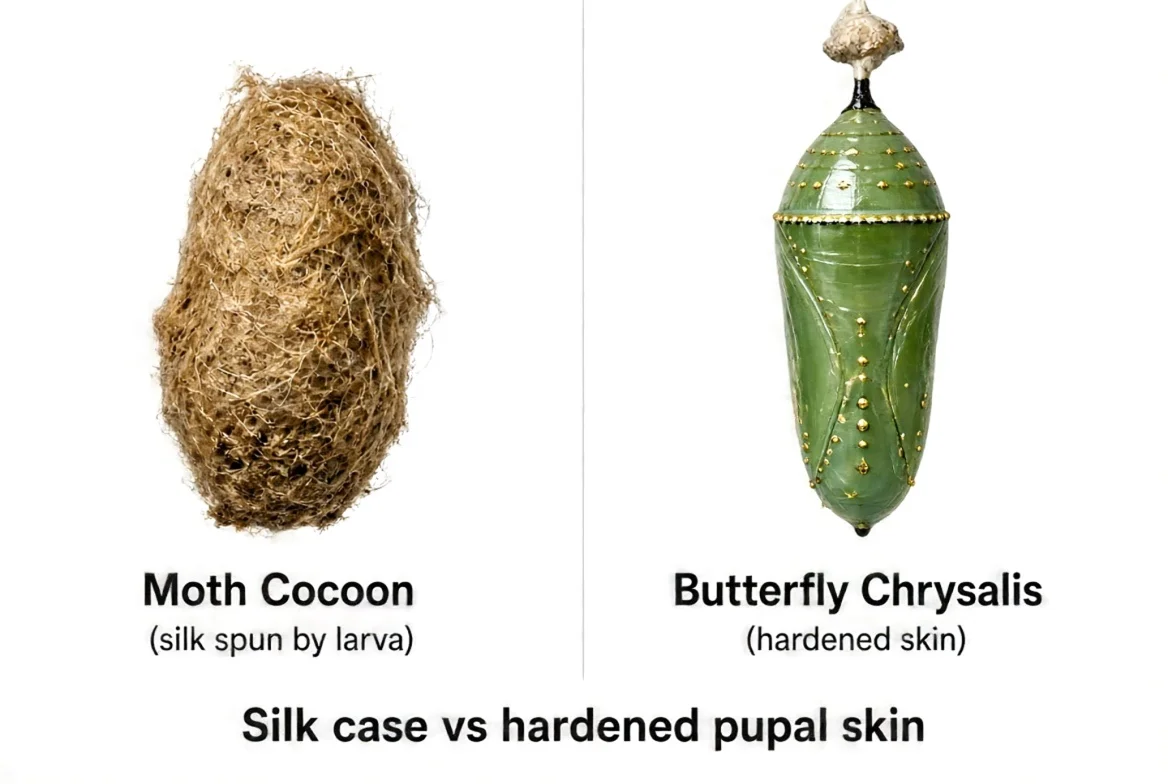
A direct comparison clears up most of the confusion between these two structures.
Moth Cocoon:
- Spun from silk threads the caterpillar produces itself
- Outer surface can feel fuzzy, rough, or densely wrapped
- Often includes additional materials — bits of leaf, bark, soil, or body hairs — mixed into the silk
- Can be found attached to bark, tucked into leaf litter, buried in soil, or hanging in hidden spots
- Example: The silkworm moth cocoon, whose thread is used commercially to make silk fabric
Butterfly Chrysalis:
- Forms as the caterpillar’s final larval skin hardens and reshapes around the pupa
- Usually smooth, firm, and sometimes has a faint sheen
- Many butterfly chrysalises carry striking colours — the Monarch’s green chrysalis with gold dots is one of the most photographed in the natural world
- Hangs from a surface using a small silk pad the caterpillar attaches beforehand, but the casing itself is hardened skin, not woven silk
- Some butterfly species, like Swallowtails, use a silk thread as a girdle to prop the chrysalis upright against a surface
The visual difference is easy once you know what to look for: if it looks silky and fibrous on the outside, it is likely a moth cocoon. If it looks smooth and almost plastic-like, it is likely a chrysalis.
Not Every Caterpillar Makes a Cocoon
This is one of the most useful facts on this entire topic, and it appears in almost no competitor article with enough clarity.
“Caterpillar” is the larval form of both butterflies and moths. But the two groups handle pupation differently. Most butterfly caterpillars skip the silk cocoon entirely and form a chrysalis. Among moths, cocoon construction varies enormously from species to species.
Some moth larvae spin dense, tight cocoons from pure silk. Others mix silk with soil, plant fragments, or the hairs from their own bodies. Some pupate inside existing plant material — rolled leaves, hollow stems, or crevices in bark — using just enough silk to hold their shelter together rather than building a freestanding cocoon. A few species pupate underground without building any silk structure at all.
This variation means it is inaccurate to say “caterpillars make cocoons” as a universal rule. What is accurate is: some moth caterpillars spin silk cocoons, most butterfly caterpillars do not, and the diversity of strategies across thousands of species is far wider than any simple rule covers.
Cocoon Meaning in Everyday Life
Beyond biology, “cocoon” has grown into a very flexible word in everyday English. Writers, designers, marketers, and ordinary speakers reach for it whenever they want to describe warmth, privacy, or enclosure.
Figurative Uses of Cocoon
Comfort and warmth: “She spent the weekend in a cocoon of blankets and hot chai.”
Emotional protection: “After the difficult year, he built a cocoon of routine around himself — the same meals, the same walks, the same quiet evenings.”
Creative focus: Writers and artists sometimes describe a period of intense, private work as a “cocoon phase” — a time of withdrawal from outside noise before something new emerges.
Architecture and interior design: Rooms designed for maximum warmth and enclosure are sometimes described as having a “cocoon-like” quality — low ceilings, soft materials, dim light, and minimal openings to the outside.
Business language: In workplace writing, teams that go into a period of deep, uninterrupted focus — no meetings, no external contact — are sometimes described as entering a “cocoon” stage of a project.
“Your Arms Are My Cocoon” Meaning
This phrase appears in songs, romantic poetry, and personal writing across several languages. It uses cocoon as a metaphor for the feeling of complete safety and warmth inside a partner’s embrace. The comparison is effective because a cocoon is, at its core, something that wraps entirely around something vulnerable and keeps it safe during a period of change. The phrase carries that same tenderness — the idea that another person’s presence can be the thing that holds you together when everything else feels uncertain.
Cocooning: The Lifestyle Trend Explained
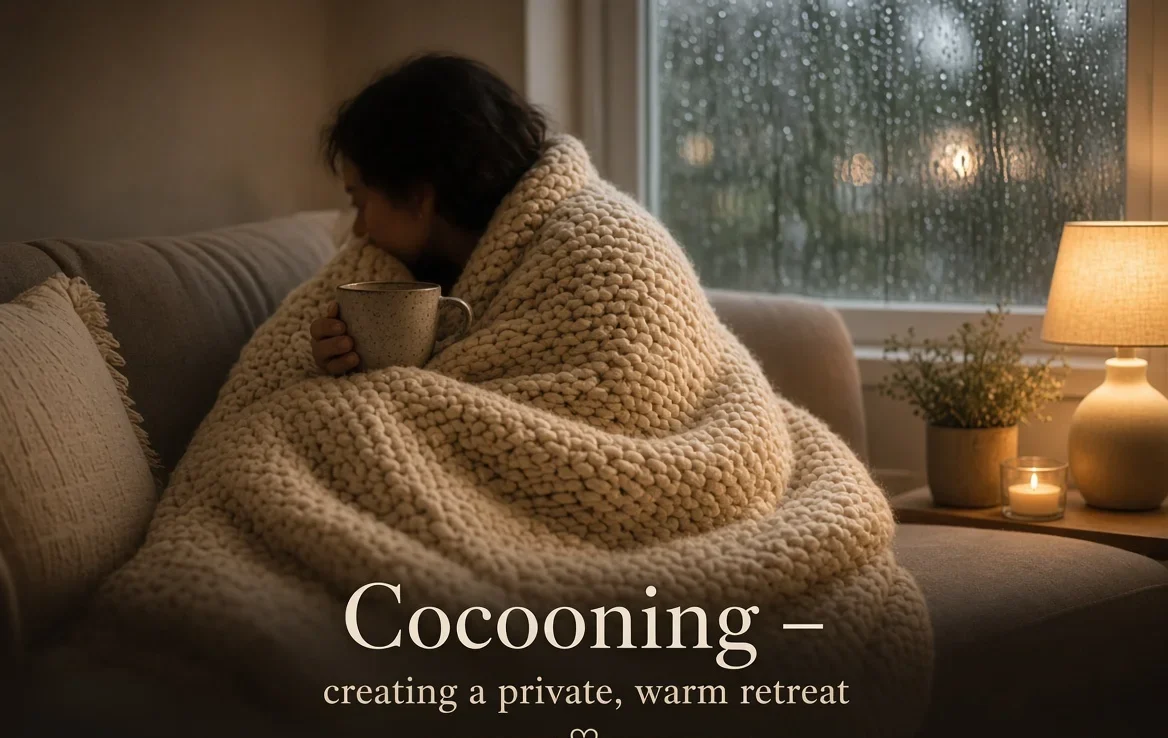
“Cocooning” as a lifestyle concept deserves its own section because it has developed a life well beyond its biological roots.
The term describes the deliberate choice to stay home and create a private, comfortable, self-contained world rather than going out to socialize. It is associated with warm lighting, comfortable furniture, home cooking, films, books, and the conscious rejection of outside demands for a period of time.
The concept became especially prominent in consumer research and lifestyle journalism. Marketers noticed that significant numbers of people — particularly in wealthier urban environments — were investing heavily in making their homes into retreats. Home cinema systems, premium bedding, food delivery services, and streaming platforms all benefited from this shift.
Cocooning is not the same as isolation or depression. The distinction matters. Cocooning is an active, chosen withdrawal for rest and renewal. The person decides to pull inward, spend time in a protected space, and re-emerge when ready — exactly as the insect in the original cocoon does.
You will find the word used naturally in:
- Weekend plans (“I am just cocooning this weekend”)
- Home design articles (“The cocooning trend is driving demand for soft, enveloping furniture”)
- Wellness writing (“Winter is the natural season for cocooning and rest”)
- Marketing copy for home goods, bedding, and food delivery
The lifestyle meaning has become so established that many readers encounter “cocooning” in this sense long before they think about the biological one.
Cocoon in Pop Culture: Movie, Game, Coat, and More
The word “cocoon” turns up across film, fashion, technology, and gaming. Here is an accurate overview of each reference.
Cocoon Movie (1985)
Cocoon is a 1985 American science fiction film directed by Ron Howard. The story follows a group of elderly Florida residents who begin swimming in a pool that contains alien pods — referred to as cocoons — left behind by an extraterrestrial species. Contact with the water near these pods gives the elderly swimmers remarkable energy, physical renewal, and a sense of vitality they had not felt in years. The film raises thoughtful questions about ageing, mortality, and what people would give up to escape them. It won two Academy Awards and was followed by a 1988 sequel, Cocoon: The Return. For anyone searching “cacoon or cocoon movie,” the answer is clear: the film title is Cocoon, with two pairs of o.
Cocoon Game (2023)
COCOON is a puzzle-adventure game released in September 2023, developed by Geometric Interactive. The studio was founded by Jeppe Carlsen, who previously designed the gameplay for Limbo and Inside. The game’s central mechanic involves carrying entire worlds inside glowing orbs and moving between them — a nested-universe structure that critics found genuinely original. It received strong scores from major game review publications. The title is spelled COCOON in all official material, not CACOON.
Cocoon Coat
A cocoon coat is a recognizable fashion silhouette — wide through the shoulders and chest, then narrowing toward the hem to create a rounded, enveloping shape. The name comes from the way the coat wraps around the body the way silk wraps around a pupa. The style is associated with structured knitwear and wool outerwear, often seen in autumn and winter collections. It became closely linked with Italian fashion house Max Mara, whose long-running oversized coat collections helped define the silhouette internationally. In fashion writing, the correct spelling is always cocoon coat.
Cocoon Frontend (Tech)
In web development contexts, “Cocoon” has been used as the name for several tools and frameworks. The best-known is the Apache Cocoon project, an XML-based web publishing framework that packages application logic inside a structured processing pipeline — the “cocoon” metaphor referring to the way it encloses and manages content transformation. Developers searching for “cocoon frontend” are usually looking at this framework or similar tools that adopted the name for its connotations of wrapping and protection.
How to Remember the Correct Spelling
Here are four distinct tricks. Use whichever one sticks in your memory.
Trick 1: No A Anywhere
The word “cocoon” contains exactly six letters: C-O-C-O-O-N. There is no A in it at all. Not at the start, not in the middle. If your spelling has an A, delete it.
Trick 2: Four O’s, Round Like a Silk Ball
Count the vowels in “cocoon”: four of them, and every single one is the letter O. A cocoon is round, and the letter O is round. The shape of the word matches the shape of the thing.
Trick 3: Rhyme With Balloon
“Balloon” and “cocoon” end with exactly the same sound and the same letters: “-oon.” If you can spell balloon — and most people can — you know how to spell the ending of cocoon. Start it with “co-co” instead of “bal-l,” and you are done.
Trick 4: Separate It from Raccoon
Raccoon has an A. Cocoon does not. These two words sound vaguely similar, and raccoon is the one that people know best, so it bleeds into their spelling of cocoon. Keep them apart: the animal with the mask has an A; the silk casing does not.
Example Sentences Using Cocoon
Biology Context
- The silk moth larva spins a cocoon from a single continuous thread, sealing itself inside before the pupa stage begins.
- Entomologists study cocoon structure to understand how different moth species manage temperature and humidity around the developing pupa.
Figurative Context
- After finishing her exams, she spent the entire week cocooned in her flat, eating leftovers and watching films she had missed all semester.
- The small hill town felt like a cocoon — quiet, self-contained, cut off from the pace of the city below.
Verb Forms in Use
- The packaging team cocooned each glass piece in bubble wrap before boxing it.
- Every winter, he cocoons himself in the same wool blanket and rereads the same three books.
Describing the Movie
- Cocoon holds up well even decades after its release — Ron Howard balances the science fiction premise with a genuinely warm story about what older people want from life.
Describing the Coat
- She picked up a camel-coloured cocoon coat from a vintage stall and wore it for the rest of the trip.
How NOT to Write It
- Incorrect: The caterpillar hid inside its cacoon for several weeks.
- Correct: The caterpillar hid inside its cocoon for several weeks.
Conclusion
The answer to “cacoon or cocoon” is final: cocoon is correct every time you are writing about insects, metamorphosis, the 1985 film, the 2023 game, the fashion silhouette, or the lifestyle concept. Cacoon belongs only to a narrow botanical context involving tropical plants, and even there it is rarely encountered outside specialist literature.
Cocoon entered English over three centuries ago, passed through French and Occitan from Latin and Greek roots that all pointed to the same shell-like image, and built up a rich life in the language along the way — from biology to fashion to romantic poetry to video games. It is one of those words that looks unusual on the page (four O’s, no A, an unusual rhythm) precisely because it describes something unusual in nature.
Once you remember that it has four O’s, rhymes with balloon and shares no letters with raccoon except the final three, you are unlikely to write “cacoon” again.
Learn More English Words Definitions:-
- Insolence Meaning
- Stalactite Meaning
- 5201314 Meaning
- Torta Meaning Slang
- Combatting Or Combating
- Audiodisplayed Meaning
- Connotation vs Denotation
- Lygophile Meaning
- Fozzie Meaning
- Infront or In Front
- Javert Meaning
- Solti Meaning
FAQs: Cacoon or Cocoon
Q: Is cacoon or cocoon the correct spelling?
Cocoon. Always. Cacoon is a spelling error in any context involving insects or everyday English.
Q: How do you spell cocoon?
C-O-C-O-O-N. No A anywhere. Four O’s total.
Q: Do butterflies make cocoons?
No. Most butterflies make a chrysalis. Moths are the ones that spin silk cocoons.
Q: What is the difference between a cocoon and a chrysalis?
A cocoon is a silk case spun by moth larvae. A chrysalis is a butterfly’s hardened pupal skin. Different structure, different insect.
Q: What is the difference between a pupa and a cocoon?
A pupa is a life stage. A cocoon is a physical structure the larva builds. The pupa lives inside the cocoon — they are not the same thing.
Q: Is a cocoon alive?
No. The cocoon is just a silk structure. The pupa inside it is alive.
Q: Can cocoon be used as a verb?
Yes. “She cocooned herself in a blanket” is correct usage.
Q: What does cocooning mean?
Staying home deliberately to rest in a warm, private, comfortable space instead of going out.
Q: What is the Cocoon movie?
A 1985 Ron Howard sci-fi film about elderly residents in Florida who regain energy after swimming near alien pods. It won two Academy Awards.
Q: What is a cocoon coat?
A wide, rounded coat that tapers at the hem — designed to wrap around the wearer like a silk cocoon.
Q: Where does the word cocoon come from?
From French cocon, from Occitan coucoun, meaning shell. It has been in English since around 1699.
Q: What does “your arms are my cocoon” mean?
A romantic metaphor. It means a partner’s embrace feels like a safe, warm enclosure that protects you from the outside world.
