
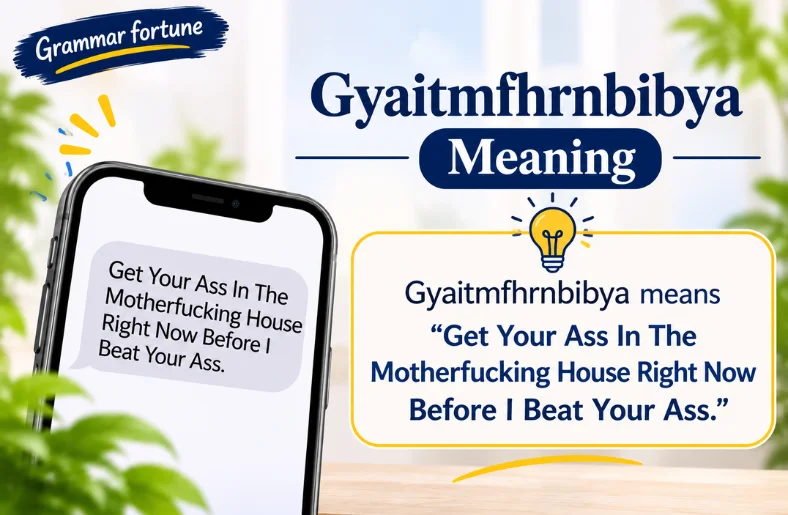
GYAITMFHRNBIBYA stands for “Get Your Ass In The Motherfucking House Right Now Before I Beat Your Ass.” It is a viral internet acronym built on a very specific childhood memory — the moment a parent’s voice echoed down the street and every kid knew it was time to run home. Online, it functions as a nostalgic inside joke aimed at Gen X and older Millennials, not an actual threat.
Gyaitmfhrnbibya Meaning – The Quick Answer
You typed it into Google because it looks impossible to read. That is exactly why it became famous.
GYAITMFHRNBIBYA stands for:
“Get Your Ass In The Motherfucking House Right Now Before I Beat Your Ass.”
It originated as a nostalgic reference to the no-nonsense parenting style of the 1970s, 80s, and 90s. Every single letter maps to a word in that sentence. The result is one of the longest internet acronyms to ever go viral, and despite looking like a keyboard glitch, it carries a meaning millions of adults feel immediately — most of all Gen X and older Millennials.
The core message is simple: come inside right now, or face consequences. But what made this phrase spread across Facebook, TikTok, and Instagram meme pages is the shared memory behind it. Hearing something very close to this growing up — shouted from a porch, echoing down the street, aimed directly at you — is an experience that needs no explanation for the people it hits. Online, it circulates as a humorous inside joke, not an actual threat.
Letter-by-Letter Acronym Breakdown
The reason GYAITMFHRNBIBYA confuses so many people on first sight is the sheer number of letters. Here is exactly what each one stands for:
| Letter(s) | Word | Word Meaning |
|---|---|---|
| G | Get | A command — do this action now |
| Y | Your | Belonging to the person being addressed |
| A | Ass | Slang for backside; here used as “yourself” or “body” |
| I | In | Moving to the inside of something |
| T | The | Refers to a specific place already known — home |
| MF | Motherfucking | Intensifier; expresses extreme urgency or anger |
| H | House | The home; where you are supposed to be right now |
| R | Right | Used with “now” to mean immediately, no delay |
| N | Now | This exact moment — not in five minutes |
| B | Before | Introduces the consequence that follows if you do not |
| I | I | The parent or speaker — the one making the threat |
| B | Beat | Slang for physically punish; a warning of consequences |
| Y | Your | Belonging to the person being addressed — same as above |
| A | Ass | Same as the first A — reinforces the consequence |
15 letters. 14 words. One very memorable parental command.
The M and F together represent a compound profanity — which is why the letter count does not match the word count exactly. This also explains the variant spelling GYAITMFHBIBYA (without the R and N), which appears in older posts from around 2020. Some people type the shorter version out of habit or because they found it before the longer, now-standard spelling became dominant.
A further shorthand, GYAITM, crops up in quick-fire group chats where people abbreviate the abbreviation — cutting it down to just the first four words of the warning and trusting that the recipient fills in the rest.
Where Did Gyaitmfhrnbibya Actually Come From?
No single creator has ever been verified as the original source. This is common for meme-culture slang that grows organically rather than from one viral post.
What can be established with reasonable confidence:
- The phrase’s earliest documented form in an online slang dictionary appeared around 2020, when the variant GYAITMFHBIBYA was submitted to Urban Dictionary in October of that year.
- The longer, current standard spelling was submitted to Urban Dictionary by a user going by “Two dog” in April 2021.
- From there, it spread heavily through Facebook nostalgia groups — the kind where adults share “you grew up in the 80s if you remember this” content. This is where most Gen X and Millennial parents first encountered it.
- TikTok then carried it to a wider and younger audience, giving it a second surge in visibility.
The phrase itself — not the acronym but the actual words — reflects a parenting culture that was very real in those decades. Parents routinely called children inside with loud, direct, unfiltered language from the front door. There were no texts, no location pins, no gentle reminders. There was a voice from the porch, and you either came home or faced what came next.
The internet did not create the phrase. It just gave it a name.
The Facebook Meme That Made It Famous
This is the angle most people miss when they read about GYAITMFHRNBIBYA online.
The meme that launched it into wide circulation was not a TikTok video or a Twitter thread. It was a Facebook post structured as a test of parental identity. The text read something like:
“If you know what GYAITMFHRNBIBYA means, you know you’re a parent.”
That framing is clever because it does three things at once. It makes you curious enough to look up the acronym. It creates an in-group for people who recognise the phrase. And it frames the whole experience as a badge of parenthood rather than simply a string of profanity.
Parents who shared it were not sharing a threat. They were sharing a memory and a generational marker. The meme said: we survived this kind of parenting, and we turned out fine. That sentiment travels fast in Facebook groups built around shared childhood nostalgia.
This is also where the phrase earned the label “parent code” — a shorthand that required no explanation for people who had lived through that era of parenting.
Gyaitmfhrnbibya Meaning on TikTok
TikTok gave this acronym its second and significantly larger audience. The platform’s algorithm pushed it toward users already engaging with nostalgia content, parenting humor, and childhood memory videos.
How creators use it on TikTok:
- Comedy skits where someone plays a child ignoring repeated warnings from a parent.
- POV videos with text overlays like “my mom at 7:03pm when I was still outside.”
- Reaction clips where adults hear the acronym spelled out and immediately recognise the experience.
- Montages set to music that show kids playing outside past sunset, followed by a parent calling them in.
On TikTok the humor lands faster because the video format lets creators show the scenario rather than just describe it. A five-second cut from a kid laughing in the street to a parent’s face at the door communicates everything the acronym contains, without spelling it out.
Younger viewers who did not grow up with this kind of parenting also engage with these videos. For them the humor is less about personal memory and more about the contrast — the gap between the parenting they experienced and the one being described.
The Parent Code Angle — Why Only Some People Know It
The phrase is widely called a “parent code” or a “code only parents know,” and that framing is worth taking seriously because it explains why the meme has such long legs.
It works as a code for three reasons:
- No explanation needed for those who lived it.
Adults who grew up in certain households in the 70s, 80s, and 90s hear this phrase and immediately picture the specific moment it was delivered — the tone, the speed at which they had to move, the look on the face waiting at the door. - Younger or differently-raised people have to look it up.
Gen Z and those raised with more supervised, structured childhoods often encounter the acronym and have no context for it. That is why search volume for “gyaitmfhrnbibya meaning” keeps climbing — there is a constant supply of new people who need the translation. - The full government name test.
A universal marker from that parenting era: if your parent used your first, middle, and last name, you were in serious trouble. GYAITMFHRNBIBYA captures that same level of urgency without needing to spell out three names.
The phrase also reflects a parenting philosophy where the warning itself was considered sufficient — no negotiation, no five-minute countdown, no second chance. That directness is part of what makes it funny to people who remember it. It was simply how things worked.
Who Gets It and Who Doesn’t — The Generational Divide
This is a genuinely important piece of context that most articles skip entirely.
Not everyone who stumbles on GYAITMFHRNBIBYA finds it funny. A writing teacher on Substack documented a real situation in 2023 where a younger student found the phrase on Facebook and was genuinely distressed by it. The student’s question was not about the nostalgia. It was: “What kind of parent would yell that, let alone make an acronym for it?”
That reaction is worth taking seriously because it reveals the actual generational split this meme sits across.
| Who tends to find it funny | Why |
|---|---|
| Gen X (born roughly 1965-1980) | They likely heard something very similar growing up and survived it |
| Older Millennials (born early 1980s) | Shared the same style of neighborhood, free-play childhood |
| Anyone who grew up in a loud, direct, working-class household | The energy of the phrase is instantly recognisable |
| Who tends to find it confusing or uncomfortable | Why |
|---|---|
| Gen Z (born mid-to-late 1990s onward) | Grew up with more supervised childhoods, digital communication norms |
| Younger Millennials raised in quieter households | Less exposure to this parenting style |
| People for whom the reference to physical punishment is not abstract | The phrase’s final words carry different weight for different people |
The meme is not universally funny. It is specifically funny to a generation that understands the experience behind it — and understands that the words, however forceful, usually meant come home right now, not an actual threat.
That specificity is both its strength and its limitation.
Gyaitmfhrnbibya Meme — Why It Went Viral
The GYAITMFHRNBIBYA meme spread for reasons beyond just the words.
Three things drive it:
1. Absurd visual length.
At 15 characters, the acronym looks like a typo or a foreign word. That confusion is funny before anyone knows what it means. People share it just because it looks ridiculous.
2. Instant emotional recall.
Once decoded, adults from the relevant generation do not just understand — they remember. The feeling of running home, the sound of a parent’s voice three houses away, the speed at which you had to move. That emotional specificity is rare in internet content and makes this one genuinely sticky.
3. The parenting culture contrast.
Parenting in 2026 looks very different from parenting in 1985. Location apps, family chats, gentle correction, negotiated bedtimes — none of that existed in the era GYAITMFHRNBIBYA captures. The contrast between then and now is itself the joke.
The meme appears in Facebook nostalgia groups, Instagram and TikTok comment sections, WhatsApp group chats between people who grew up in the same neighborhood, and on physical merchandise — which leads to its own interesting story.
How People Use It in Texts and Comments
Here are fictional examples showing how this acronym lands in everyday online conversation.
Sibling group chat
Sister: “Where are you? It’s getting dark.”
Brother: “Five more minutes.”
Sister: “Mum said GYAITMFHRNBIBYA. No joke this time.”
TikTok comment section
Video: Kid still outside 20 minutes after being called in.
Comment: “GYAITMFHRNBIBYA vibes 💀”
Facebook nostalgia post
“Who else got the GYAITMFHRNBIBYA treatment every summer? No text. No call. Just the voice from across the street.”
Friends messaging
“It’s dark bro, your mum is about to GYAITMFHRNBIBYA you if you don’t leave now 😂”
Quick shorthand version
“Get home. GYAITM. Now.”
The pattern is consistent. In modern use, the acronym almost never functions as a genuine warning. It is a reference — to the concept, to the era, to the specific energy of that moment. The humor is in the recognition, not the threat.
The Gyaitmfhrnbibya Shirt — What It Represents
GYAITMFHRNBIBYA has crossed from internet meme into physical merchandise, and that transition tells you something specific about how this kind of internet humor works.
T-shirts, hoodies, and mugs bearing the acronym have been sold on print-on-demand platforms. The appeal works on a simple mechanic: anyone who reads the shirt and immediately knows what it means shares the same generational reference point. It is an instant signal between strangers.
The meme’s framing — “if you know what this means, you’re a parent” — transferred directly onto the merchandise. Wearing the shirt is a way of saying: I survived that parenting style. I remember it. And I can laugh about it now.
One important note before buying: the full phrase behind the acronym contains explicit profanity and a reference to physical punishment. What reads as a puzzle on a shirt becomes much more explicit once decoded. That is worth considering if you plan to wear it somewhere other than around people who already know the joke.
Gyaitmfhrnbibya vs. Similar Long Acronyms
The internet has a few other famously long acronyms. Here is how GYAITMFHRNBIBYA compares:
| Acronym | Stands For | Vibe |
|---|---|---|
| GYAITMFHRNBIBYA | Get Your Ass In The Motherfucking House Right Now Before I Beat Your Ass | Nostalgic, parental, Gen X/Millennial |
| ROFLMAO | Rolling On The Floor Laughing My Ass Off | General humor, universal |
| IYKYK | If You Know You Know | Insider knowledge, Gen Z |
| DYWMTCOASYDTYCOMF | Do You Want Me To Come Over And Sort Your Day The F**k Out My Friend | Supportive, sarcastic |
| LMFAO | Laughing My F**king Ass Off | Casual expression, widely used |
At 15 letters, GYAITMFHRNBIBYA is the longest of the group. But what makes it truly different from the others is emotional specificity. ROFLMAO and IYKYK work in any context. GYAITMFHRNBIBYA only really works if you have a specific frame of reference. That narrowness is not a weakness — it is precisely why the people it hits, it hits so hard.
Is Gyaitmfhrnbibya Offensive?
The honest answer: the words behind the acronym are vulgar. The full phrase contains strong profanity and a reference to physical punishment of a child. By any mainstream content standard, it qualifies as explicit language.
Whether it offends in practice depends entirely on context and audience.
Situations where it reads as humor:
- Shared between adults who recognise the nostalgic context.
- Used in a caption, comment, or meme about childhood.
- Texted as a joke between siblings or close friends.
Situations where it could cause real concern:
- Sent to someone who does not know the meme and might read it as a genuine threat.
- Used in a professional setting, school, or any formal space.
- Shared around children, since the reference to hitting is embedded in the full phrase.
The acronym format softens the visual impact. GYAITMFHRNBIBYA on a T-shirt reads as a puzzle before it reads as a threat. But the puzzle’s answer is explicit. That gap between first impression and decoded content is the whole mechanic of the meme — and it is also worth being aware of before you use it somewhere it could be misread.
Gyaitmfhrnbibya Urban Dictionary — What It Actually Says
The Urban Dictionary page for GYAITMFHRNBIBYA is brief. The community entry submitted by user “Two dog” in April 2021 gives the full phrase and a single usage example: “You had better GYAITMFHRNBIBYA.”
That brevity is notable. Urban Dictionary captures the definition but nothing of the cultural context — no nostalgia, no generation, no explanation of why a 15-letter acronym for a parental command exists and spreads.
A variant entry, GYAITMFHBIBYA (the shorter spelling without RN), was submitted separately in October 2020. This suggests the phrase was circulating in slightly different forms before it settled into the current standard spelling. The two entries together give us a rough origin window of late 2020 to early 2021 for when this acronym became formally documented online, though it was likely in use in Facebook groups before anyone bothered to submit it to a slang database.
How to Pronounce Gyaitmfhrnbibya
There is no official pronunciation and no audio guide exists. GYAITMFHRNBIBYA is not a word anyone says aloud in normal conversation.
Two ways people handle it:
- Spell out each letter: G-Y-A-I-T-M-F-H-R-N-B-I-B-Y-A. This takes about four seconds and usually draws a laugh before you finish.
- Say the full phrase directly. Many people skip the acronym entirely when speaking and just say the whole sentence — which also works as a callback because the full phrase is instantly recognisable on its own.
An attempted single-word pronunciation sounds something like “gyatim-furn-bibya” but no standard form exists. The unpronounceable quality is a feature, not a bug. The fact that you cannot say it out loud without either spelling it or reading the full phrase is part of what makes it funny.
Conclusion
GYAITMFHRNBIBYA is 15 letters that unlock a very specific emotional memory for a very specific group of people.
It started on Facebook as a parental identity meme. TikTok made it famous to a wider audience. And the gap between people who get it instantly and people who have to look it up is itself part of the joke — and part of why it keeps circulating.
If you grew up with a parent who had no hesitation calling you inside with volume, authority, and colorful language, the phrase needs no translation. If you didn’t, now you have the full picture: a long internet acronym, a nostalgic inside joke, and a small window into what childhood looked like before location apps replaced the porch voice.
Learn More English Words Definitions:-
- Insolence Meaning
- Stalactite Meaning
- 5201314 Meaning
- Torta Meaning Slang
- Combatting Or Combating
- Audiodisplayed Meaning
- Connotation vs Denotation
- Lygophile Meaning
- Fozzie Meaning
- Infront or In Front
- Javert Meaning
- Solti Meaning
- Cacoon or Cocoon
- Chapri Meaning
- Wyo Meaning in Text
FAQs About Gyaitmfhrnbibya
What does Gyaitmfhrnbibya mean?
“Get Your Ass In The Motherfucking House Right Now Before I Beat Your Ass.” A viral nostalgic acronym, not a real threat.
What does Gyaitmfhrnbibya stand for?
Each letter is the first letter of one word in that 14-word parental warning phrase.
What does Gyaitmfhrnbibya mean on TikTok?
Same meaning — used in comedy skits and comments about strict parents and childhood curfews.
What is the Gyaitmfhrnbibya meme?
A Facebook post that said “if you know what this means, you’re a parent.” It spread as a generational nostalgia joke.
What does the Gyaitmfhrnbibya parent code mean?
It is slang for the strict, loud call-home warning that parents used in the 70s, 80s, and 90s — instantly understood by those who lived it.
Is Gyaitmfhrnbibya a bad word?
The acronym itself is not, but the full phrase behind it contains strong profanity. Use it only in casual settings with people who know the reference.
Where did Gyaitmfhrnbibya come from?
No verified creator. It grew organically through Facebook nostalgia groups around 2020 before TikTok made it widely known.
